
MCAT
How to Choose an MCAT Prep Course: 7 Factors That Actually Matter
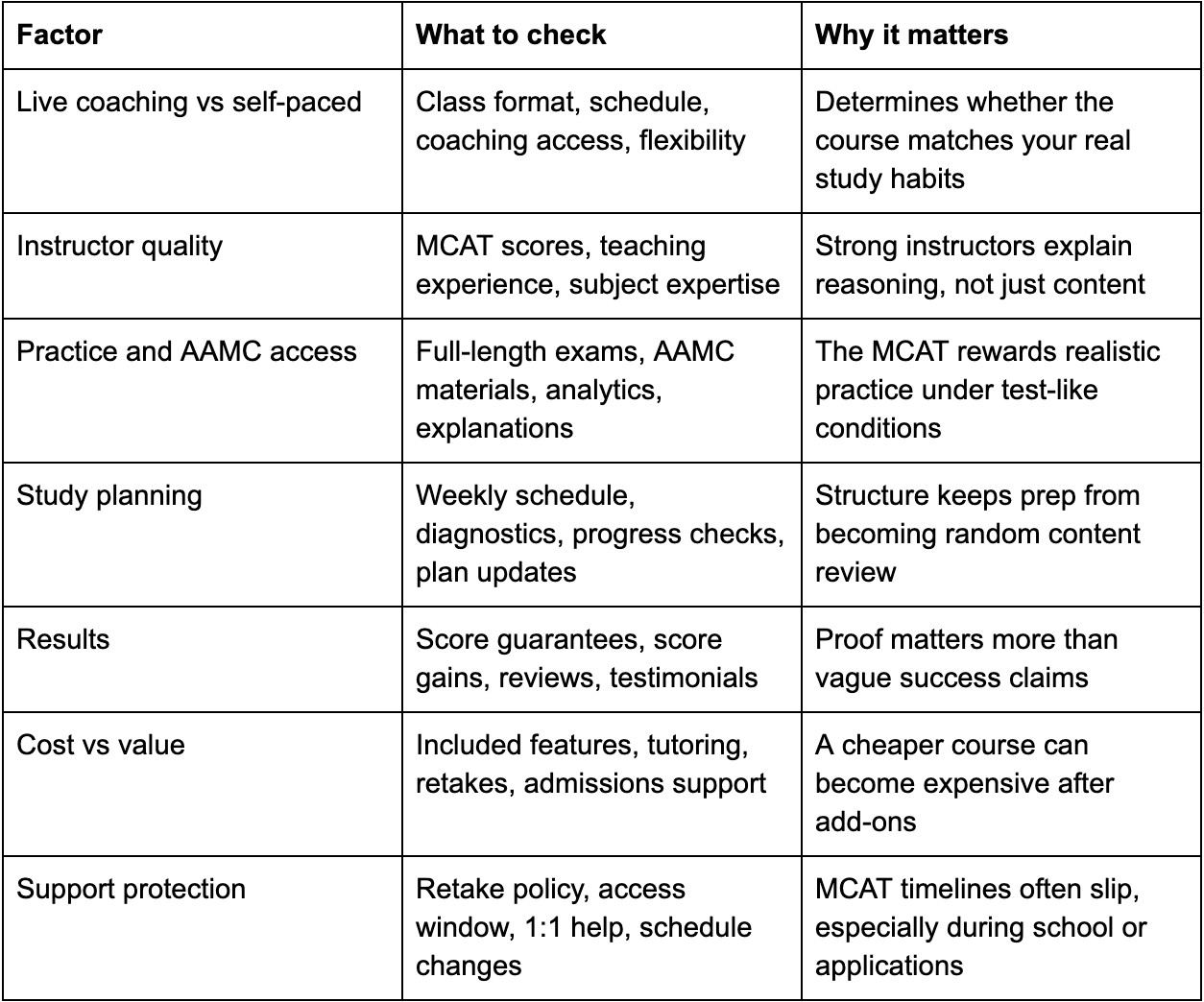
The best way to choose an MCAT prep course is to compare seven factors: live coaching vs self-paced study, instructor quality, full-length practice and AAMC material access, personalized study planning, results and track record, total cost vs value, and support protections such as retakes, schedule flexibility, and 1:1 help. The right course is the one that matches how you actually study, not the one with the loudest guarantee or the biggest question bank.
Use these seven factors as your decision checklist:
- Live coaching vs self-paced: which format fits how you actually study
- Instructor quality and credentials: who is actually teaching you
- Full-length practice and AAMC material access: how realistic your practice will be
- Personalized study planning: whether the course gives you structure and accountability
- Results and track record: whether there is proof of score improvement
- Total cost vs value: what is included vs what gets upsold later
- Support and access protection: what happens if your timeline changes
For most students, the deciding issue is not content volume. It is whether the course solves the problem most likely to derail their MCAT prep: inconsistent studying, weak passage review, poor timing, low practice volume, or lack of accountability.
Book a free advising session
If you want help matching a course to your timeline, score goal, and study habits, book a free advising session with a Wizeprep academic advisor. The session is designed to give you a tailored study plan and a clearer recommendation, not a high-pressure sales pitch.
1. Live coaching vs self-paced: choose the format that fits how you actually study
Live coaching is best for students who need structure, accountability, and real-time help, while self-paced MCAT prep is best for students who already study consistently and can diagnose their own weaknesses. This is the first factor to evaluate because it affects every other part of the course.
Self-paced prep can work well for disciplined students. If you can make a weekly schedule, stick to it for three or four months, review practice tests carefully, and adjust when your scores stall, a self-paced course may give you enough structure at a lower price.
Live coaching matters when your main risk is execution. Many students do not fall short because they lack resources. They fall short because they stop following the plan, avoid full-length review, or do not know what to change after a bad practice test.
Ask yourself what has happened in previous hard courses or standardized tests. If you usually start strong and fade, live coaching is not a luxury feature. It is probably the feature that protects your score goal.
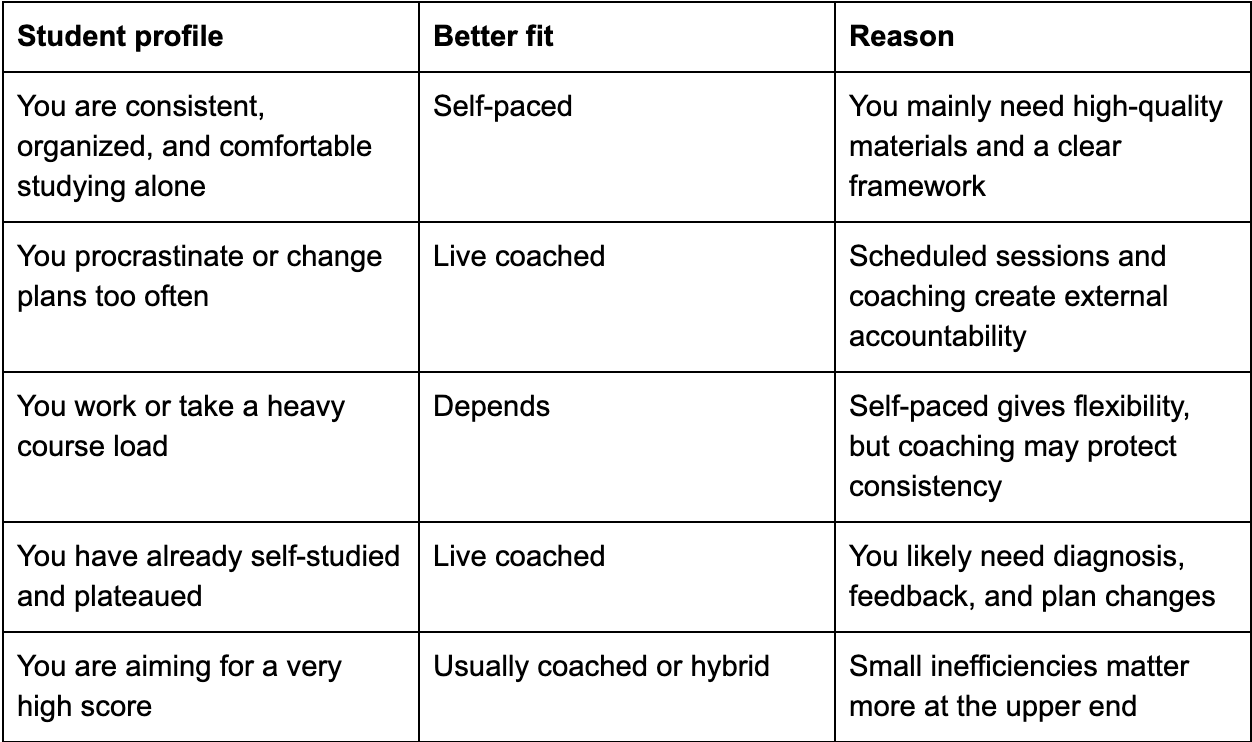
Wizeprep offers both a Self Paced MCAT Course and a higher-touch Elite 515 Course. That range matters because not every student needs the same level of support.
2. Instructor quality and credentials: know who is actually teaching you
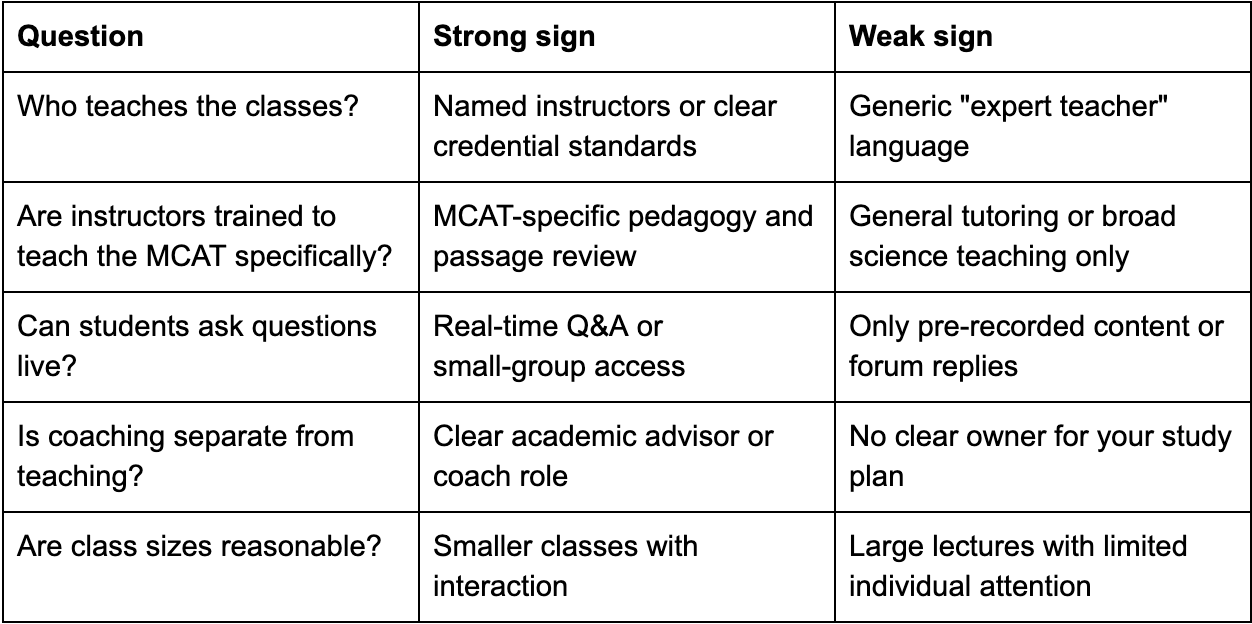
Instructor quality matters because the best MCAT teachers explain how to think through passages, not just how to memorize content. A course is only as strong as the people teaching, coaching, and reviewing your work.
When comparing MCAT prep courses, look beyond broad claims like "expert instructors" or "top scorers." Ask what the company actually tells you about instructor selection, training, subject expertise, and teaching experience.
Strong MCAT instructors usually do four things well. They simplify difficult science without making it shallow. They connect content review to AAMC-style reasoning. They show students how to review missed questions. They can explain why a tempting answer is wrong, not just why the correct answer is correct.
This is especially important for CARS and passage-based science. Students often assume they need to learn more facts, when the real issue is reading the passage, identifying the task, and choosing between close answer choices. A good instructor can make that process visible.
Use these questions when evaluating instructor quality:
For Canadian applicants, advising context can also matter. The MCAT is the same exam, but school selection, application timing, and admissions strategy may differ from a U.S.-only path. A course that understands Canadian applicants can be more useful than a course that treats every student as if they have the same application calendar.
3. Full-length practice and AAMC material access: prioritize realism over raw volume
The best MCAT prep course gives you enough full-length practice, AAMC material access, and high-quality explanations to build test stamina and improve from mistakes. Practice volume matters, but realistic practice and review quality matter more than a huge unused question bank.
The MCAT is not just a content test. It is a long, passage-based reasoning exam. You need to practice timing, endurance, question interpretation, and decision-making under pressure. That means full-length exams must be part of the plan, not something you save until the final two weeks.
AAMC materials are especially important because they come from the test maker. Third-party practice can be valuable for volume, early diagnosis, and content reinforcement, but AAMC practice is the closest signal for test-day reasoning. A strong course should tell you when to use AAMC material and how to review it.
The biggest mistake is collecting more resources than you can review. A question bank helps only if you use it intentionally, review missed questions, track patterns, and change your next week of studying based on what you learned.
When comparing courses, check the practice system:
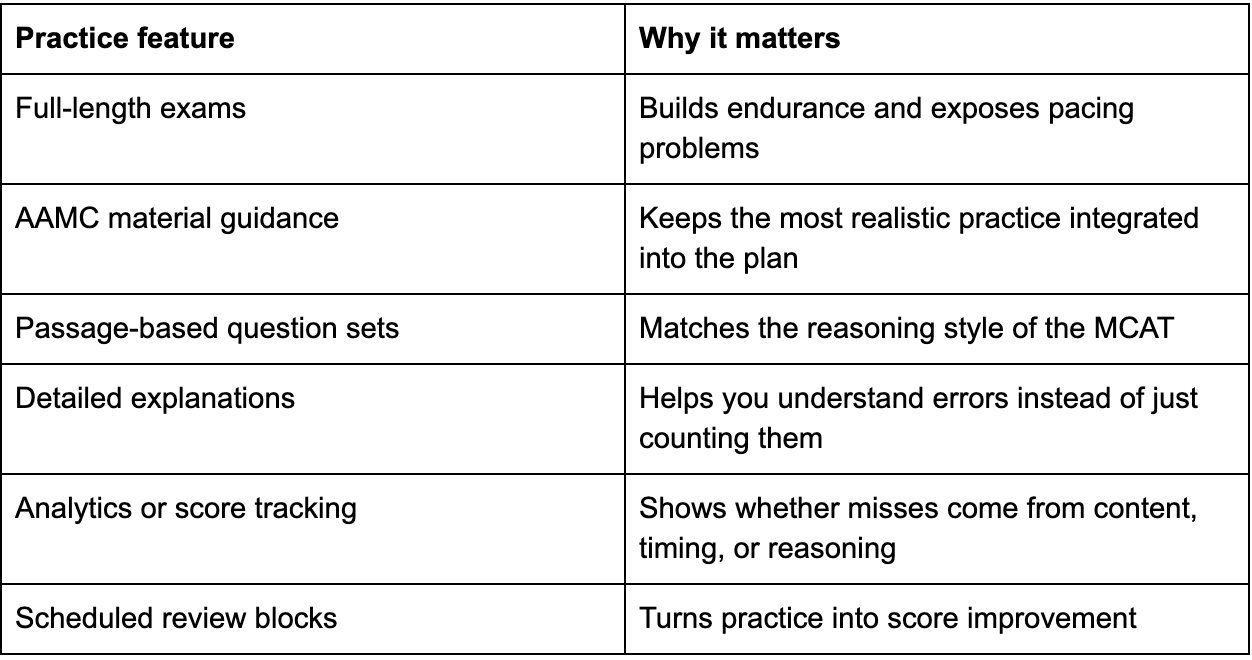
If a company advertises a very large number of questions, ask how those questions are organized. More is not automatically better. A smaller but better-guided practice system can be more effective than a massive library that leaves you guessing.
4. Personalized study planning: choose structure if your schedule is the risk
Personalized study planning matters because MCAT prep is a long project, and most students need a plan that changes as their scores, schedule, and weak areas change. A good prep course should help you decide what to study, when to take full-lengths, and how to respond when progress slows.
A generic calendar is better than no calendar, but it is not the same as a personalized plan. The plan should account for your diagnostic score, target score, test date, course load, work hours, application timeline, and the sections that need the most attention.
This factor is often the difference between feeling busy and actually improving. Students can spend weeks watching videos, reading notes, and doing random questions without fixing the bottleneck that is holding back their score.
Look for study planning that includes:
- a diagnostic starting point,
- a weekly schedule,
- planned full-length exam dates,
- content review blocks,
- passage practice blocks,
- full-length review time,
- checkpoints where the plan can change,
- a clear process for postponing or keeping the test date.
Good coaching also helps students make uncomfortable decisions. If your full-length scores are not close to your goal, you may need more practice, a different review method, or a new test date. A strong course helps you make that call earlier, when you still have options.
Wizeprep's Elite 515 Course model includes 1:1 coaching along with live class structure. That can be valuable for students who want someone to help tailor the plan, interpret score trends, and keep the prep timeline connected to applications.
5. Results and track record: look for proof, not just promises
Results matter because an MCAT prep course should provide credible evidence that students improve, not only marketing claims about confidence or support. Guarantees, score gains, reviews, testimonials, and transparent course policies all help you judge whether a program has a real track record.
Be careful with score guarantees. A 515+ guarantee can be meaningful, but only if you understand the requirements. Many guarantees depend on attendance, homework completion, diagnostic score, test date, or full-length exam participation. Those requirements are not automatically bad. They often reflect the work needed to make the guarantee realistic.
What matters is whether the terms are clear and achievable for a committed student. If the guarantee is vague, hard to qualify for, or disconnected from the actual course structure, treat it as a headline rather than proof.
Use this checklist when evaluating results:
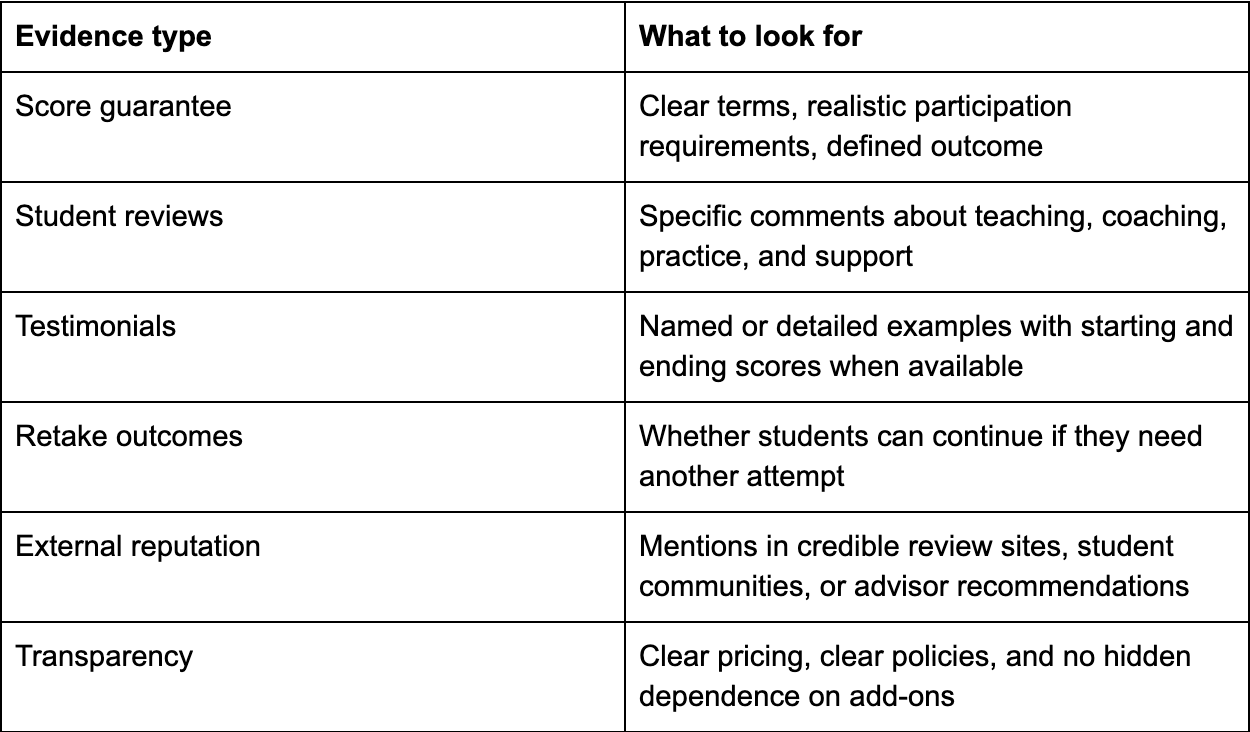
Wizeprep's Elite 515 Course includes a 515+ score guarantee, which is one of the clearest outcome-oriented signals in its MCAT lineup. It should still be evaluated the same way as any other guarantee: read the requirements, understand what is included, and decide whether the course structure fits how you will actually prepare.
6. Total cost vs value: compare what is included, not just the sticker price
The best-value MCAT prep course is the one that includes the support you are likely to use without forcing you into expensive add-ons later. Sticker price is important, but total value depends on live hours, coaching, tutoring, retakes, practice materials, admissions support, and access length.
MCAT prep ranges from low-cost self-study resources to premium live programs with coaching and tutoring. A lower price is attractive, but it can become less useful if you later need tutoring, a second course enrollment, or separate admissions advising.
Here is Wizeprep's MCAT pricing for the main course options:
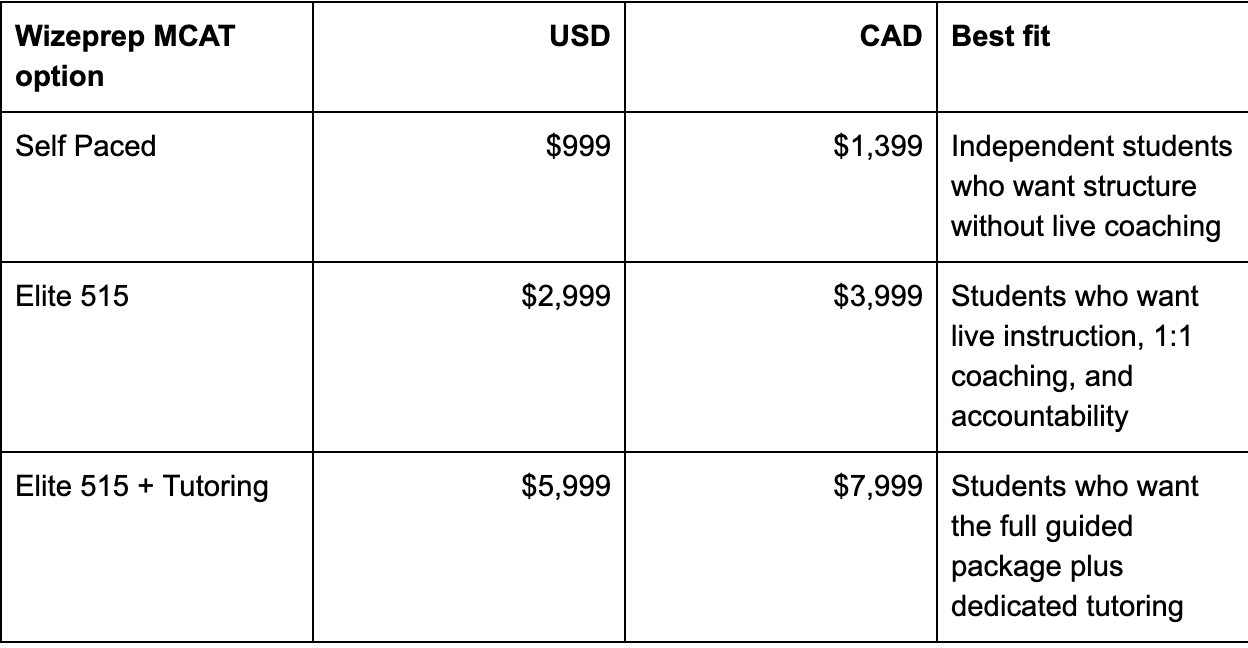
The Elite 515 Course tier includes 1:1 coaching, a 515+ score guarantee, unlimited free retakes, 150 live class hours, small class sizes, and admissions support. Those inclusions change the value comparison because they are often the features students end up needing most.
When comparing total cost, ask these questions:
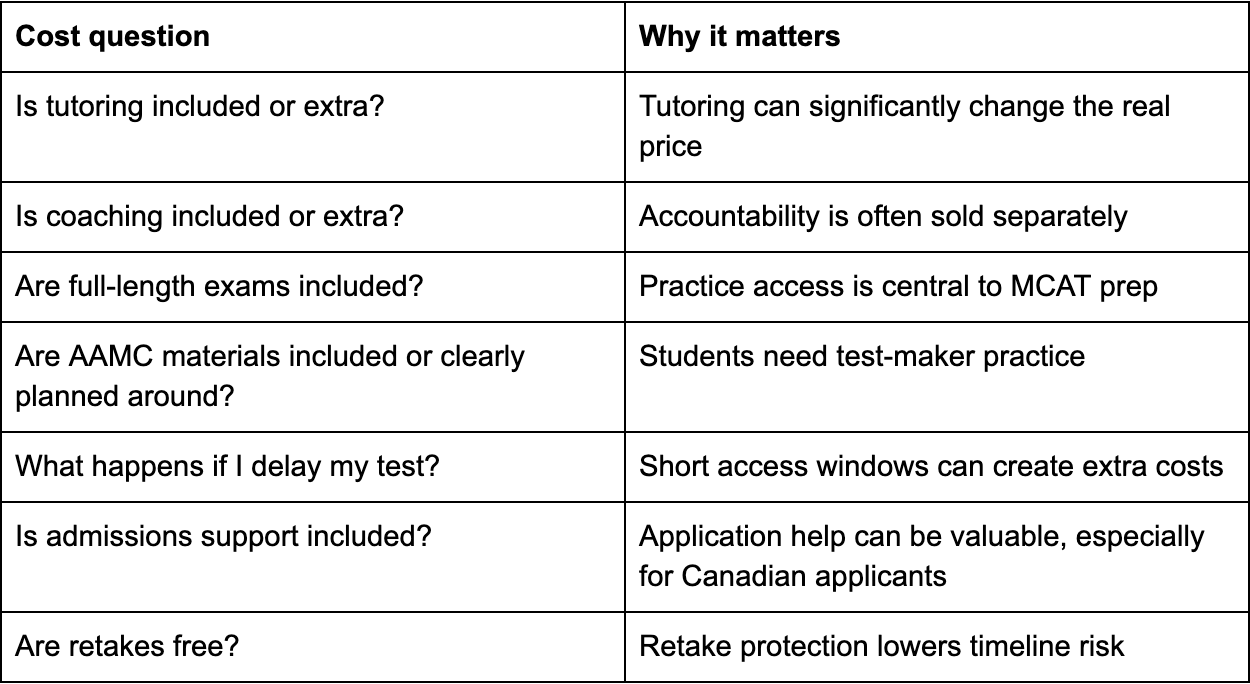
Do not choose the cheapest option automatically. Choose the lowest-cost option that actually solves your likely problem. For some students, that is a self-paced course. For others, a coached program is better value because it prevents wasted months.
7. Support and access protection: check what happens when the plan changes
Support and access protection matter because MCAT timelines often change due to coursework, burnout, application timing, work, illness, or practice scores that are not ready by the original test date. A strong course should protect students when the plan slips, not punish them with a narrow access window.
This is one of the most underrated MCAT prep factors. Many students compare class hours and question banks, then ignore what happens if they need six more weeks, another test date, or direct help after a difficult full-length.
Useful support can include academic advising, 1:1 coaching, instructor Q&A, tutoring options, schedule adjustments, retake access, and admissions guidance. The right mix depends on your risk profile.
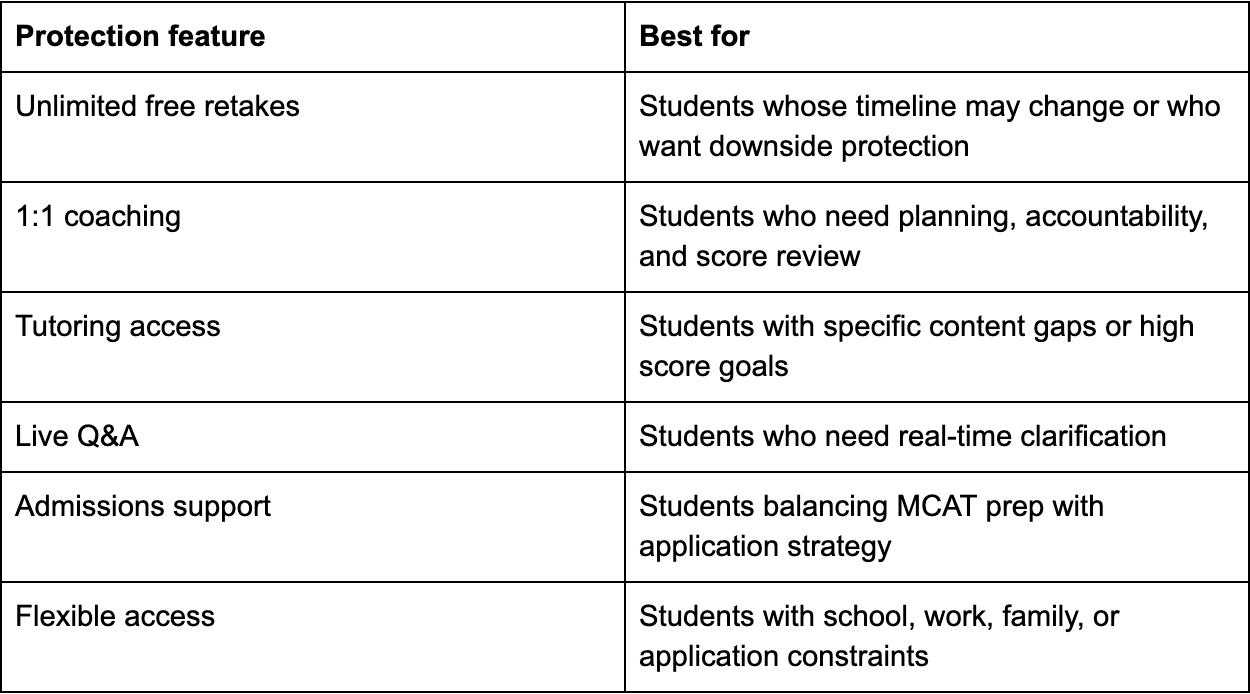
Wizeprep's Elite 515 Course includes unlimited free retakes, 1:1 coaching, 150 live class hours, small class sizes, admissions support, and a 515+ score guarantee. That makes it a strong option for students who want a guided system with protection if the MCAT timeline becomes messy.
This factor is especially important for Canadian applicants. Many Canadian students are balancing school-specific prerequisites, different application systems, and timelines that may not match the standard U.S. admissions calendar. A course with advising that understands that context can reduce friction.
Quick decision framework by student type
Choose the MCAT prep course that matches your most likely failure point. The right decision is easier when you start with the kind of student you have been, not the kind of student you hope you will become.
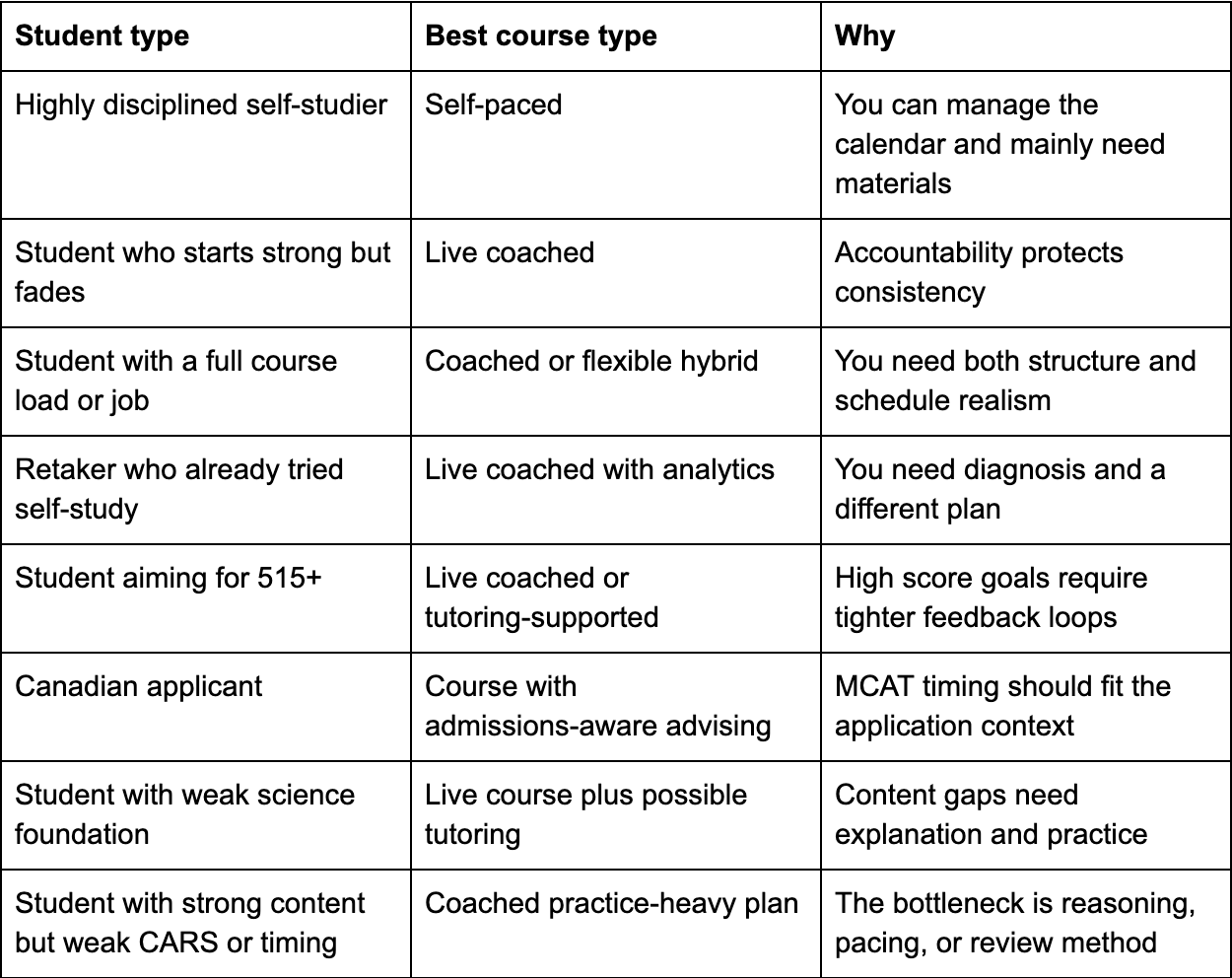
If you are choosing between two courses, identify the one feature you would most regret not having. For many students, that feature is coaching. For others, it is flexibility, tutoring, retake access, or lower cost.
Bottom line
The best MCAT prep course is the one that gives you the right mix of structure, teaching, realistic practice, planning, proof, value, and support protection. Do not choose based only on brand recognition, a headline score guarantee, or the largest question bank.
If you are independent, organized, and comfortable reviewing full-lengths on your own, a self-paced course can be enough. If you need accountability, live explanation, plan adjustments, or protection if your schedule changes, a coached program is usually the safer choice.
Wizeprep is one strong option for students who want a structured MCAT path, especially those considering the Elite 515 Course model with live instruction, 1:1 coaching, unlimited free retakes, admissions support, and a 515+ score guarantee. It is also a relevant option for Canadian applicants who want MCAT prep connected to their broader application context.
Book a free advising session
Book a free advising session with a Wizeprep academic advisor if you want a low-pressure read on your best prep path. An advisor can help you map your timeline, score goal, current starting point, and study habits into a tailored MCAT study plan.
MCAT prep course FAQ
What should I look for in an MCAT prep course?
Look for seven things in an MCAT prep course: the right format, strong instructors, realistic full-length practice, personalized study planning, credible results, clear total cost, and support if your schedule changes. The best course should match your study habits and your risk points, not just your budget.
Is a live MCAT course better than a self-paced course?
A live MCAT course is better if you need structure, accountability, real-time explanations, and help adjusting your plan. A self-paced course can be better if you are disciplined, organized, and comfortable reviewing practice tests on your own. The better format is the one you will actually follow for several months.
How important are AAMC materials for MCAT prep?
AAMC materials are very important because they come from the test maker and best reflect official MCAT reasoning. Third-party courses can add structure, content review, practice volume, and coaching, but your plan should still include AAMC practice. A strong course tells you when and how to use those materials.
How much should I expect to pay for an MCAT prep course?
MCAT prep course pricing varies widely based on live instruction, coaching, tutoring, guarantees, and access length. As one example, Wizeprep's MCAT options are $999 USD or $1,399 CAD for Self Paced, $2,999 USD or $3,999 CAD for Elite 515, and $5,999 USD or $7,999 CAD for Elite 515 + Tutoring. Compare the full package, not just the advertised starting price.
Are MCAT score guarantees worth it?
MCAT score guarantees can be useful, but only if the terms are clear and realistic. Read the attendance, homework, diagnostic, and test-date requirements before relying on the guarantee. A guarantee should support a strong course structure, not replace your own evaluation of teaching, practice, and coaching.
What is the best MCAT prep course for Canadian applicants?
The best MCAT prep course for Canadian applicants is one that combines strong MCAT instruction with advising that understands Canadian application timing and school context. Canadian students should still evaluate the same seven factors: format, instructors, practice, planning, results, value, and support. Wizeprep is a strong option to consider because its MCAT programs include Canadian-relevant advising and admissions support.

Study with Us
The help you need to get the grades you want.
Previous Blog
What Are High Yield MCAT Topics?
Next Blog