Grade 12 Chemistry
Canada High School
Course Overview
Lessons & Practice
I. Welcome
1. Organic Chemistry (Part 1: Functional Groups and Naming)
3hr2. Organic Chemistry (Part 2: Chemical Reactions)
1.9hr3. Atomic Models and Properties of Atoms
5hr3.3.1. The Bohr Model Vs The Quantum Model3.3.2. Practice: Understand Quantum Numbers3.3.3. Practice: Quantum Numbers3.3.4. Shape of Atomic Orbitals 3.3.5. Practice: Shapes of Atomic Orbitals 3.3.6. Quantum numbers3.3.7. Example3.3.8. Example3.3.9. Finding allowed sets of quantum numbers for an atomic orbital
4. Chemical Bonding and Properties of Matter
5hr4.3.1. Practice: Are these molecules polar?4.3.2. Practice: Molecular Geometry and Polarity4.3.3. Practice: Polarity, Molecular Shape, Electron Geomtetry, Hybridization, and Lewis Structure! 4.3.4. Practice: Polarity, Molecular Shape, Electron Geometry, Hybridization, and Lewis Structure!4.3.5. Review of Polar Covalent Bonds4.3.6. Molecular Polarity 4.3.7. Example4.3.8. Practice4.3.9. Practice
5. Energy Changes
2.5hr- 5.I. Chapter Intro
5.9.1. Hess’ Law5.9.2. Hess’ Law Notes5.9.3. Practice: Hess' Law5.9.4. Extra Practice: Hess' Law (Optional)5.9.5. Heats of Formation5.9.6. Enthalpy of Formation Practice 5.9.7. Example: Heats of formation5.9.8. Practice: Enthalpy of Reactions5.9.9. Enthalpy Practice 5.9.10. Practice: Multi-Step Enthalpy Problem
6. Rates of Reactions
1.7hr- 6.I. Chapter Intro
6.5.1. Reactions Mechanisms – Elementary Reactions6.5.2. Example: Reactions Mechanisms – Elementary Steps6.5.3. Rate Determining Step Introduction 6.5.4. Example: Rate Determining Step6.5.5. Practice: Rate of A Reaction6.5.6. Practice: Reaction Coordinate Diagram6.5.7. Example: Identifying a Catalyst Vs an Intermediate In a Mechanism 6.5.8. Practice: Mechanism
7. Equilibrium
2.1hr8. Acids and Bases
3hr9. Electrochemistry
2.7hrMock Exam
I Welcome
Free Activity
Welcome to Chemistry!
My name is Avneet and I'm the instructor for this course.
Feel free to go through this course at your own pace
- Use the table of contents 📃 on the left to skip to parts you need help with
- Watch the video ▶ or read the written lessons 📖
- Speed up ⏩ or slow down ⏪ the videos
- Use the "Ask a question"❓ feature below each lesson/question any time!
Unanswered
D
Darren &
Electromagnetic radiation cheat sheet
Answered
Anonymous
How do I figure out the energy required to completely decompose a compound when I am only given the number of moles. (eg. 1.50 mol of PCl3(l) )
R
Rex H
InstructorGreat Question!
To find the energy required to completely decompose a compound when you're given the number of moles (like 1.50 mol of PCl₃), you just need one more key piece of information — the enthalpy (ΔH) of the reaction or bond energy per mole from a thermochemical equation.
Here’s the general process:
- Find or use the balanced chemical equation for the decomposition of the compound.
- Look for the ΔH value (energy change) — usually given in kJ per mole of the substance decomposed.
- Multiply the ΔH by the number of moles you have:
Energy Required = moles x ΔH
Heres an example:
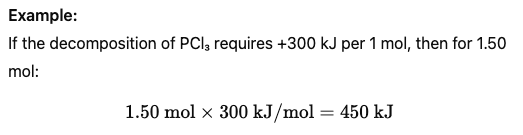
Hope this helps!
Answered
H
Hala A
I'm preparing for the AC-HPAT test because I'm applying for the Dental hygiene program. Do I study all units in chemistry, biology, and physics?
d
daniel l
InstructorHi!
I'll do my best to answer this question, but I believe the Dental hygiene program will require you to know Grade 11/12 Chemistry, biology, and physics - so I think that'd be a good idea to review those courses!
Answered
Anonymous
In high school chemistry, what unit/topic relates closets to the chemistry studied in university when studying to go into healthcare?
A
Avneet D
InstructorHey,
Surprisingly all of the units in grade 12 chemistry will help you if you're on the path to a career in healthcare. You'll most likely take general chemistry both semesters in your first year of university. Organic chemistry isn't taught until second year. I would say the organic chemistry unit in high school is the least important for university. It does a good job introducing students to molecules and functional groups, but you're not often tested on nomenclature in university. :)
Answered
Chellewin S
Would chemistry be a good course to major in if I'm heading towards the medicine field?
M
Michelle H
YESS!!!!
Answered
Anonymous
Whats the best way to find if something is endothermic or exothermic
M
Mikaela S
If the reaction releases or absorbs heat. Usually if the reaction is exothermic it would release heat, hence, the vessel used in the experiment would feel warm. On the other hand, endothermic is when heat is absorbed, vessel used would feel cooler.
Answered
Anonymous
How do I practice memorization
M
Michelle H
Note cards, writing down notes and review them!
Answered
Mae M
What is the difference between regular Chem and biochemistry
A
Avneet D
InstructorHi,
Biochemistry still involves chemistry and general chemistry concepts like molecules reacting, the speed of reactions, enzymes that help products form, catalysts that speed up reactions etc, but biochemistry has to do with the chemistry involved with biology or life.
Biochemistry is concerned with molecules that make up all living things and reactions involved in living things. One common example of a concept taught in biochem is cellular respiration. This looks at how humans can eat food for energy and use that energy to produce CO2. There are many reactions and pathways that molecules take inside of us!
Answered
Mae M
Is chemistry a good college major?
A
Avneet D
InstructorHi,
Yes, it is. There are so many good college majors though.
I would recommend searching university websites to see the different programs they offer. Once you've found some you're interested in, you could look into the potential careers you might be able to get with that degree. That should help you to narrow your choices down :)
Answered
Anonymous
How do I figure out the molar mass of an element?
A
Avneet D
InstructorHi,
Great question!
The molar mass of an element can actually be found right from the periodic table!
The larger number underneath the element symbol is the molar mass of that element.
For example, if we look at N in the periodic table:

We can see that it's molar mass is 14.007g/ mol (this is the number written underneath the symbol N for nitrogen!) :)
Answered
C
Coner C
Does wise prep have anything for Physics of Calculus/ math 31?
A
Avneet D
InstructorHi,
Sorry about my late response! At the moment we don't have physics, but we do have math 31! Let me know if you have trouble finding it on the site :)
Answered
Anonymous
Is it too early to prep for the MCAT if I’m still in high school?
A
Avneet D
InstructorYes, it is too early to prep for MCAT :). Students usually study for the MCAT in the summer after the 2nd year of university.
You also need to learn the first year university courses in order to understand the MCAT :). Grade 12 courses will also help! So for now just focus on understanding your classes.
Answered
Lucy L
What's the best way to study for Chemistry?
A
Avneet D
InstructorHey,
That's a great question :)
I think the best strategy would be to try to make good notes for your class first. If your teacher already provides you with powerpoint slides you can add additional notes to the margins of the notes during class to help you understand the concept. Then either in class, or when you're reviewing, you can highlight key concepts.
When you do your homework, circle questions you found difficult or got wrong on the first try. When you're reviewing for an exam, you can spend some time reviewing the questions you circled. This will help you save time and study effectively. By reviewing these specific questions, you won't make the same mistakes on the exam!
After learning a concept in class, you can visit this website to watch the videos if you had trouble understanding a concept and/or want more practice. This is a great resource to use weekly and before the exam :). In this course, at the end of each chapter, I've also included a summary sheet that you can use to check and see if you understand all of the main concepts in the chapter. This sheet is a great resource to use before tests! If you forgot something, you can then go back, check out the related videos, and try the practice :)
Enjoy the course!
Answered
Lucy L
What are the best programs for under grad?
A
Avneet D
InstructorHi,
I don't think there are best programs for undergrad! It really depends on what you like, and what you might see yourself doing in the future!
I would recommend doing a free career test online. It may help you to think about careers you may not have even considered yet. This link has a bunch of free career tests you can try. I would also suggest looking into things like how in demand the career is, how happy the people who have this career are, etc.
Once you have an idea of what you like and may want to do, then you can start looking at the programs that are offered by universities that may align with your goals.
I hope that helps!
Best,
Avneet