PHY 1124
uOttawa
Course Overview
Lessons & Practice
I. Welcome
1 min1. Physics and Measurement
2.1hr2. Motion in One Dimension
2.5hr3. Motion in Two Dimensions
1.7hr4. Laws of Motion
3hr5. Circular Motion & Other Applications of Newton's Laws
1.7hr6. Work and Kinetic Energy
1.4hr7. Conservation of Energy
41min8. Momentum, Impulse and Collisions
1.9hr9. Dynamics Rotational Motion
4hr10. Periodic Motion
5hr10.2.1. Velocity and Acceleration in SHM (Advanced)7 min10.2.2. Velocity and Acceleration in SHM (Basic)10 min10.2.3. Finding Acceleration by Knowing Displacement (Advanced)6 min10.2.4. Example: SHM with mass on a spring10.2.5. Practice: Oscillations - Displacement Function7 min10.2.6. Practice: Oscillations - Acceleration Graph
11. Electric Fields
2.9hr11.6.1. Finding Electric Field with Integrals3 min11.6.2. Example: Electric Field from a Rod9 min11.6.3. Example: Electric Field from a Rod (off-axis)11.6.4. Practice: Rod with Nonlinear Charge Density8 min11.6.5. Practice: Rod with Positive and Negative Charge9 min11.6.6. Practice: Rod Electric Field Without Symmetry14 min
12. Gauss's Law
1.5hr12.3.1. Gauss's Law with Spherical Symmetries1 min12.3.2. Example: Gauss's Law for a Spherical Symmetry3 min12.3.3. Practice: Charges on a Hollow Conducting Sphere4 min12.3.4. Practice: Gauss's Law for a Spherical Insulator10 min12.3.5. Practice: Electric Field with an Off-Center Spherical Cavity (hard!)11 min
13. Magnetic Fields
1hr13.3.1. Circular Motion in a Magnetic Field3 min13.3.2. Example: Circular Motion in a Magnetic Field3 min13.3.3. Example: Circular Motion in a Magnetic Field1 min13.3.4. Practice: Circular Motion in a Magnetic Field4 min13.3.5. Practice: Circular Motion in a Magnetic Field2 min13.3.6. Practice: Helical Motion in a Magnetic Field7 min
14. Sources of Magnetic Field
1.5hr14.5.1. Ampere’s Law1 min14.5.2. Example: Ampere’s Law3 min14.5.3. Example: Ampere’s Law4 min14.5.4. Practice: Ampere's Law - shell14.5.5. Practice: Ampere's Law - coax7 min14.5.6. Practice: Ampere's Law - toroid3 min14.5.7. Practice: Ampere's Law - sheet8 min14.5.8. Practice: Ampere's law - variable density5 min
15. Modern Physics
1hr16. Motion in Two Dimensions
2.9hr17. Force Vectors (Advanced Info)
7hr17.2.1. Scalars & Vectors - Definitions & Examples3 min17.2.2. Vectors (2D)12 min17.2.3. Vectors (3D)6 min17.2.4. Examples: Scalars and Vectors (Sine and Cosine Laws)13 min17.2.5. Practice: Scalars and Vectors (Sine and Cosine Laws)10 min17.2.6. Practice: Scalars and Vectors (Catesian Format, Sine Law)16 min17.2.7. Example: Scalars and Vectors (Rectangular Components)13 min17.2.8. Practice: Scalars and Vectors (Rectangular Components) 11 min
17.6.1. Forces 3D Cartesian Form (IMPORTANT!)11 min17.6.2. Example 1 - Part 1: 3D Force Vectors 11 min17.6.3. Example 1 - Part 2: 3D Force Vectors 7 min17.6.4. Example 2: 3D Force Vectors13 min17.6.5. Practice 1: 3D Force Vectors10 min17.6.6. Practice: 3D Vector Practice Questions Part 15 min17.6.7. Practice: 3D Vector Practice Questions Part 26 min17.6.8. Example: Forces in Cartesian Vector Form16 min
17.10.1. Vector Addition and Subtraction: Algebraic Method 54 sec17.10.2. Vector Addition and Subtraction: Graphic Methods9 min17.10.3. Example: Vector Addition6 min17.10.4. Practice: Algebraic Addition4 min17.10.5. Practice: Resultant of 2 Vectors1 min17.10.6. Practice: Vector Addition and Subtraction
I Welcome
Free Activity
0:00 / 1:04
Answered
S
Sara d
Hello, I incorrectly answered this question in my PHY151 term test and am currently preparing for my deferred final exam. The professor's answer is below. It involved a tricky amount of algebraic manipulation to get here and it would be helpful, in the future, to understand what variables I want in my equation and what I want to get rid of. Is it safe to assume that I don't want to have V1' in my equation for V2' and vice versa? Is that why I couldn't simply re-arrange my conservation of momentum equation? Also, does it matter if the particles are going in the same direction or opposite directions? Thanks!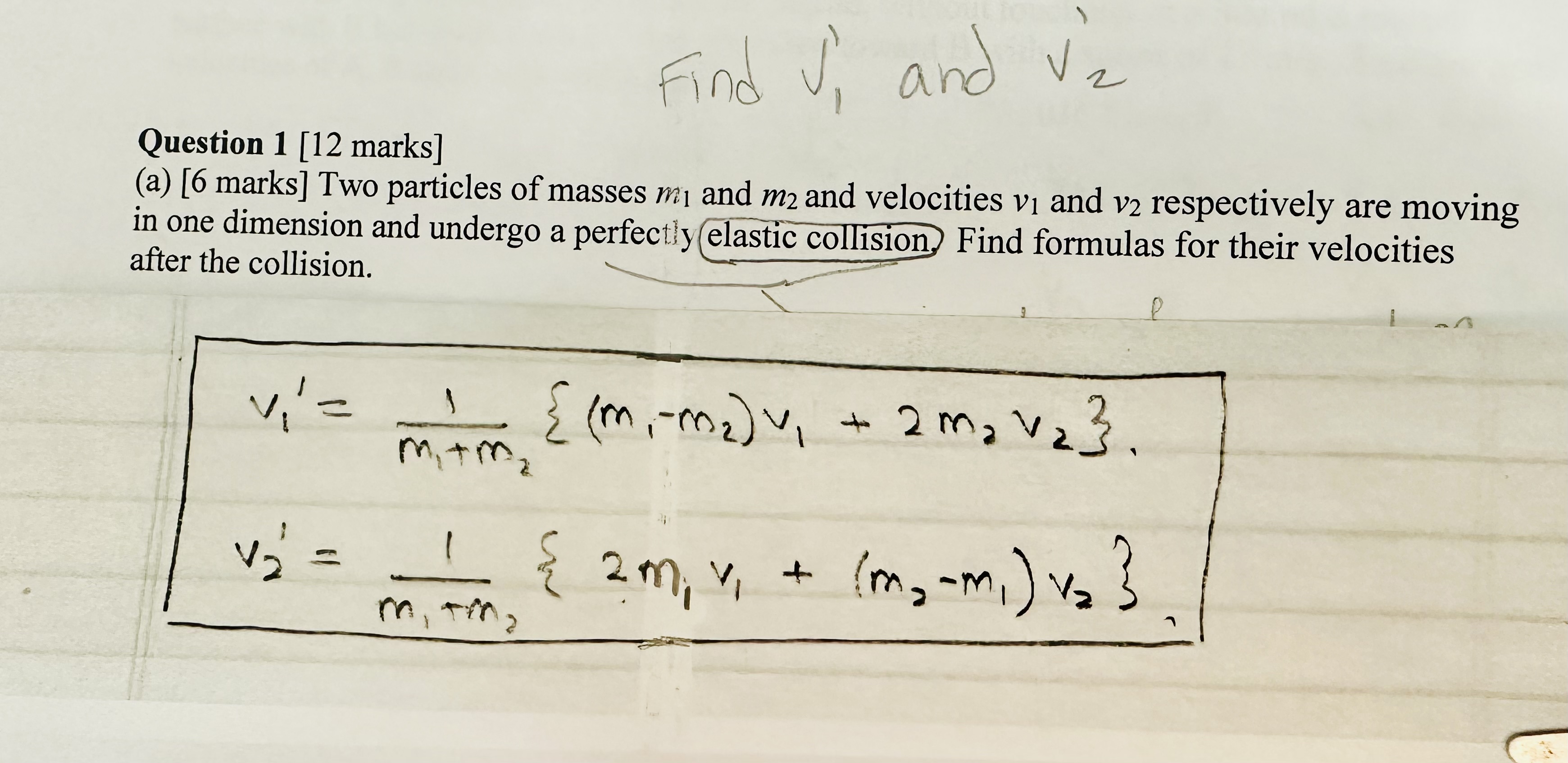
W
Will D
InstructorI’d have to see your work in getting these. But you would start with:
P before = P after
Answered
Anonymous
could you tell me which topic corresponds to which topic of the textbook though, I think it is in 1.1-5, 12.1-12.10, 13.1-13.3, if that is the case where it ends to in Wizeprep
W
Will D
Instructoragain, you should check the course syllabus and with your instructor to confirm and get the latest and most correct information for what's on the assessment and what is covered.
Answered
Anonymous
Hi I just want to ask what topics of wizeprep EN-PH 131 are covered in the midterm exam, since I know that work and energy is not covered
W
Will D
Instructoryou should check the course syllabus and with your instructor to get the latest and most correct information for this.
Answered
M
Mark L
Hi, do we have videos for electromagnetism? I found it is covered in phys 142, but I can't find it.
W
Will D
Instructorcan you provide a syllabus or course outline for PHYS 142 that indicates that? i'll need that to request an update to that Wizeprep resource. thx.
Answered
S
Sara C
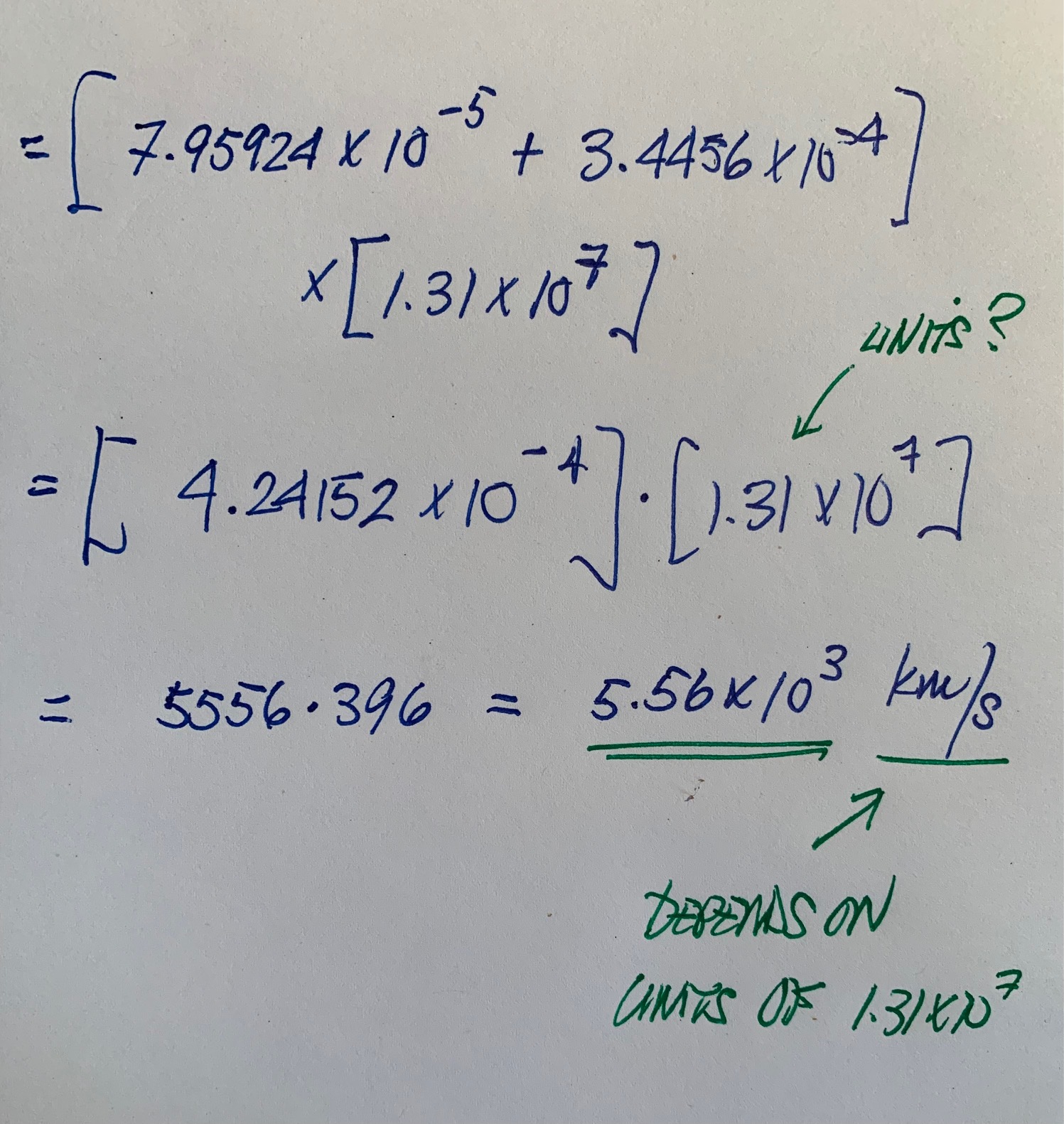
how would i solve this (7.95924 x 10^-5 km/s + 3.4456 x 10^-4 km/s) (1.31 x 10^7)
W
Will D
Instructorhi. not seeing what the units of the "1.31x10^7" is, or if you need to keep with Sig Figs, but here's how it would go...
Answered

Abebro Z
P
Philippa N
Instructor1cm = 0.3937 inches therefore 23.3 inches will be 23.3/0.3937 cm which is 59.1cm (this is 3 significant figures).
Answered
Anonymous
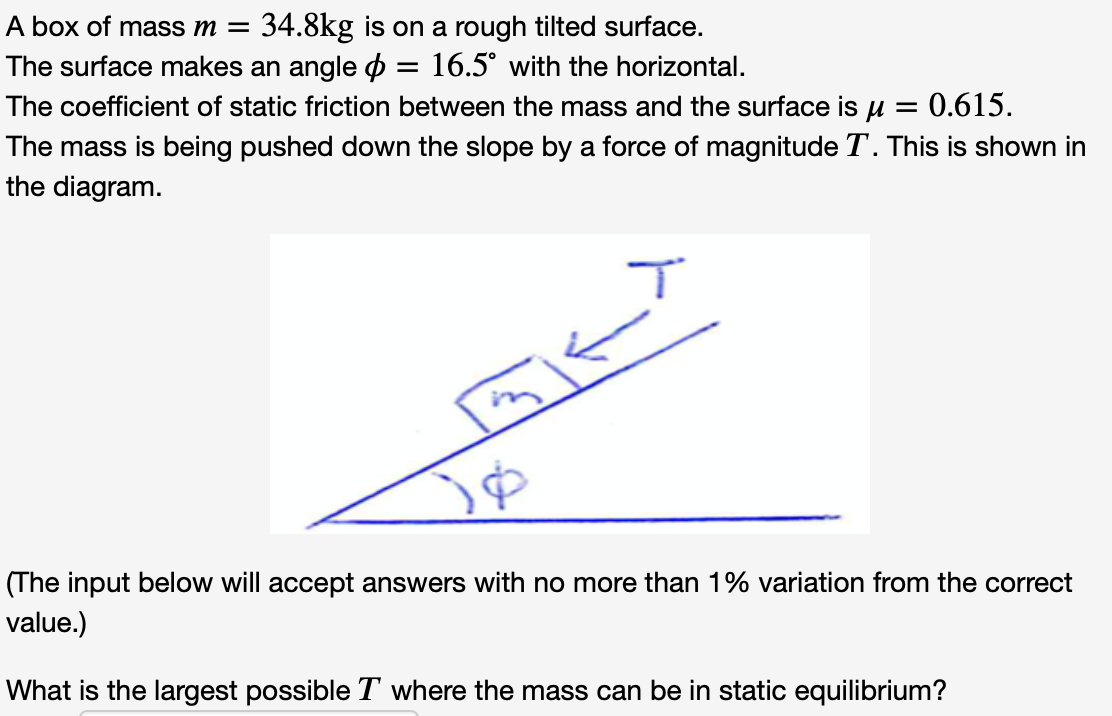
Hello, how does one go about answering a question like this? I am just studying for the final and can't seem to get the correct answer no matter the option I try.
Thank you
M
Mohammad M
InstructorHello, we usually only answer questions regarding the problems we have in Wize courses but I can give you some hint how to approach this problem :)
The maximum of the status friction is equal to mu_s*N which is in this case mu_s*mgCos(theta). As long as the downward force acting on the mass I less than this number, it does not move and it remains in the static equilibrium. There is already a downward force of gravity with the size of mg*Sin(theta) along the surface acting on the mass. So, the difference between the maximum static friction and this force is the largest possible T on the mass to keep it still in the static equilibrium. I hope it helps.
Answered
A
Alexis C
Do you typically notice a interest deficit between genders?
M
Mohammad M
InstructorNot at all.
Answered
A
Alexis C
How competitive are physics majors in college?
M
Mohammad M
InstructorAs long as I know, it is not that difficult to get admission in physics. But, it is definitely challenging to good grades in physics :)
Answered
A
Alexis C
Do you believe the conceptual or the mathematical aspect of physics is more difficult for students to comprehend?
M
Mohammad M
InstructorThe conceptual part is definitely the hardest part. Learning the mathematical part is easy, but if you don't understand the concept behind the equations they are useless!
Answered
M
Matthew M
Why is physics important?
M
Mohammad M
InstructorYou can see and use physics in your daily life. It has happened a lot to me to solve a problem that I have encountered in my life with laws of Physics :) Also, physics is looking for some of the most fundamental questions that human being has been always curious about such as the origin of the world. Finally, If you understand laws of nature, you can harness them to create new technology and make our life more pleasant. All engineers have root in physics :)
Answered
M
Matthew M
How many people study physics?
M
Mohammad M
InstructorA lot :)
Answered
M
Matthew M
Whats the best college for physics?
M
Mohammad M
InstructorIt is hard to say what is the best university in all aspects of physics. However, my favourite one is Harvard :)
Answered
M
Matthew M
What jobs are associated with physics?
M
Mohammad M
InstructorIt really depends on the special field of physics you are working in. There is wide range, from university prof to a researcher at a private company to an astronaut :)
Answered
M
Matthew M
How long does this take to learn?
M
Mohammad M
InstructorA lifetime :)
Welcome to Physics 1!
My name is Mohammad and I'm here to help you ace your course :)
Feel free to go through this resource at your own pace
- Use the table of contents 📃 on the left to skip to parts you need help with
- Watch the video ▶ or read the written lessons 📖
- Speed up ⏩ or slow down ⏪ the videos
- Use the "Ask a question"❓ feature below each lesson/question any time!
Happy studying! 🚀