A student adds some CuBr (s) (Ksp = 6.3x10⁻⁹) to each of the flasks shown here.…
Related Topics
A student adds some CuBr (s) (Ksp = 6.3x10⁻⁹) to each of the flasks shown here.
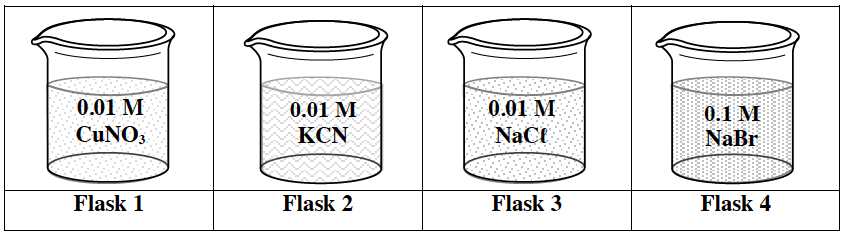
Assume that any salts in each flask were fully dissociated before CuBr(s) was added.
Additional data:
Based on this information, rank the solubility of CuBr(s) in each flask by assigning each flask a number from 1 to 4, with 1 being most soluble and 4 being least soluble.
A.
1
B.
4
C.
3
D.
2
Flask 1
Flask 2
Flask 3
Flask 4