High School
SAT
SAT Elite 1500
SAT Tutoring
ACT
ACT Elite 33
ACT Tutoring
University
MCAT
MCAT Elite 515
Med-School Admissions
Pre-Med Tutoring
Pre-Med Plus
LSAT
LSAT Elite 170
LSAT Self-Paced
LSAT Tutoring
DAT
DAT Elite
DAT Tutoring
Log in
Get Started for Free
Valence Bond Theory, Hybridization, and MO Theory
Related Topics
Organic Chemistry 1 Textbook > The Basics (Lewis Structures, Bonding, VSEPR)
Bonding: Valence Bond Theory, Hybridization, MO Theory, and Resonance
6 Activities
Practice: Hybridization and Bond Angle
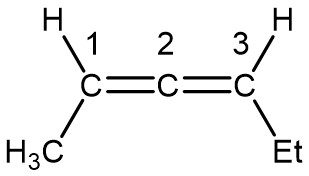
An organic compound possessing an alkene functional group is shown below.
For each of C1, C2, and C3: define the hybridization, determine the bond angle around the carbon atom, and state the geometry.
For C1, the hybridization, angle, and geometry are.... (list in order with commas)
For C2, the hybridization, angle, and geometry are.... (list in order with commas)
For C3, the hybridization, angle, and geometry are.... (list in order with commas)
I don't know
Check Submission
More Bonding: Valence Bond Theory, Hybridization, MO Theory, and Resonance Questions:
Resonance Structures: Stability
Practice: Resonance Structures
Provide all contributing resonance structures for the following radical species:
Resonance structures
Practice: Resonance Structures
Provide all contributing resonance structures for the following radical species:
Practice: What is the hybridization of the central carbon atom in allene (H₂C=C=CH₂)?
Practice: Hybridization of Atoms
What is the hybridization of the central carbon atom in allene (H₂C=C=CH₂)?
A) sp
Valence Bond Theory, Hybridization, and MO Theory
An organic compound possessing an allene functional group is shown below.
For each of C1, C2, and C3: define the hybridization, determine the bond angle around the carbon atom, and state the geometry.
Hybridization
Valence Bond Theory, Hybridization, and MO Theory
An organic compound possessing an allene is shown below.
Draw the
π
orbital overlap for C1, C2, and C3. Name the orbitals, ex.
π
(2p-3p)
and indicate the phases with +/-.
Draw the
σ
orbital overlap for C1, C2, and C3. Name the orbitals. ex.
σ
(2sp2-3s)
and indicate the phases with +/-.
Valence Bond Theory, Hybridization, and MO Theory
An organic compound possessing an allene is shown below.
Draw the
π
orbital overlap for C1, C2, and C3. Name the orbitals, ex.
π
(2p-3p)
and indicate the phases with +/-.
Draw the
σ
orbital overlap for C1, C2, and C3. Name the orbitals. ex.
σ
(2sp2-3s)
and indicate the phases with +/-.
Valence Bond Theory, Hybridization, and MO Theory
An organic compound possessing an allene is shown below.
Draw the
π
orbital overlap for C1, C2, and C3. Name the orbitals, ex.
π
(2p-3p)
and indicate the phases with +/-.
Draw the
σ
orbital overlap for C1, C2, and C3. Name the orbitals. ex.
σ
(2sp2-3s)
and indicate the phases with +/-.
Which C-Br Bond length is the shortest?
Valence Bond Theory, Hybridization, MO Theory
Draw any major contributing resonance structures for the following molecule.
Valence Bond Theory and Hybridization
An organic compound possessing an allene functional group is shown below.
For each of C1, C2, and C3: define the hybridization, determine the bond angle around the carbon atom, and state the geometry.
Valence Bond Theory, Hybridization, and MO Theory
An organic compound possessing an allene functional group is shown below.
For each of C1, C2, and C3: define the hybridization, determine the bond angle around the carbon atom, and state the geometry.
Draw any major contributing resonance structures for the following molecule.
Which C-Br Bond length is the shortest?
Which C-Br bond length is the longest?
Valence Bond Theory, Hybridization, and MO Theory
Practice: Valence Bond Theory, Hybridization, and MO Theory
An organic compound possessing an alkene functional group is shown below.
For each of C1, C2, and C3: define the hybridization, determine the bond angle around the carbon atom, and state the geometry.
Resonance
Draw all the resonance structures of the following compounds and choose the most contributing one for each:
Resonance
Show the complete flow of electrons to draw a resonance structure of the following molecule:
Resonance
Which ones are resonance structures of the following compound?
Bond Length
Rank the following in terms of increasing C-C bond length between the marked C atoms:
Resonance
Draw all the possible resonance structures for each of the following compounds and choose the most contributing one in each case:
Resonance: Carbocation Rearrangements
Are any additional resonance structures present in the following compound? Select the most correct answer.
Resonance Structures: Stability
Provide all contributing resonance structures for the following radical species:
Hybridization
In the following compound, count the number of each type of hybridization for
carbon
:
sp
3
=
6
sp
2
=
1
Molecular orbital Theory
How many electrons can reside in the p orbitals
Resonance Effects on Hybridization
Determine the hybridization of the following heteroatoms:
Which resonance contributor is more significant?
Determining Atom Hybridization
Determine the hybridization of each carbon atom in the following molecules
(Duplicated)
What is the
molecular geometry and bond angle
of the C-N-C bond in the following molecule?
(Duplicated)
What orbital is the N-atom
lone pair
in for the following molecule?
Equilibrium: Resonance
Chemical reactions: Resonance
Resonance structures
Draw any major contributing resonance structures for the following molecule.
Bond length
Which C-Br Bond length is the shortest?
Valence Bond Theory, Hybridization, MO Theory
Draw any major contributing resonance structures for the following molecule.
Valence Bond Theory, Hybridization, MO Theory
Which C-Br bond length is the longest?
Hybridization
Valence Bond Theory, Hybridization, and MO Theory
An organic compound possessing an allene is shown below.
Draw the orbital overlap for C1, C2, and C3.
What is the hybridization of C1, C2, and C3