AI Tutor
High School
SAT
SAT Elite 1500
SAT Tutoring
ACT
ACT Elite 33
ACT Tutoring
University
MCAT
MCAT Elite 515
Med-School Admissions
Med School Calculator
MCAT Score Percentiles
Pre-Med Tutoring
Pre-Med Plus
LSAT
LSAT Elite 170
LSAT Self-Paced
LSAT Tutoring
DAT
DAT Programs
DAT Elite
DAT Self-Paced
DAT Tutoring
Log in
Get Started for Free
Orbital Overlap Diagrams
Related Topics
Wize University Chemistry Textbook > Valence Bond Theory (Hybridization)
Orbital Overlap Diagrams
2 Activities
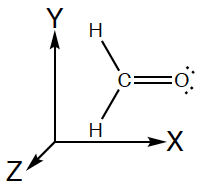
Use the axes to your right and your understanding of valence bond theory to decide which of the statements correctly explains the bolded piece in each diagram.
All of the statements are correct
None of the statements are correct
Only i. and iii. are correct
Only i. is correct
Only iii. and iv. are correct
I don't know
Check Submission
More Orbital Overlap Diagrams Questions:
Hybridization, Shape of Molecules
Draw the complete structure of the following molecule and identify the orbitals involved for each bond:
Hybridization: Orbital Overlap Diagrams
The hybrid orbitals are used for sigma bonds and lone pairs. The remaining p orbitals are used for pi bonds or vacant orbitals such as the case for B (Group 13 elements).
Draw the orbital overlap of acetonitrile using the Lewis structure shown.
What would the symmetry be of the molecular orbitals formed through the combination of a 1s orbital and a 2p orbital?
Orbital Overlap Diagrams
Given the following sigma framework for a molecule of phosgene, COCl
2
, which of the orbitals of oxygen
will be responsible for its pi interaction?
i. 2p
x
Hybridization: Orbital Overlap
Use the axes to your right and your understanding of valence bond theory to decide which of the statements correctly explains the bolded piece in each diagram.
VSEPR: σ and π Frameworks with Consecutive Double Bonds
Answer the following questions about the species H
2
CN
2
, whose Lewis structure is shown below:
VSEPR: σ and π Frameworks with Triple Bonds
Solve the following two part question, regarding the line drawing shown below.
Part 1:
Part 2:
Practice: σ and π Frameworks
Solve the following two part question, regarding the line drawing shown below.
Part 1:
The condensed formula of the molecule shown below is:
ClC(O)CH3