AI Tutor
High School
SAT
SAT Elite 1500
SAT Tutoring
ACT
ACT Elite 33
ACT Tutoring
University
MCAT
MCAT Elite 515
Med-School Admissions
Med School Calculator
MCAT Score Percentiles
Pre-Med Tutoring
Pre-Med Plus
LSAT
LSAT Elite 170
LSAT Self-Paced
LSAT Tutoring
DAT
DAT Programs
DAT Elite
DAT Self-Paced
DAT Tutoring
Log in
Get Started for Free
Which one of the species below is the best reducing agent?
Related Topics
Wize University Chemistry Textbook > Electrochemistry
Reduction Potentials
4 Activities
Which one of the species below is the best reducing agent?
C
o
(
s
)
Co(s)
C
o
(
s
)
Z
n
(
s
)
Zn(s)
Z
n
(
s
)
C
u
2
+
(
a
q
)
Cu^{2+}(aq)
C
u
2
+
(
a
q
)
C
u
(
s
)
Cu(s)
C
u
(
s
)
A
g
+
(
a
q
)
Ag^+(aq)
A
g
+
(
a
q
)
I don't know
Check Submission
More Reduction Potentials Questions:
Electrochemistry: Galvanic Cells
The cell pictured below is prepared under standard conditions. In this cell, what will be the
anode
?
𝐶
𝑢
2
+
(
𝑎
𝑞
)
+
𝐻
2
(
𝑔
)
⇌
𝐶
𝑢
(
𝑠
)
+
2
𝐻
+
(
𝑎
𝑞
)
𝐸
°
=
0.339
𝑉
𝐶𝑢^{2+} (𝑎𝑞)+𝐻_2 (𝑔)\rightleftharpoons 𝐶𝑢 (𝑠)+2 𝐻^+ (𝑎𝑞) \qquad𝐸°=0.339 𝑉
C
u
2
+
(
a
q
)
+
H
2
(
g
)
⇌
C
u
(
s
)
+
2
H
+
(
a
q
)
E
°
=
0.339
V
Which one of the species above is the best oxidizing agent?
Z
n
2
+
(
a
q
)
+
2
e
−
⇌
Z
n
(
s
)
E
o
=
−
0.74
V
C
u
2
+
(
a
q
)
+
2
e
−
⇌
C
u
(
s
)
E
o
=
+
0.34
V
C
o
2
+
(
a
q
)
+
2
e
−
⇌
C
o
(
s
)
E
o
=
−
0.28
V
A
g
+
(
a
q
)
+
e
−
⇌
A
g
(
s
)
E
o
=
+
0.80
V
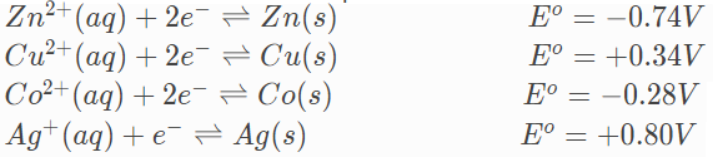
\def\arraystretch{1.5}\begin{array}{cc}Zn^{2+}(aq)+2e^-⇌Zn(s)&&E^o=-0.74V\\ Cu^{2+}(aq)+2e^-⇌Cu(s)&&E^o=+0.34V\\ Co^{2+}(aq)+2e^-⇌Co(s)&&E^o=-0.28V\\ Ag^+(aq)+e^-⇌Ag(s)&&E^o=+0.80V\end{array}
Z
n
2
+
(
a
q
)
+
2
e
−
⇌
Z
n
(
s
)
C
u
2
+
(
a
q
)
+
2
e
−
⇌
C
u
(
s
)
C
o
2
+
(
a
q
)
+
2
e
−
⇌
C
o
(
s
)
A
g
+
(
a
q
)
+
e
−
⇌
A
g
(
s
)
E
o
=
−
0.74
V
E
o
=
+
0.34
V
E
o
=
−
0.28
V
E
o
=
+
0.80
V
A concentration cell consists of two H
2
/H
+
half-cells. Half-cell A has H
2
at 0.90 atm bubbling into 0.10 M HCl. Half-cell B has H
2
atm bubbling into 2.0 M HCl. Which half-cell houses the anode? What is the voltage of this cell?
Use the data below to answer the question:
Z
n
2
+
(
a
q
)
+
2
e
−
⇌
Z
n
(
s
)
E
o
=
−
0.74
V
Zn^{2+}(aq)+2e^-⇌Zn(s)\ \ \ \ \ \ \ \ \ \ \ \ \ \ \ \ \ \ \ \ \ \ \ \ \ E^o=-0.74V
Z
n
2
+
(
a
q
)
+
2
e
−
⇌
Z
n
(
s
)
E
o
=
−
0.74
V
C
u
2
+
(
a
q
)
+
2
e
−
⇌
C
u
(
s
)
E
o
=
+
0.34
V
Cu^{2+}(aq)+2e^-⇌Cu(s)\ \ \ \ \ \ \ \ \ \ \ \ \ \ \ \ \ \ \ \ \ \ \ \ \ E^o=+0.34V
C
u
2
+
(
a
q
)
+
2
e
−
⇌
C
u
(
s
)
E
o
=
+
0.34
V