Wize High School Grade 10 Math Textbook > Systems of Linear Equations
Solving by Elimination (Part 2)
Popular Courses
Grade 10 Math
Canada High School
Algebra I
US High School
DAT
General Course
Grade 10 Principles of Mathematics
Ontario High School
Math 10C
Alberta High School
MATH 206
Concordia University
SC/MATH 1506 3.00
York University
ADM 1305
University of Ottawa
Foundations of Math and Pre-Calculus 10
British Columbia High School
QMS 110
Toronto Metropolitan University
Grade 10 Foundations of Mathematics
Ontario High School
MATH-1980
University of Windsor
MATH 1314
Tarrant County College District
MAT 211
Arizona State University - Tempe
MATH 1148
Ohio State University
MTH 116
Michigan State University
MATH 1302
University of Texas at Arlington
0:00 / 0:00
Solving by Multiplication before Elimination
Simple elimination works very well when the or variables have the same number values in both equations or if they are opposites (negative) of one another.
What if the numbers in front of the variables are different?
In this case, we have to first multiply one or both equations by a number to end up with the same or opposite numbers in front of one of our variables, then we can use simple elimination again.
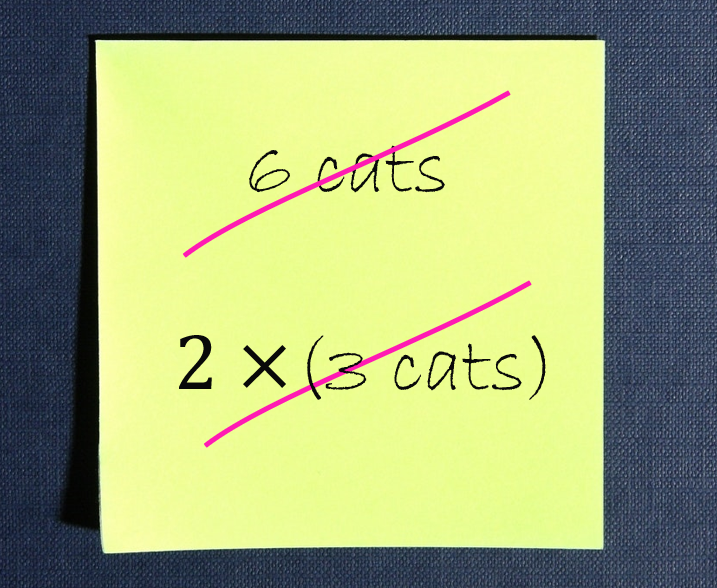
Wize Tip
We're trying to find the lowest common multiple between the two numbers in front of one of the variables -- it's kind of like finding a common denominator!
Here are the basic steps:
- Multiply one or both equations to end up with the same or opposite numbers in front of one of the variables. ⭐ Tip that always works⭐ Pick one variable then "cross-multiply" the entire equations by the numbers in front of this variable
- Add or subtract the equations and simplify
- Solve for the remaining variable
- Use this answer to go back and solve for the other variable
It sounds more complicated than it is! Let's take a look at an example.
Example
Solve these simultaneous equations:
Step 1: Pick a variable and "cross-multiply"
Let's pick variable (if you picked , you would end up with the same answer)
We can cross multiply these so we end up with in each equation once we multiply.
Simplify:
Step 2: Add or subtract the equations
Since we have in both equations, let's subtract the equations to eliminate :
So we get .
Step 3: Solve for the remaining variable
Step 4: Go back and solve for the other variable
Using to solve for in (you will get the same answer if you used equation )
Therefore, the answer is .
Optional
You can always check your answer by putting the value for and back into both equations to see if they "fit" both equations.
0:00 / 0:00
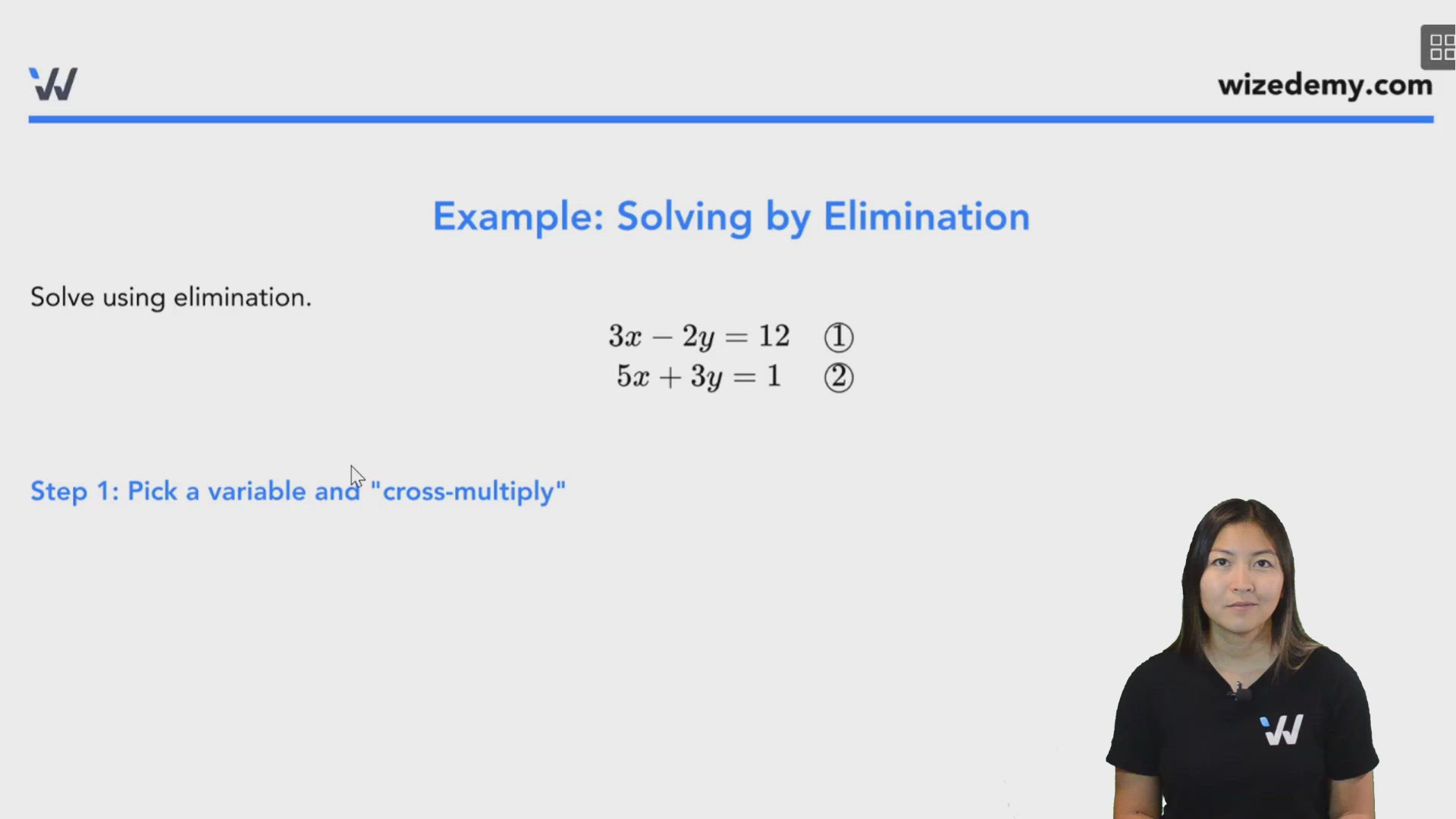
Example: Solving by Elimination
Solve using elimination.
Step 1: Pick a variable and "cross-multiply"
Let's pick variable (if you picked , your calculations may look a bit different, but you would end up with the same answer)
We can cross multiply these so we end up with in each equation once we multiply.
Simplify:
Step 2: Add or subtract the equations
Since we have in both equations, let's subtract the equations to eliminate :
So we get .
Step 3: Solve for the remaining variable
Step 4: Go back and solve for the other variable
Using to solve for in (you will get the same answer if you used equation )
Therefore, the answer is .
Optional
You can always check your answer by putting the value for and back into both equations to see if they "fit" both equations.
0:00 / 0:00
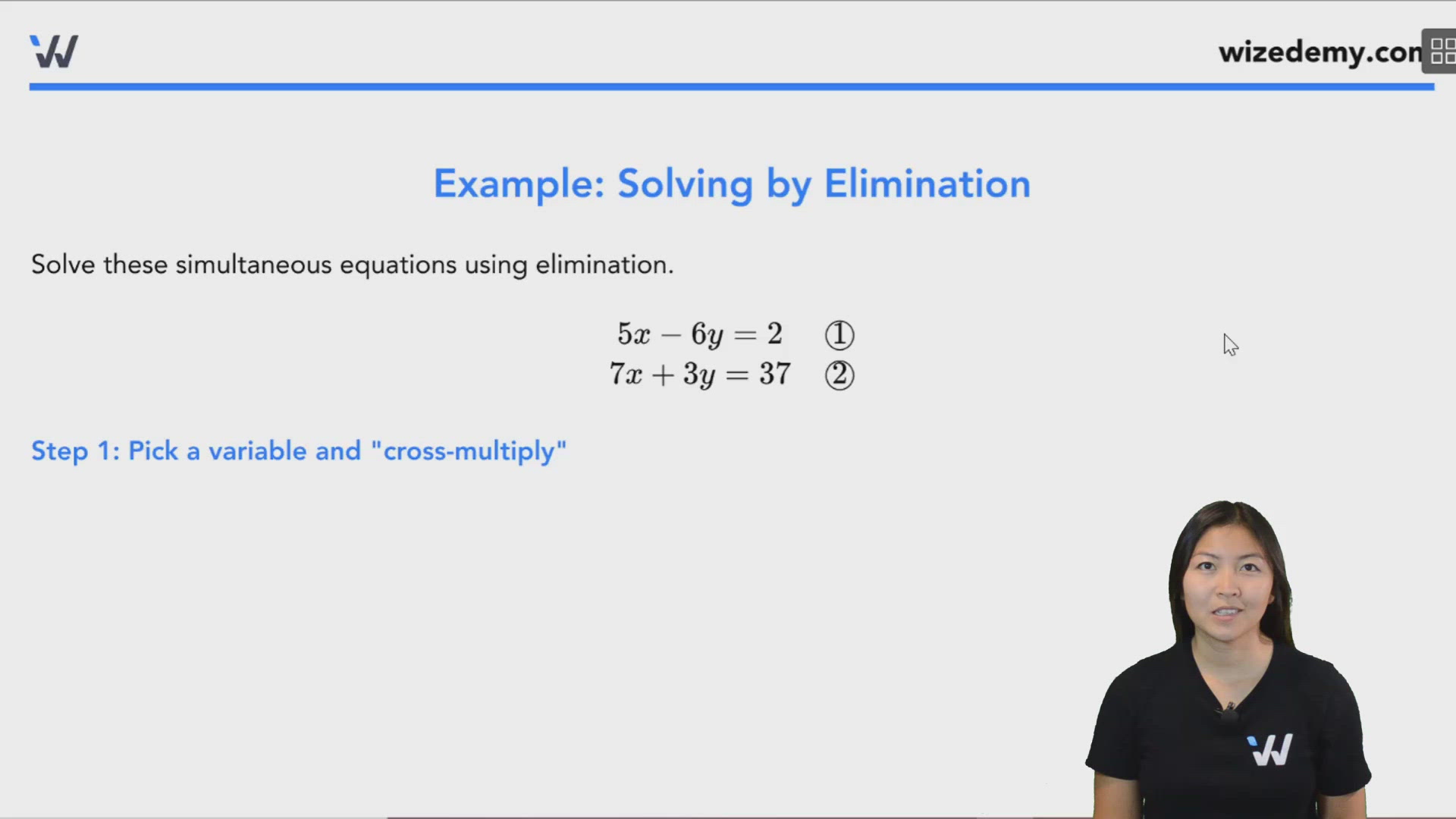
Example: Solving by Elimination
Solve these simultaneous equations using elimination.
Step 1: Pick a variable and "cross-multiply"
Our "cross-multiplying" trick still works for this question, but there's actually a slightly faster method for this question.
If we look at the variables (ignore the + or - sign for now), notice that we have in equation and in equation . So if double equation , we'll be able to eliminate the variable!
Simplify:
Now we see that we can add the two equations to eliminate the 's in both equations.
Step 2: Add or subtract the equations
Let's add the equations to eliminate :
So we get .
Step 3: Solve for the remaining variable
Step 4: Go back and solve for the other variable
Using to solve for in (you will get the same answer if you used equation )
Therefore, the answer is .
Optional
You can always check your answer by putting the value for and back into both equations to see if they "fit" both equations.
Practice: Solving by Elimination
Solve this system of linear equations using elimination.
Practice: Solving by Multiplication before Elimination
Solve these simultaneous equations using elimination.
Practice: Solving by Elimination
A high school sports committee is selling raffle tickets at a football game to raise money for a local charity. They decide to sell two types of tickets -- adults and students. The adult tickets are priced at $7 each and the student tickets are priced at $5 each. If the sports committee sold 275 tickets in total and raised $1615, how much of each type of raffle ticket did they sell?