Wize University Linear Algebra Textbook > Systems of Linear Equations (SLEs) (Linear Systems)
Reducing a Matrix (Gauss-Jordan Elimination)
Popular Courses
MATH 211
University of Calgary
MATH 1229A/B
Western University
Algebra II
US High School
Linear Algebra
University Study Guides
MATH 1ZC3
McMaster University
MATH 152
University of British Columbia
MATH 1600A/B
Western University
Linear Algebra
General Course
MAT188H1
University of Toronto
Linear Algebra
University Study Guides
SC/MATH 1506 3.00
York University
APSC 174
Queen's University
MATH 151
University of Victoria
MATH 102
University of Alberta
MATH 115
University of Waterloo
MAT133Y1
University of Toronto
MATH 1B03
McMaster University
ADM 1305
University of Ottawa
MAT223H1
University of Toronto
MATH 123
McGill University

0:00 / 0:00
Reducing a Matrix
Elementary Row Operations (EROs)
There are three elementary row operations:
1. Swap any two rows:
Example
: replace Row 1 with Row 2, and vice-versa, in the matrix .
2. Multiply any row by a non-zero constant :
Example
: multiply every entry in Row 1 by in the matrix .
3. Add or subtract any multiple of one row to any other row:
Example
: Take Row 2 and subtract 4 times the entries of Row 1 in the matrix .
Wize Concept
Performing EROs on an augmented matrix preserves solutions.
We say that the new augmented matrix represents an equivalent system.
Reducing a Matrix (Matrix Reduction)
Goal: Use the process of Gauss-Jordan Elimination to turn a matrix into RREF using EROs! (There are many ways.)
Exam Tip
This is one of the most important concepts of the entire course!
There will be many questions and concepts that use this procedure.
Gauss-Jordan Elimination
- At any point if you see a zero row, move it to the bottom of the matrix
- Swap rows as necessary to get a leading coefficient as near as possible to the top left
- Use EROs on this row to get a leading 1 (divide by the leading coefficient or add/subtract other rows)
- Use this leading 1 to make all other entries in that column 0 (adding/subtracting multiples of this row)
- Repeat until the matrix is in RREF
Wize Tip
Avoid getting fractions whenever possible for simpler calculations.
0:00 / 0:00
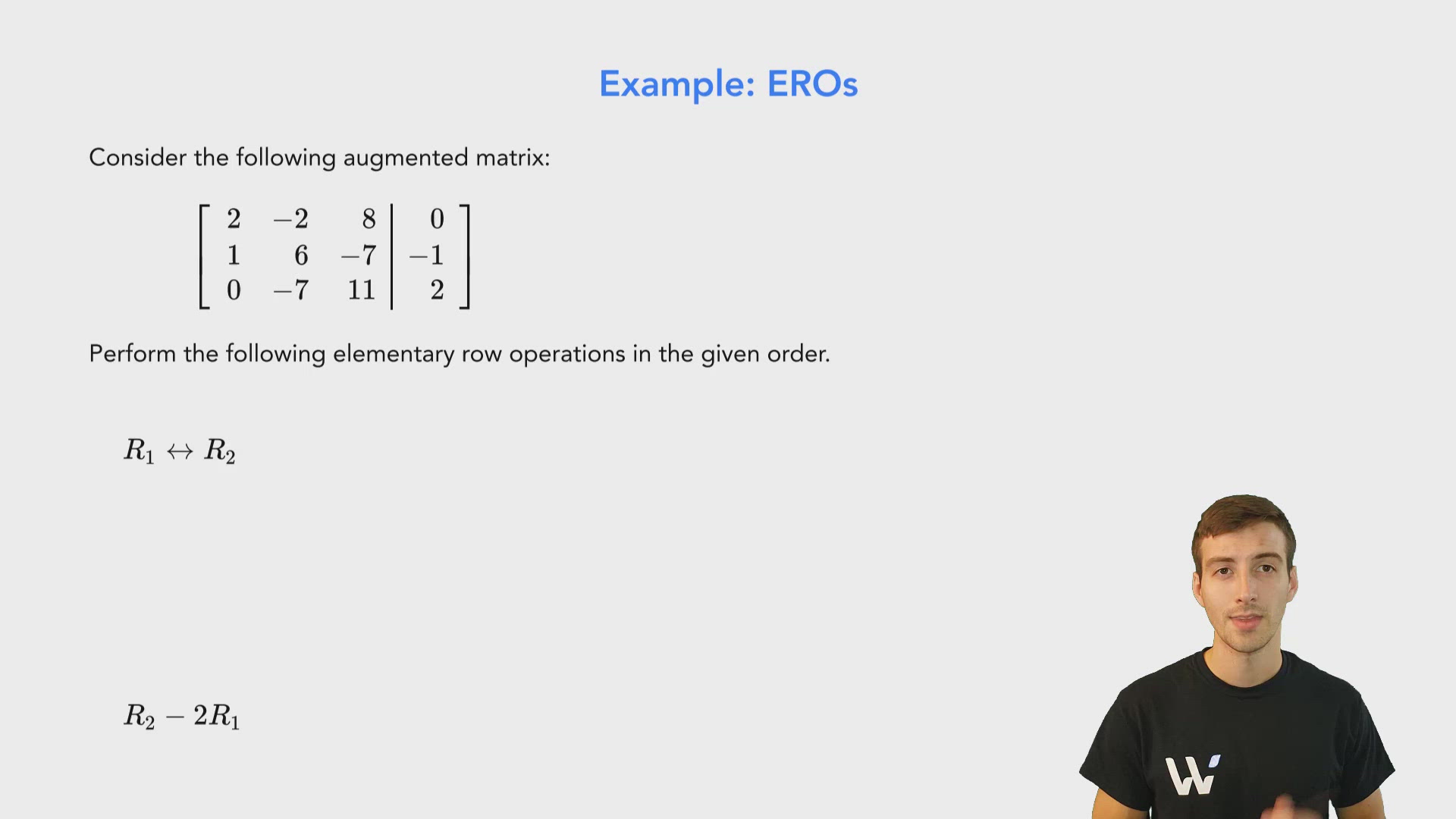
Example: EROs
Consider the following augmented matrix:
Perform the following elementary row operations in the given order.
Is the resulting matrix in REF, RREF, or neither?
The matrix is in REF.
0:00 / 0:00
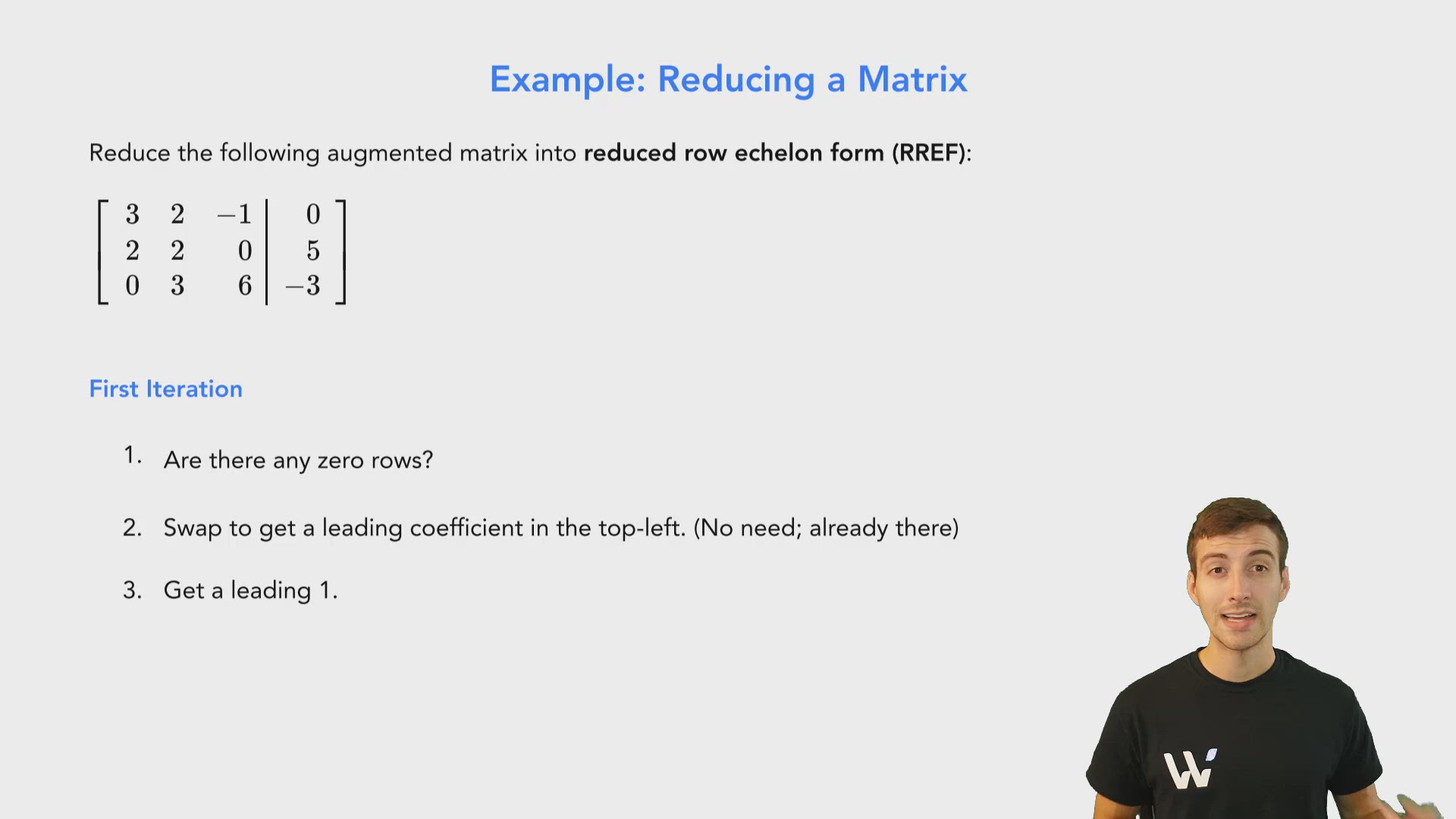
Example: Reducing a Matrix
Reduce the following augmented matrix into reduced row echelon form (RREF):
First Iteration
- Are there any zero rows?No
- Swap to get a leading coefficient in the top-left. (No need; already there)
- Get a leading 1.
We could do , but this will introduce fractions.
Instead, let's change Row 1 by doing .
- Use this new leading 1 to make all other entries in the first column 0.
We want to cancel the below our first leading 1. We can do this with .
- Repeat: move on to the next staircase position row2, column2
Second Iteration
- Are there any zero rows?No
- Swap to get a leading coefficient in row 2, column 2.
Thinking ahead, let's swap Row 2 and Row 3 since we can easily divide Row 3 to get a leading 1.
- Get a leading 1.
- Use this new leading 1 to make all other entries in the second column 0.
- Repeat: move on to the next staircase position row3, column3
Third Iteration
- Are there any zero rows?No
- Swap to get a leading coefficient in row 3, column 3. (No need; already there)
- Get a leading 1.
Now we have no choice but to create fractions.
- Use this new leading 1 to make all other entries in the third column 0.
This is now in RREF.
Perform the indicated elementary row operations, in the given order, on the following augmented matrix:
Fill in the missing values of the resulting matrix.
| 0 | 0 | ||
| 0 | |||
| 0 | 0 |
Given the matrix,
find the first row of the RREF of this matrix.
Practice: Reducing a Matrix
Find the reduced row echelon form (RREF) of the matrix:
| 0 | ||
| 0 | 0 |
Extra Practice
Gauss-Jordan Elimination $\tkct{LAT}$
This activity is just here as a convenient reminder / link for the Linear Algebra Toolkit. The solution illustrate a few points about how to use it; however, the actual details of row-reduction should be addressed in the context of the original chapter :)
Use Gauss-Jordan Elimination to find the RREF of the matrix .