0:00 / 0:00

Matrix Multiplication

To multiply two matrices, their dimensions must be compatible.

The product ABAB exists only if the number of columns in matrix AA is equal to the number of rows in matrix BB.

If matrix AA is of size m×p\colorOne{m}\times \bm{\colorTwo{p}}, and matrix BB is of size p×n\bm{\colorTwo{p}} \times \colorThree{n}, the product ABAB will be of size: m×n\colorOne{m} \times \colorThree{n}
Am×p Bp×n=(AB)m×nA_{\colorOne{m} \times \bm{\colorTwo{p}}} \ B_{\bm{\colorTwo{p}} \times \colorThree{n}} = (AB)_{\colorOne{m} \times \colorThree{n}}

Wize Tip
Think of the "inner dimensions" as matching and cancelling.
If they don't match, the matrices cannot be multiplied (incompatible)!

PAGE BREAK

Multiplying Matrices

The (i,j)(i,j)-entry of the product ABAB is the dot product of row ii of matrix AA with column jj of matrix BB:
[AB]ij=[ai1ai2aip][b1jb2jbpj]=ai1b1j+ai2b2j++aipbpj[AB]_{ij}= \left[ \begin{array}{cccc} a_{i1} & a_{i2} & \cdots & a_{ip} \end{array} \right] \left[ \begin{array}{c} b_{1j} \\[0.2em] b_{2j} \\[0.2em] \vdots \\[0.2em] b_{pj} \end{array} \right] = a_{i1}b_{1j} + a_{i2}b_{2j}+\cdots+a_{ip}b_{pj}

Example
Consider the rows of the first matrix and the columns of the second matrix.
Take the dot product of each of these pairs of rows and columns:

[124503][3152]=[1(3)+2(5)1(1)+2(2)4(3)+5(5)4(1)+5(2)0(3)+3(5)0(1)+3(2)]=[133376156]\left[\begin{array}{rr} \colorThree{1} & \colorThree{2}\\[0.5em] {4} & {5}\\[0.5em] \colorFive{0} & \colorFive{3} \end{array}\right] \left[\begin{array}{rr} \colorTwo{3} & \colorOne{-1}\\[0.5em] \colorTwo{5} & \colorOne{2} \end{array} \right] = \left[\begin{array}{rr} \colorThree{1}\colorTwo{(3)} + \colorThree{2}\colorTwo{(5)} & \quad \colorThree{1}\colorOne{(-1)} + \colorThree{2}\colorOne{(2)}\\[0.5em] {4}\colorTwo{(3)} + {5}\colorTwo{(5)} & \quad {4}\colorOne{(-1)} + {5}\colorOne{(2)}\\[0.5em] \colorFive{0}\colorTwo{(3)} + \colorFive{3}\colorTwo{(5)} & \quad \colorFive{0}\colorOne{(-1)} + \colorFive{3}\colorOne{(2)}\\ \end{array}\right] = \left[ \begin{array}{rrr} 13 & 3\\[0.5em] 37 & 6\\[0.5em] 15 & 6\\ \end{array} \right]


PAGE BREAK

Properties of Matrix Multiplication

Watch Out!
In general: ABBAAB\neq BA
The order in which we write the matrices matters!
  • A(B+C)=AB+ACA(B+C)=AB+AC
  • (A+B)C=AC+BC(A+B)C=AC+BC
  • A(BC)=(AB)CA(BC)=(AB)C
  • AI=IA=AAI = IA = A
Note: If AB=0AB=0, it does not necessarily mean that AA or BB is the zero matrix!
PAGE BREAK

Matrix Powers

Just like with real numbers, we can multiply a square matrix by itself, raising it to the power of some integer kk.
Ak=AAAk timesA^k = \underbrace{AA\cdots A}_{k\text{ times}}

Properties

  • A0=IA^0=I
  • (cA)k=ckAk(cA)^k=c^kA^k
Watch Out!
(AB)kAkBk(AB)^k \textcolor{red}{\neq}A^kB^k

Since matrix multiplication is not commutative, powers do not distribute over matrix multiplication:
(AB)k=(AB)(AB)(AB)k times(AB)^k = \underbrace{(AB)(AB)\cdots(AB)}_{k\text{ times}}


0:00 / 0:00

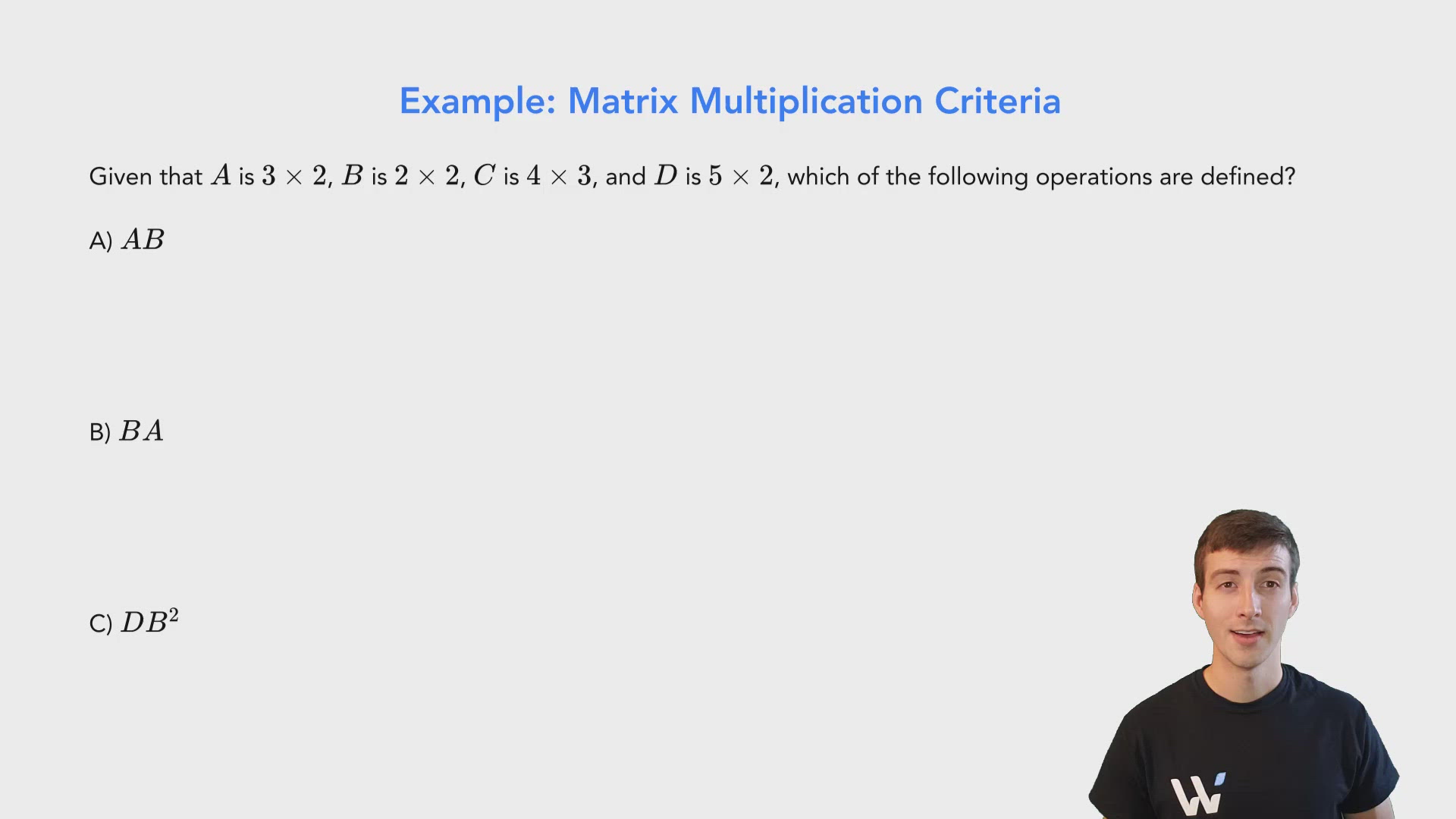
Example: Matrix Multiplication Criteria

Given that AA is 3×23\times2, BB is 2×22\times2, CC is 4×34\times3, and DD is 5×25\times2, which of the following operations are defined?
A) ABAB
Well-defined. The result is a matrix of size (3×2)A(2×2)B=3×2\overbrace{(3\times \cancel2)}^A \overbrace{(\cancel2\times 2)}^B = 3\times 2 .
B) BABA
Not defined since the inner dimensions do not match: (2×2)A(3×2)B\overbrace{(2\times \colorTwo{2})}^A \overbrace{(\colorTwo{3}\times 2)}^B .
C) DB2DB^2
Well-defined. The result is a matrix of size (5×2)D(2×2)B(2×2)B=5×2\overbrace{(5\times \cancel{\colorThree{2}})}^D \overbrace{(\cancel{\colorThree{2}} \times \cancel{\colorOne{2}})}^B \overbrace{(\cancel{\colorOne{2}} \times 2)}^B = 5\times 2.
0:00 / 0:00

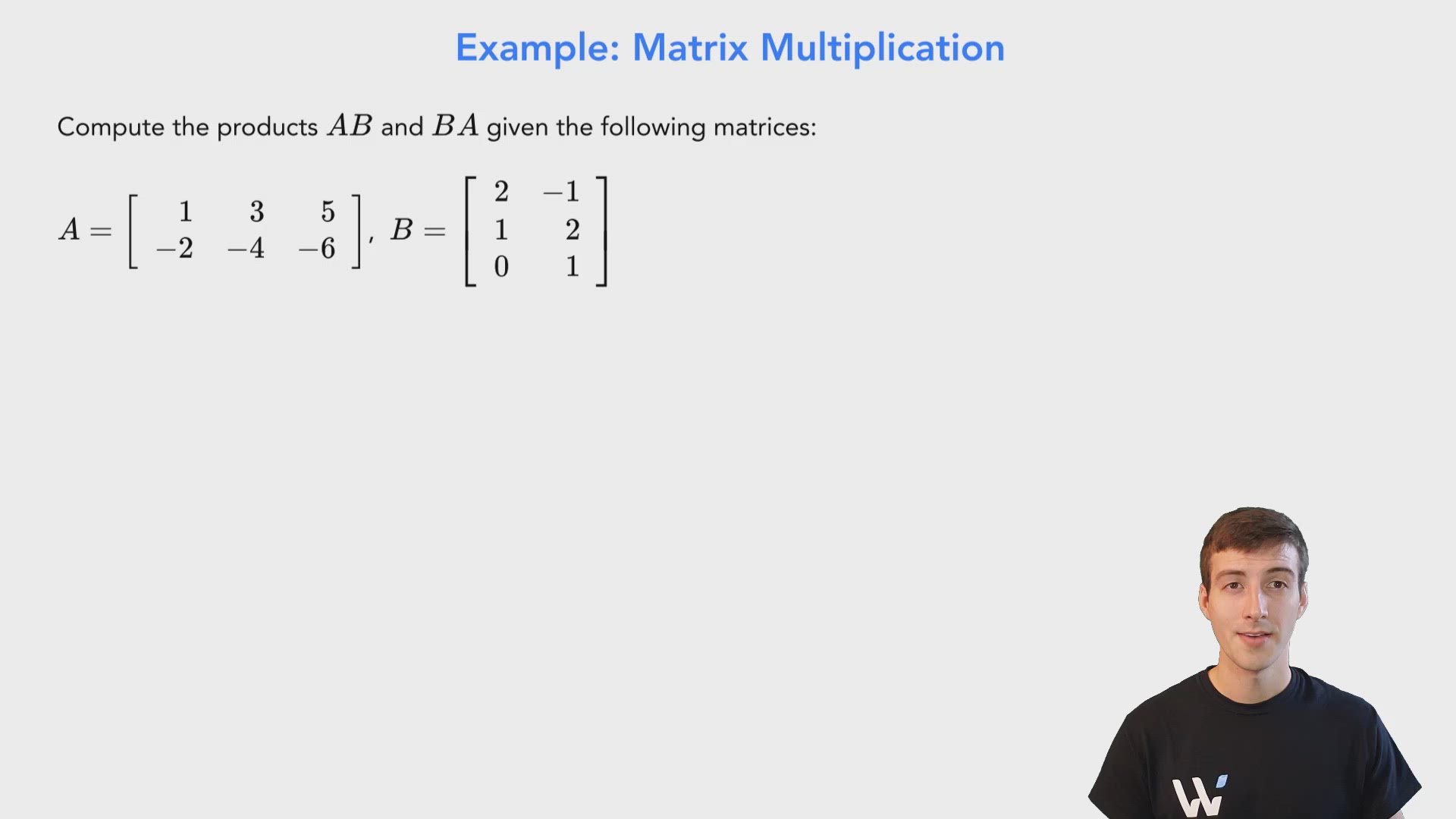
Example: Matrix Multiplication

Compute the products ABAB and BABA given the following matrices:
A=[135246]A=\left[\begin{array}{rrr}1&3&5\\-2&-4&-6\end{array}\right], B=[211201]B=\left[\begin{array}{rr}2 & -1\\1&2\\0&1\end{array}\right]
Note that AA is 2×32\times 3 and BB is 3×23\times 2, so the product ABAB is well-defined and is of size (2×3)A(3×2)B=2×2\overbrace{(2\times \cancel3)}^A \overbrace{(\cancel3\times 2)}^B = 2\times 2.
AB=[135246][211201]=[1(2)+3(1)+5(0)1(1)+3(2)+5(1)2(2)4(1)6(0)2(1)4(2)6(1)]=[510812]\begin{array}{rcl} AB&=&\left[\begin{array}{rrr}1&3&5\\-2&-4&-6\end{array}\right]\left[\begin{array}{rr}2 & -1\\1&2\\0&1\end{array}\right]\\[2em] &=&\left[\begin{array}{cc} 1(2)+3(1)+5(0) & 1(-1)+3(2)+5(1)\\[0.5em] -2(2)-4(1)-6(0)&-2(-1)-4(2)-6(1) \end{array}\right]\\[2em] &=&\left[\begin{array}{rr} 5 & 10\\ -8&-12 \end{array}\right]\\[2em] \end{array}
The product BABA is also well-defined, and will be of size (3×2)B(2×3)A=3×3\overbrace{(3\times \cancel2)}^B \overbrace{(\cancel2\times 3)}^A = 3\times 3.
BA=[211201][135246]=[2(1)1(2)2(3)1(4)2(5)1(6)1(1)+2(2)1(3)+2(4)1(5)+2(6)0(1)+1(2)0(3)+1(4)0(5)+1(6)]=[41016357246]\begin{array}{rcl} BA&=&\left[\begin{array}{rr}2 & -1\\1&2\\0&1\end{array}\right]\left[\begin{array}{rrr}1&3&5\\-2&-4&-6\end{array}\right]\\[2.5em] &=& \left[\begin{array}{cc} 2(1)-1(-2) & \quad2(3)-1(-4) & \quad2(5)-1(-6)\\[0.5em] 1(1)+2(-2) & \quad1(3)+2(-4) & \quad1(5)+2(-6)\\[0.5em] 0(1)+1(-2) & \quad0(3)+1(-4) & \quad0(5)+1(-6)\\ \end{array}\right]\\[3em] &=&\left[\begin{array}{rr} 4 & 10 & 16\\[0.5em] -3 & -5 & -7\\[0.5em] -2 & -4 & -6 \end{array}\right]\\[2em] \end{array}

Practice: Matrix Multiplication

M=[6103],N=[1301]M=\left[ \begin{array}{rrrr} 6&-1&0&3\end{array} \right] ,\qquad N=\left[ \begin{array}{r} -1\\[0.5em] -3\\[0.5em] 0\\[0.5em] 1 \end{array} \right]
Compute MNMN.
Given the matrix A=[1011]A=\begin{bmatrix} 1&0\\1&1 \end{bmatrix}, find AnA^n for any integer n1n \ge 1.

Practice: Matrix Multiplication

A=[331220112],B=[213011003]A=\left[ \begin{array}{rrr} -3&3&1\\ -2&2&0\\ -1&1&2 \end{array} \right] ,\qquad B=\left[ \begin{array}{rrr} 2&-1&-3\\ 0&1&-1\\ 0&0&3 \end{array} \right]
Compute ABAB.