Wize University Statistics Textbook > Probability
Probability of Independent Events

0:00 / 0:00
Probability of Independent Events
Events A and B are independent if the occurrence of one does not affect the probability of the occurrence of other.
Watch Out!
If events are independent, does that mean they are disjoint or mutually exclusive? NO!
Why not? If you know that events are disjoint/mutually exclusive, which means they have no outcomes in common, then you also know that one occurred means the other didn't. Thus, the probability of one event occurring changed because other event occurred. This means the two events are not independent.
There are some common reasons why events are independent:
- The events are unrelated. Example Drawing a "three of hearts" from a deck of cards does not affect the probability of rolling a "three" on a die; it's still P("three") =
- The probabilities of each event occurring will not change. Example The probability of flipping "heads" with a fair coin is always and the probability of rolling a "three" on a die is always
- The probabilities of each event occurring do not change when you replace the item that was drawn. If you draw from a fixed number of items without replacement, then the events are not independent. Example
- Drawing a "three of hearts" from a deck of cards without replacement will affect the probability of drawing other cards, and therefore the events are not independent.
- Conversely, if you draw a "three of hearts" from a deck of cards with replacement (i.e. you put the card back and the deck still contains all 52 cards), it will not affect the probability of drawing other cards, and therefore the events are independent.
Multiplication Rule (Independent Events)
If Events A and B are independent, then multiplication rule says the probability of both events occurring is the product of the probabilities for each event:

Key words: "and"
Example
(0.3)(0.4) = 0.12
0:00 / 0:00
Example: Independent Events
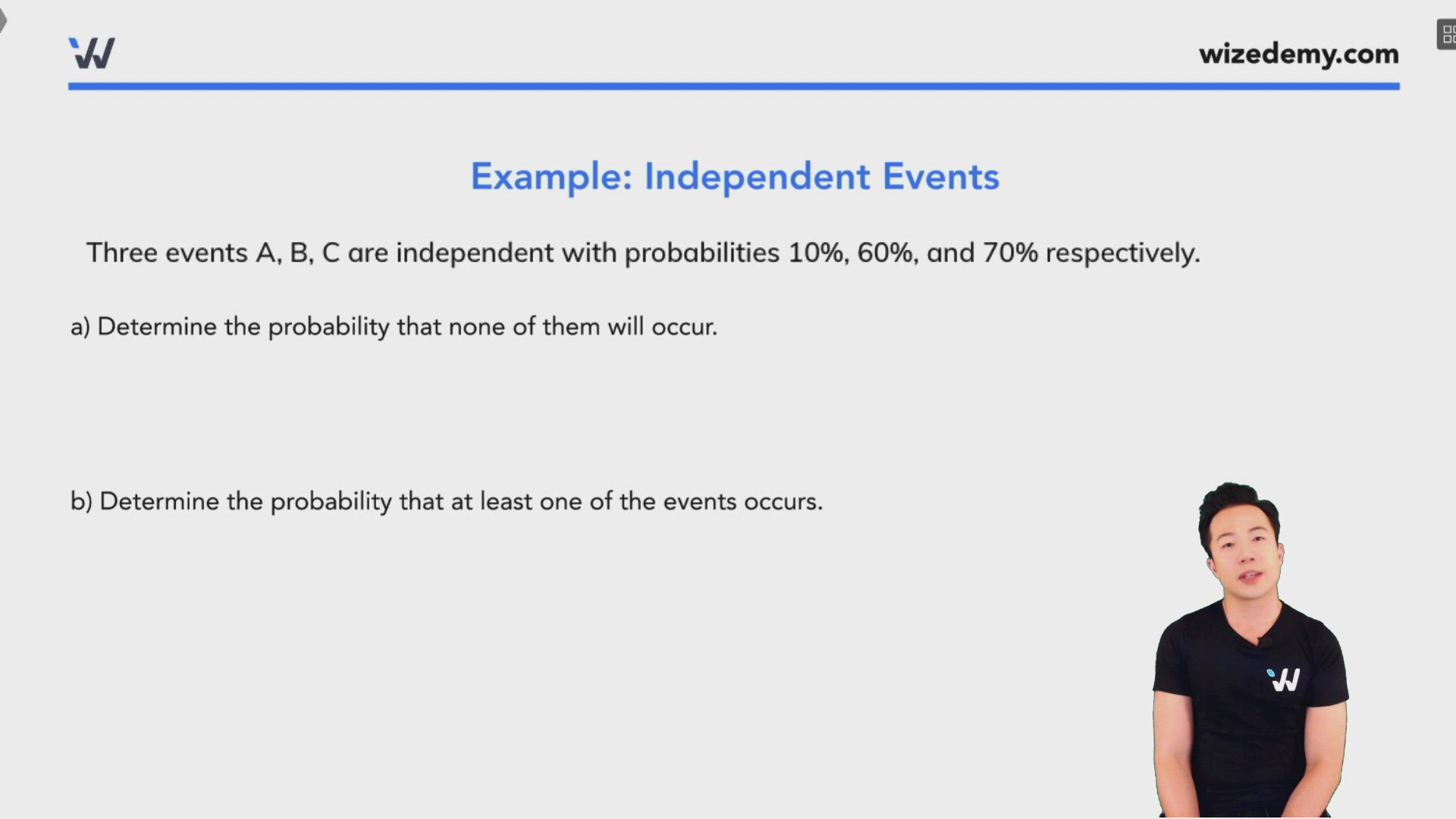
Three events A, B, C are independent, with respective probabilities 10%, 60%, and 70% of occurring.
a) Determine the probability that none of them will occur.
a) We can examine the probability of none of these events occurring by looking at the complement of each event, which is calculated by subtracting the probability of each event occurring from , and then using the multiplication principle:
b) Determine the probability that at least one of the events occurs.
b) We can determine this probability by recognizing that the outcome 'at least one occurs' is the complement of 'none occurring', which is the probability we calculated in the previous part of the question.
You roll two fair dice: Die #1 and Die #2. What is the probability of rolling the same number or the sum of the two die is 6?
