Wize High School Geometry Textbook (Common Core) > Circles
Measuring and Circles

0:00 / 0:00
Arcs and Circles

Vocabulary
The central angle of a circle is the angle whose vertex is the same as the center.
The points of the circle that end up inside of this central angle from a minor arc of a circle. The points on the exterior of this angle make a major arc of a circle. Many times we will just call these an arch of a circle.

Measuring
We can measure an arc by using degrees. Specifically the measure of an arc is the same as the central angle that forms the arc.
Watch Out!
The measure of an arc is different from the length of an arc. The length of an arc can be found using the following formula.
Here is the length of the arc, is the measure of the central angle in degrees, and is the radius of the circle.
We say that two arcs are similar if they have the same measure.
Properties
Two arcs in the same circle are congruent if and only if their central angles are congruent.
The measure of an arc formed from two smaller arcs is equal to the sum of the measures of the smaller arcs.
Specifically we have .

Example 1
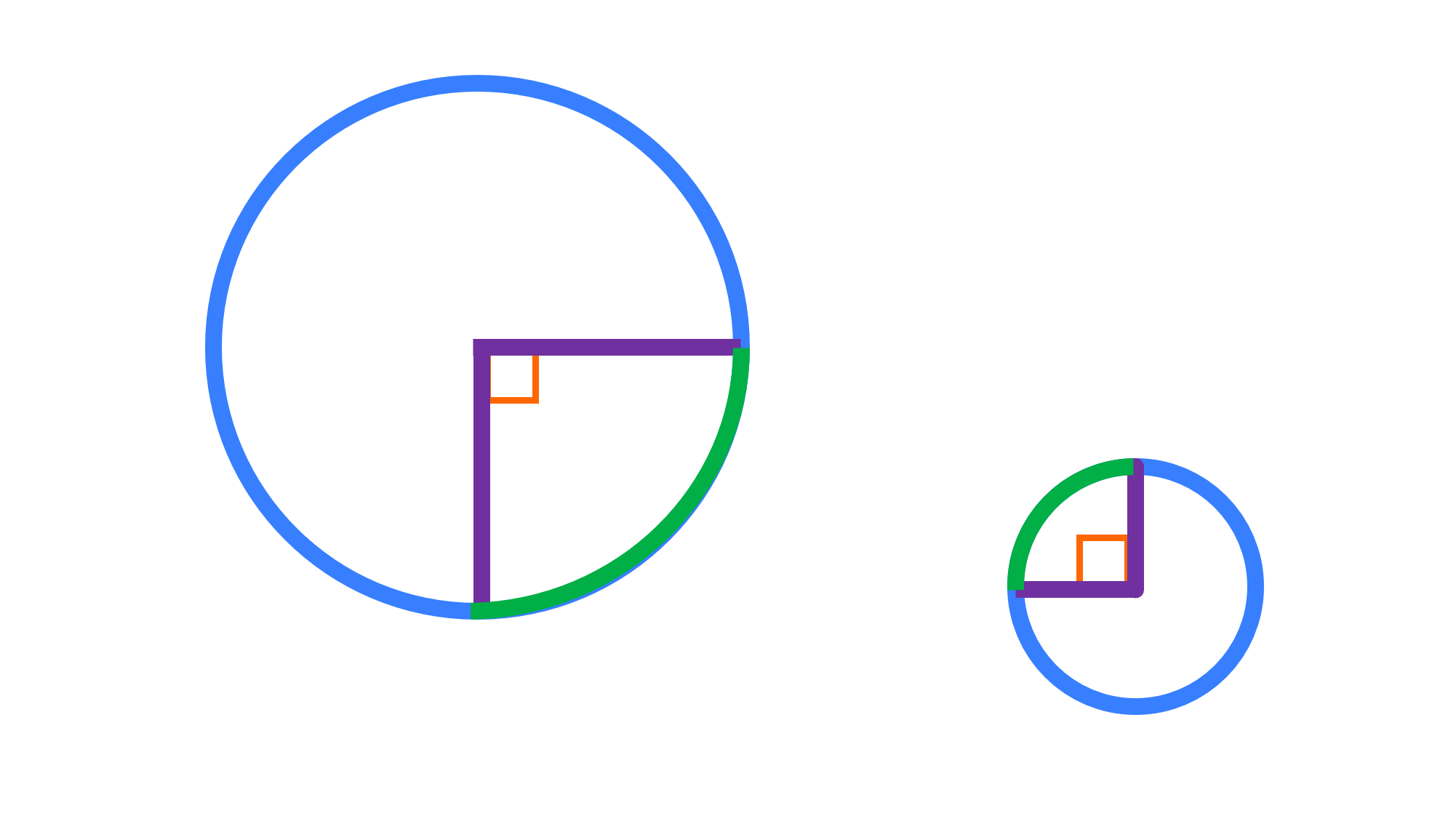
Draw two circles that contain a similar arc but are not congruent.
ANSWER:
To create two similar arcs we have to make sure that the central angle is the same. Since we don't want the arcs congruent, we will put them in circles with different radii. One possible sketch using right angles looks like this
Example 2
Find the sum of the two arcs

ANSWER:
From our properties we know that this will simply be the sum of the smaller arcs.
This gives us
0:00 / 0:00
Chords of Circles

The chords of a circle have some great properties as well, these are often related to the arcs related to the chords.
Wize Tip
Remember that a chord of a circle is a line segment that has its endpoints on the circle.
Vocabulary
We say that chords in the same circle are congruent if their corresponding arcs are congruent.
Properties
If a chord is perpendicular to the diameter of a circle, then the diameter will bisect the chord and its corresponding arc.
If one chord is the perpendicular bisector of a second cord, then it must be the diameter of the circle.

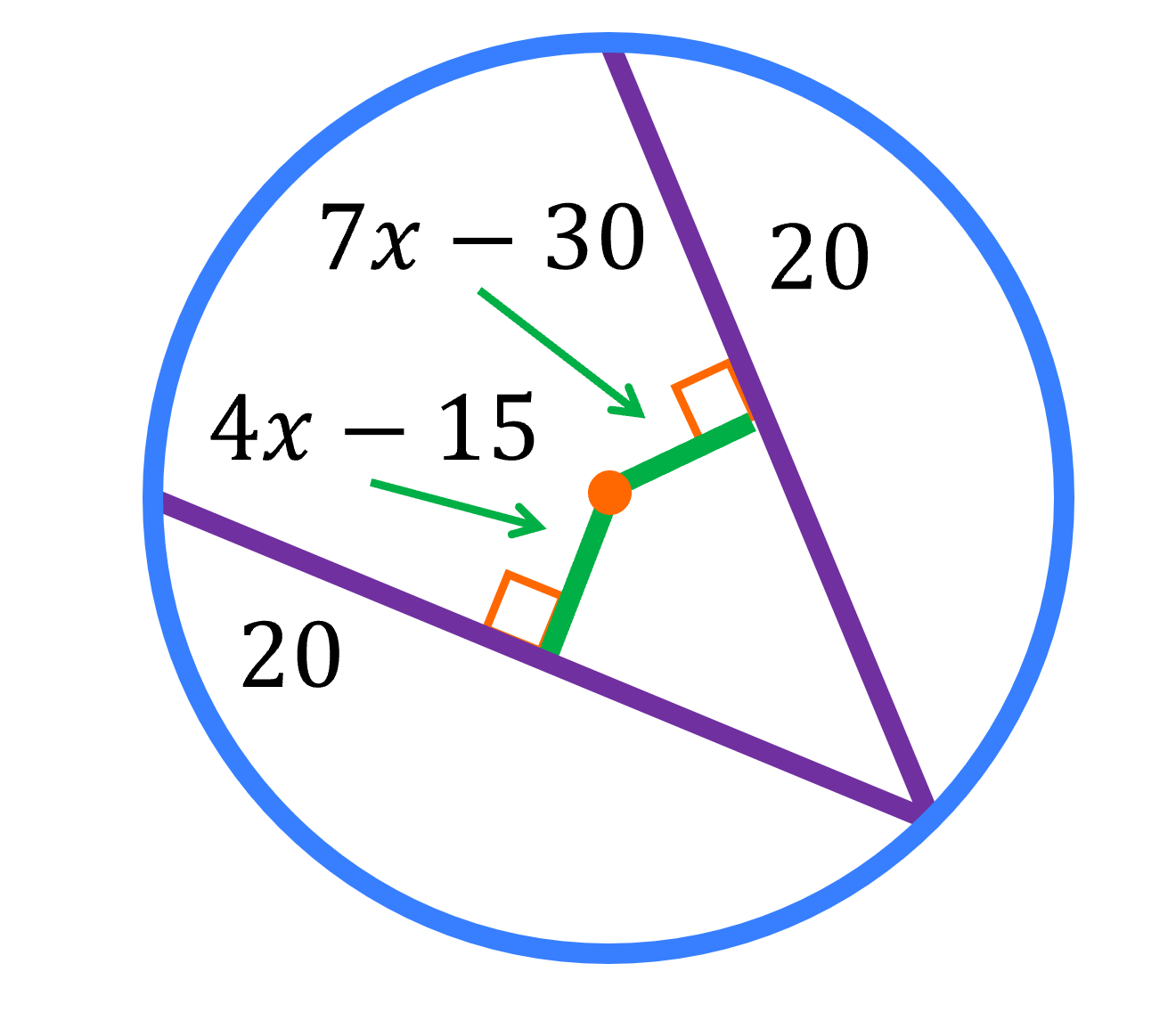
Two chords are congruent if they are the same distance from the center of a circle. Specifically we'll have that .

Example
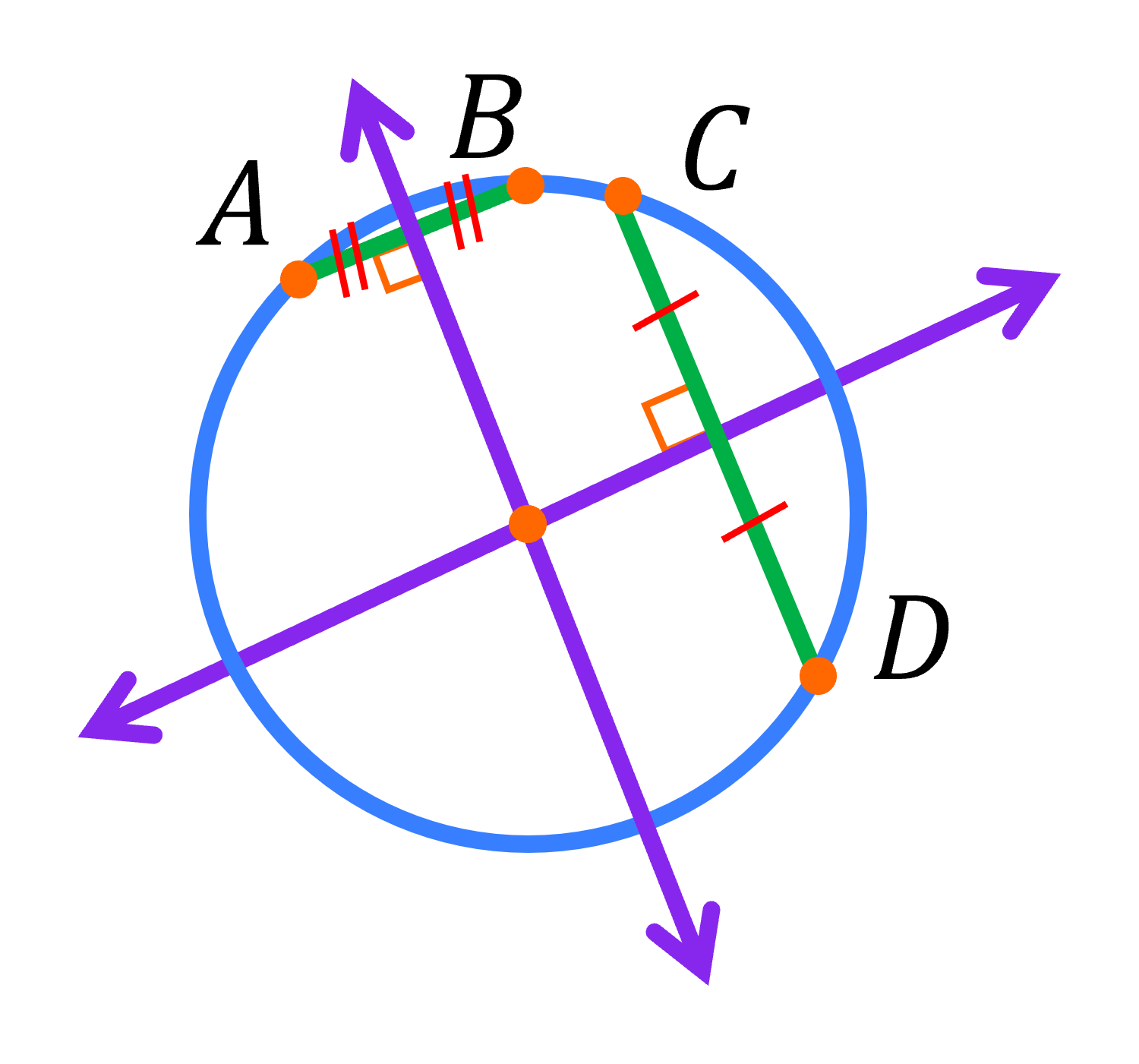
Find the center of a circle using the properties of chords.
ANSWER:
- We can start by making a cord to the circle.
- Then we can construct the perpendicular bisector of this cord, from our properties this will be the diameter of a circle.
- Repeat this process by making a different cord and its perpendicular bisector.
- Because a diameter goes through the center of a circle, we know that the intersection of these diameters must be the center of the circle.
0:00 / 0:00
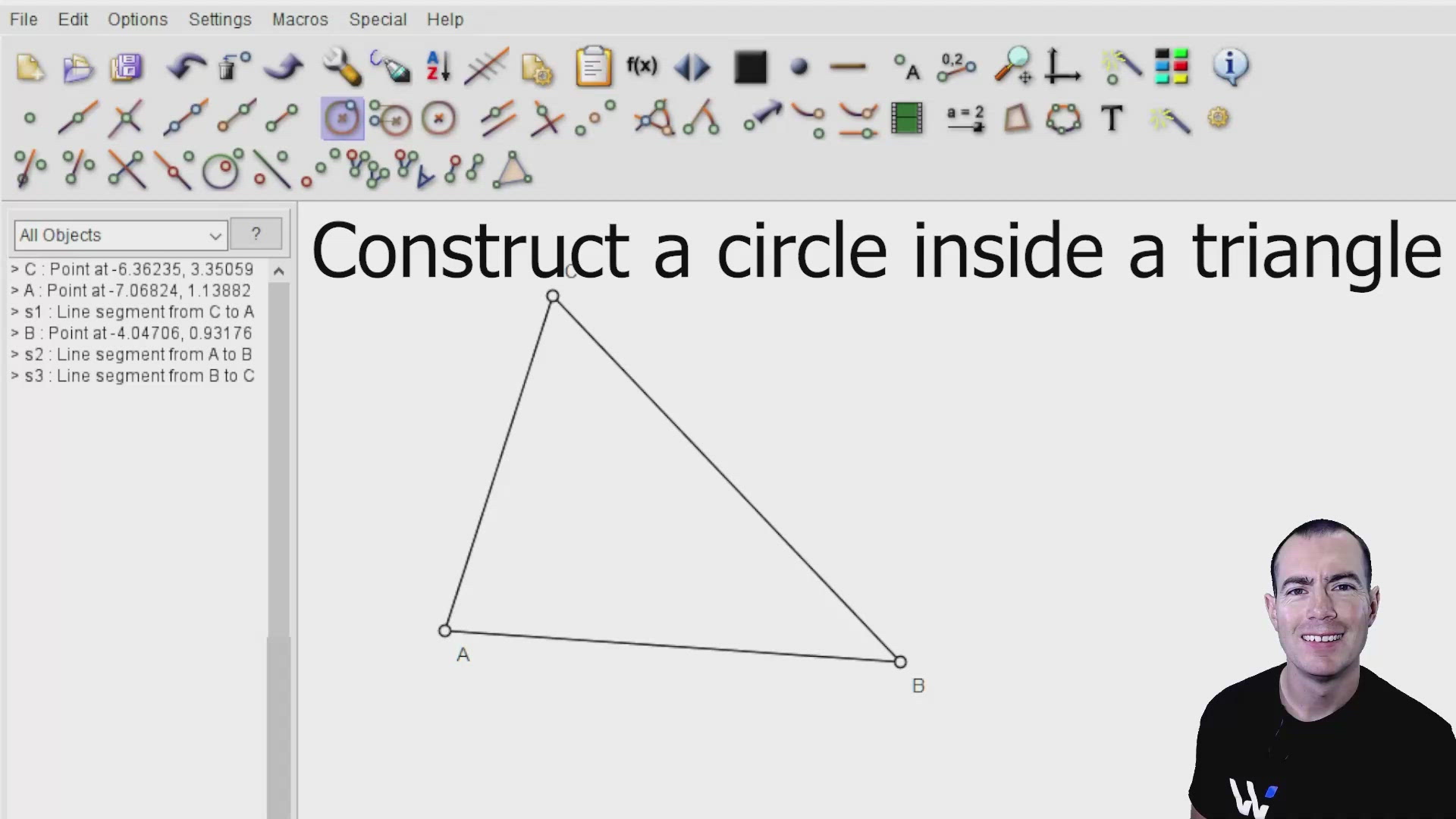
Construct a circle inside a triangle
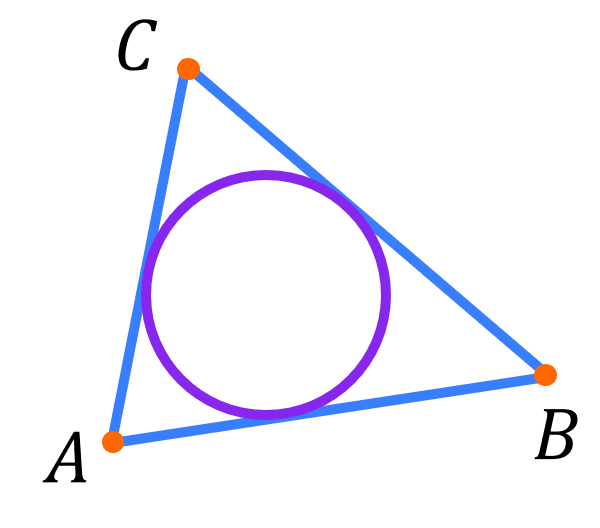
Our goal in this construction is to create a circle inside a given triangle. Each side of the triangle will touch the triangle exactly once.
Using Technology
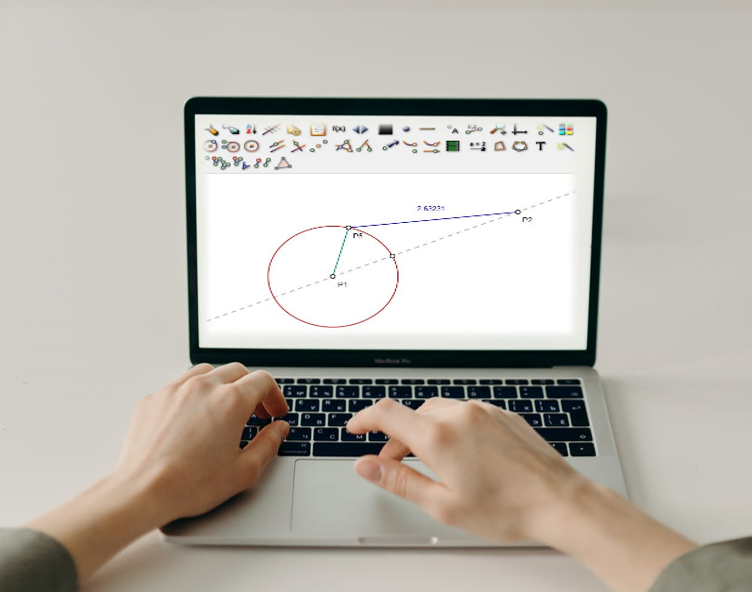
Begin with triangle
- Construct an angle bisector for angle .
- Construct an angle bisector for angle . Label the intersection of these bisectors as point .
- Construct a perpendicular line to side , and through the point Label the intersection of the side and the line as point .
- Use the compass tool to draw a circle with radius , centered at .
From this we now have a circle inside of triangle .
0:00 / 0:00
Arcs and Chords of Circles
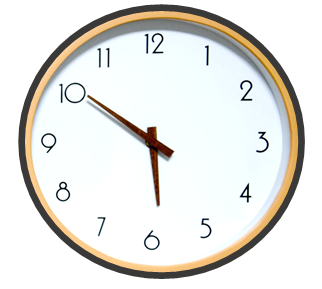
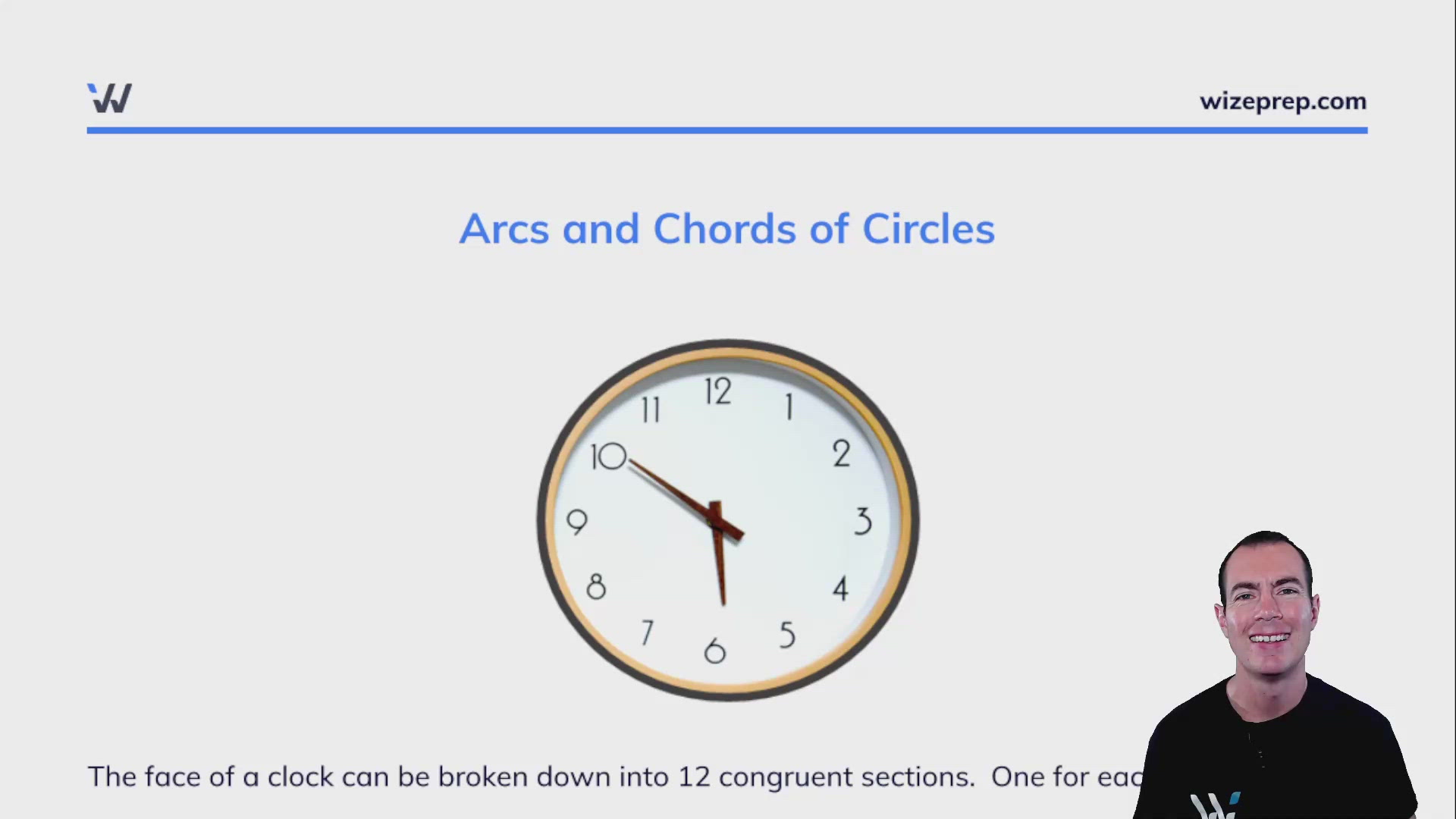
The face of a clock can be broken down into 12 congruent sections. One for each hour segment.
A) What is the measure of the arc that goes from 1 to 3?
ANSWER:
The total for all of the arcs will equal 360 degrees. So we want to take this and divide it by 12 to get the measure of a single arc.
Now the arc that goes from 1 to 3 is made up of two arcs, so we can multiply our answer by 2.
So the measure of the arc is 60 degrees.
B) If the time reads as 11 o'clock, what is the measure of the major arc between the hour and the minute hand?
ANSWER:
During this time the minute hand should be at the 12 position and the hour hand at the 11 position. This gives us a minor arc of from our previous work. Since we want the major arc we can subtract this from 360.
So the measure of the major arc is 330 degrees.
C) A crack forms along the face of the clock, forming a chord from the 4 to the 6 position.
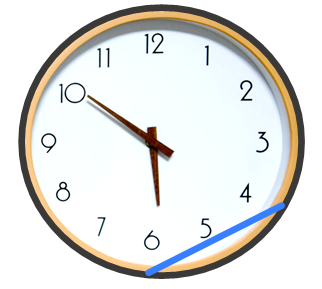
Will the minute hand ever be perpendicular to this cord?
ANSWER:
Yes, from our properties of chords and circles we know that a diameter will be perpendicular to a chord. The minute hand is half of this diameter. Its a radius, so it will also be perpendicular to this chord at some point.
Specifically it will be perpendicular when it bisects the chord. This will happen when it is facing the 5 position.
Practice with Circles

The brake pad of a car's wheel forms a chord with the rotor disc.
If the arc formed from the brake pad is , what is the value of the central angle associated with it?
Algebra and Circles
Use the diagram to answer the following questions

A) What is the value of x?
B) What is the value of the arc marked out in pink?
Algebra and Circles
Use what you know about circles and chords to find the value of x in the diagram.