Wize High School Geometry Textbook (Common Core) > Circles
Angles and Segments in Circles
0:00 / 0:00
Angles and Circles

So far we've seen inscribed angles, but there are other angles we can form with a circle, especially if we include things like tangent lines. These also have some great properties associated with them.
Angles
If a tangent line and chord intersect the circle at the same point of a circle, then the measure of each angle is exactly one-half the measure of its intercepted arc.

When two chords intersect inside of a circle, the measure of each angle is exactly one-half the sum of the measures of the arcs intercepted by the angle and its vertical angle.

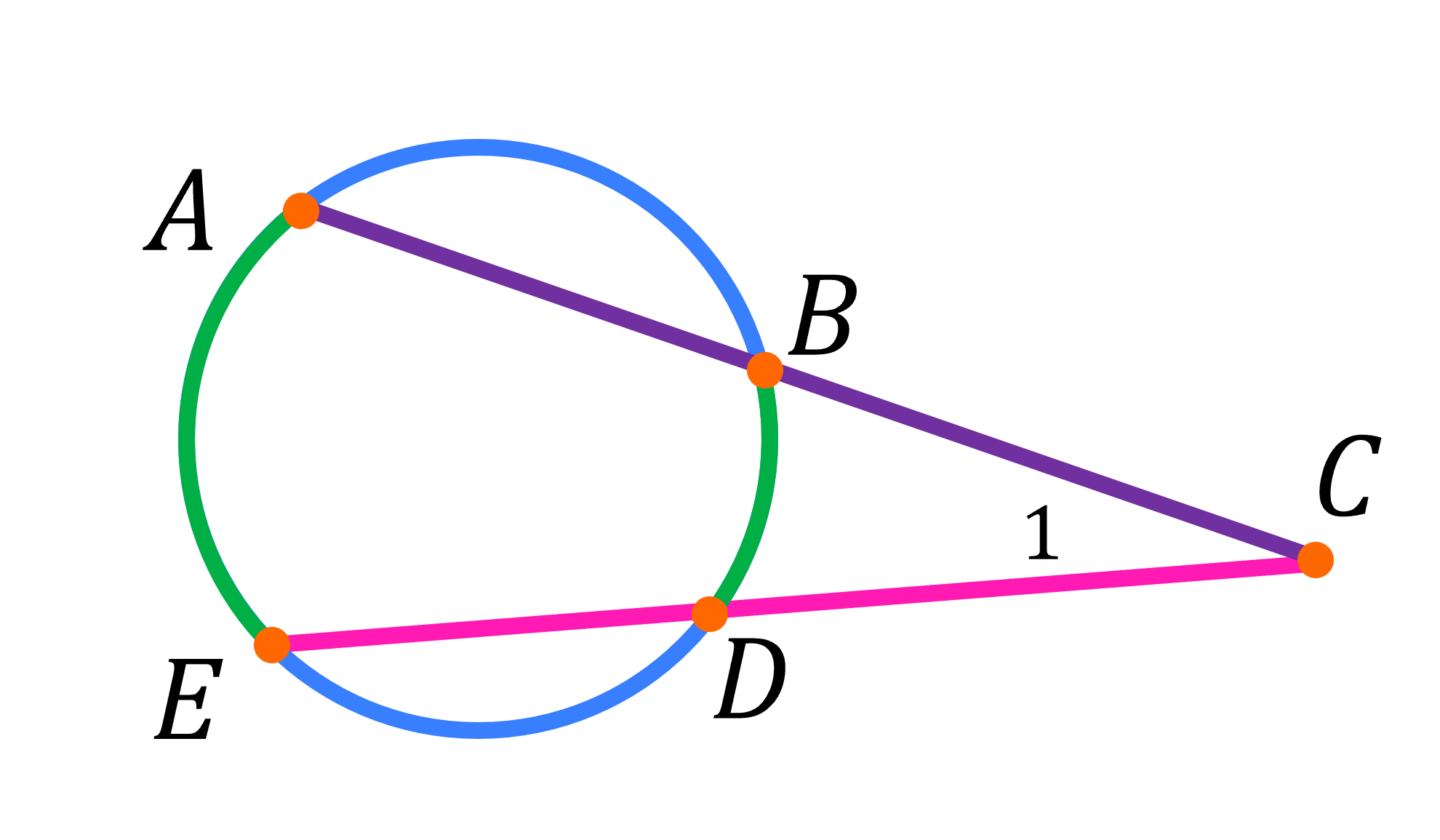
When an angle intersects a circle, with its vertex outside of the circle, then the measure of the angle is one-half the difference of the measures of the intercepted arcs.
Circumscribed Angles
We say an angle is circumscribed if its sides are both tangent to the circle.
The measure of a circumscribed angle is equal to 180 minus the measure of the central angle that intercepts the same arc.

Example
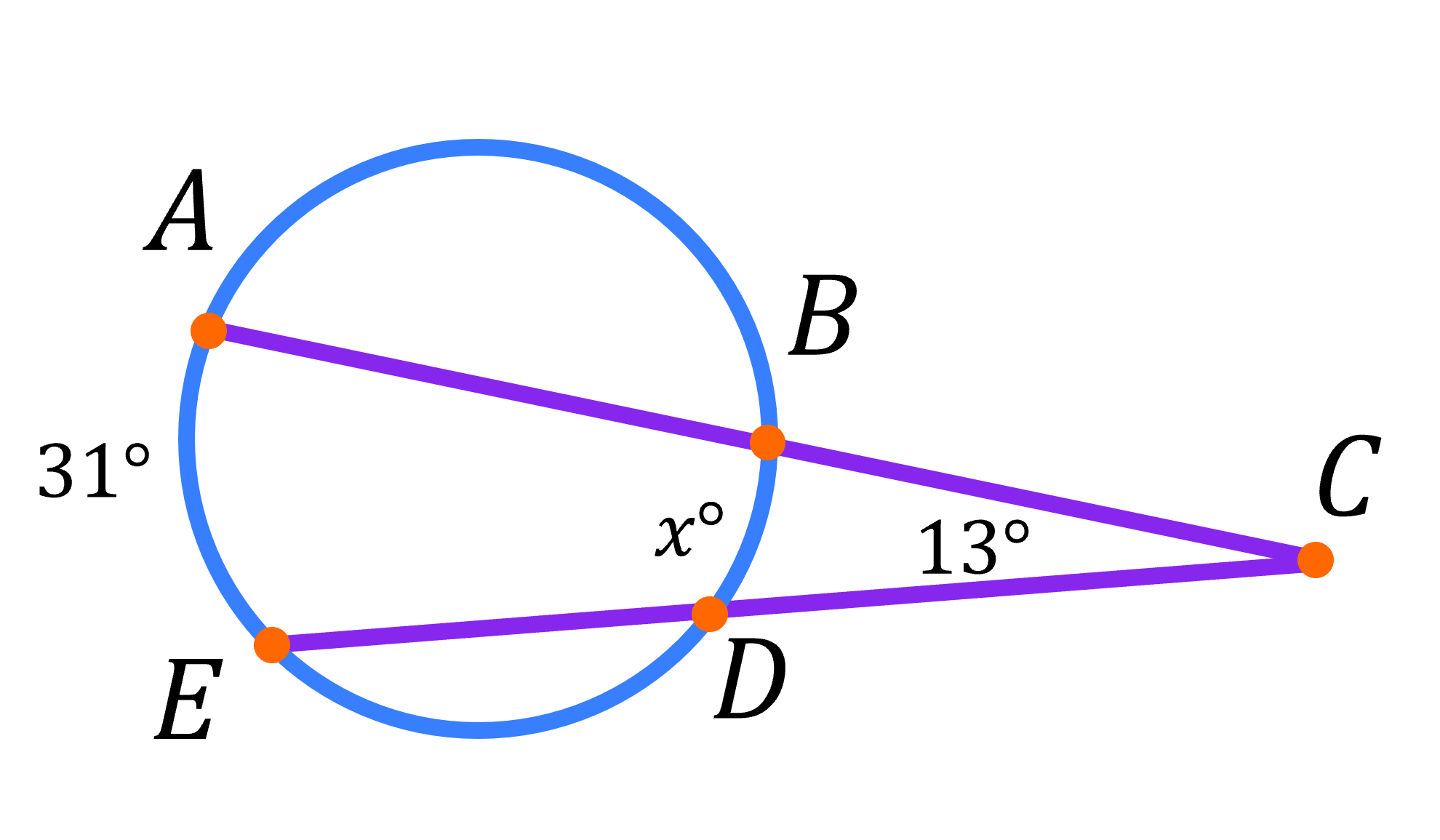
Use the properties of angles and circles to find the value of .
ANSWER:
From the diagram we can see that this is the case where
So we have that

0:00 / 0:00
Segments and Circles

If two lines cross, their intersection can end up in three different possible places in relation to a circle
- Intersect inside a circle
- Intersect outside a circle
- Intersect on the circle
Depending on which case we have, we'll have different properties associated with the chords and arcs formed. We've seen a few of these, but lets look at a few more, specifically the properties of the chords.
Intersect inside
When two chords intersect inside of a circle, then the product of the lengths of segments of one chord is equal to the product of lengths of the segments of the second chord.

Intersect outside
If two chords extent outside the circle and intersect, then the product of the lengths of extended segment with the chord and the extended segment equal the product of the other extended segment with its chord and extension.
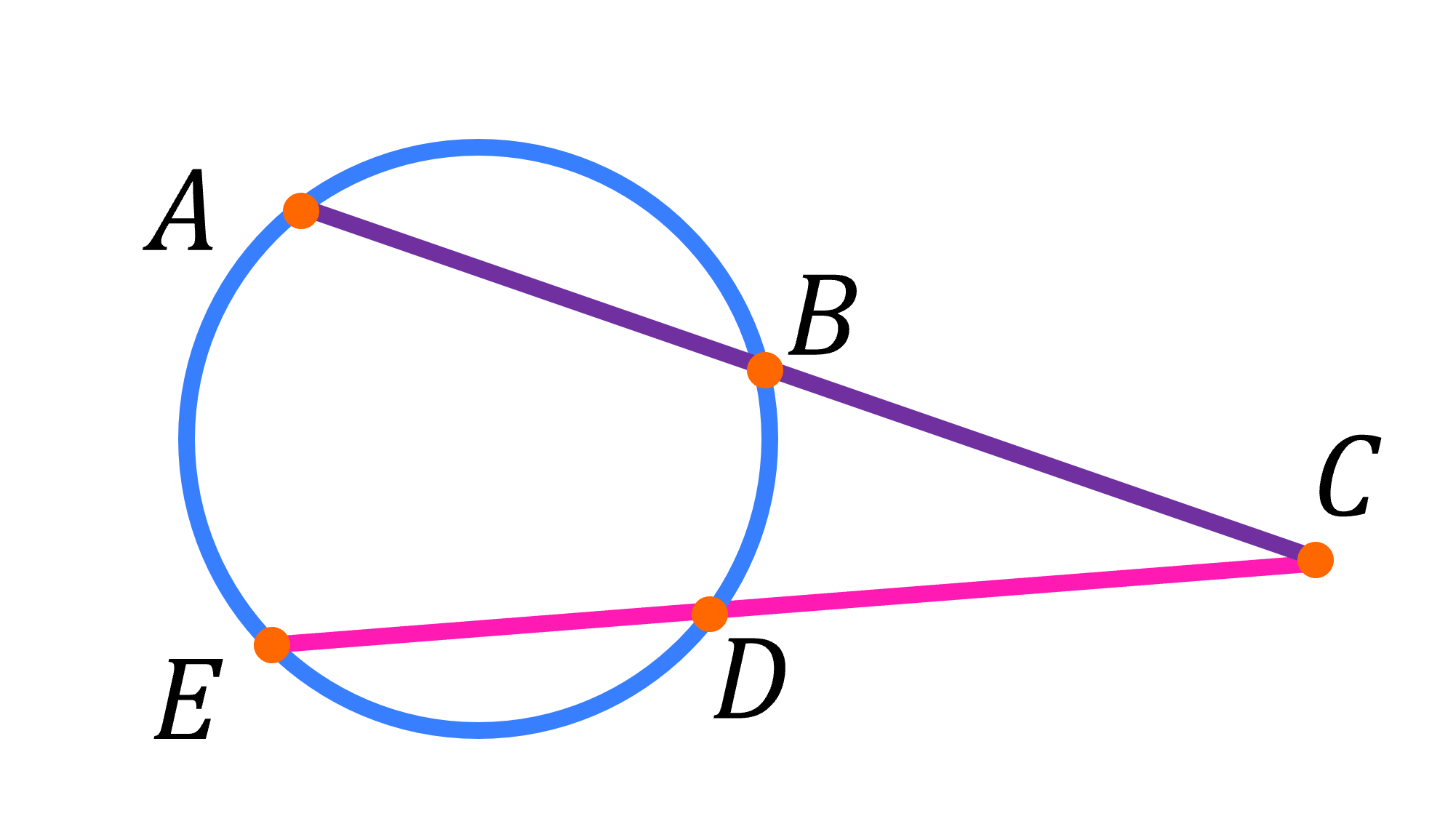
In a similar case if one of the chords is tangent to the circle, the the product of the extended segment squared is equal to the other extended segment with its chord.

Example
Find the value of

ANSWER:
This looks like the case where the intersection is inside of the circle. This means the segments are related by their products. This gives us
This gives us the value of x as 6.25.

0:00 / 0:00
Farming and Geometry

While watering his field, a farmer noticed that the pattern from the water marked out a circle.
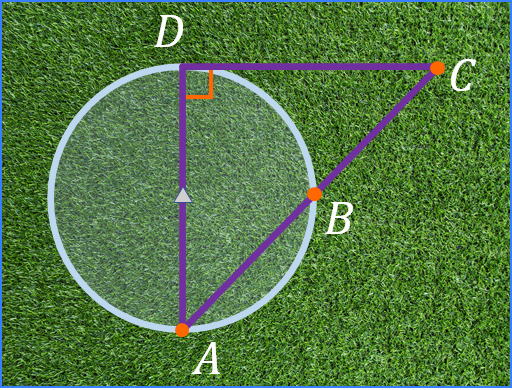
If the distance from A to B is 24 feet and the distance from B to C is 28 feet, what is the radius of the circle?
ANSWER:
Because we have a right angle with the circle we know that is tangent to the circle. From this we have the following relationship.
From this we can substitute our given information
With the value of this side of a right triangle, we can then use the Pythagorean Theorem to find .
This length is a diameter, so for the last step we simply need to divide by two to find the radius of the circle.
This gives us that the radius is about 17.67 feet.
Algebra and Circles
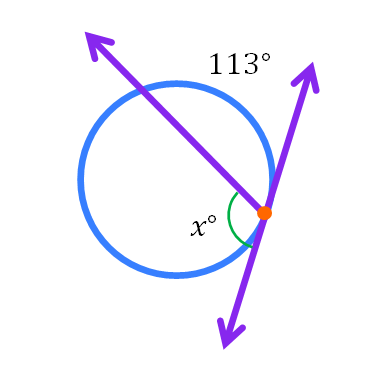
Find the value of x in the diagram. You can assume that the line is tangent to the circle.
Algebra and Circle
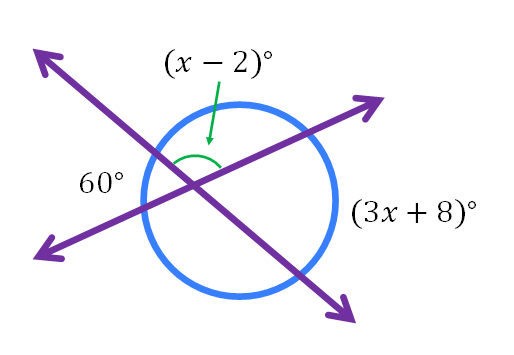
Use the diagram to find the value of x.
Astronomy and Circles
When traveling in space, astronauts can use the distance to other heavenly bodies to gather information about their own position.
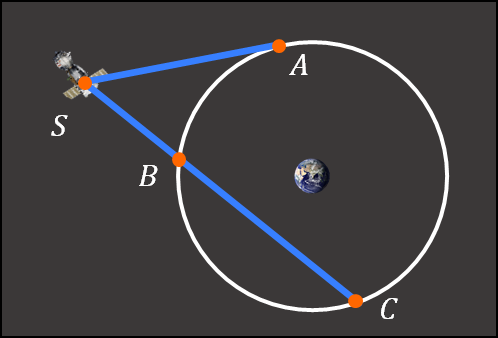
Suppose there are three satellites in a circular orbit around earth as marked in the diagram with and , with a space station marked as .
Find the distance to satellite , if the distance to satellite B is 20,000 km and the distance to satellite A is 34,000 km. (You can assume that is tangent to the circle.)