Popular Courses
MCAT
General Course
Intro to Physics
University Study Guides
PHYSICS 1D03
McMaster University
AP Physics C: Mechanics Exam Prep Course
AP Exam Prep
Physics
General Course
PHYS 115
Queen's University
PCS 211
Toronto Metropolitan University
PHYS 204
Concordia University
PHYS*1300
University of Guelph
Intro to Physics
University Study Guides
PHYS*1080
University of Guelph
PHY 1321
University of Ottawa
PHYS 131
McGill University
APSC 111
Queen's University
PHYS 111
University of Waterloo
PCS 120
Toronto Metropolitan University
PHYS 110
University of Victoria
LE/PHYS 1800 3.00
York University
PHYS-1400
University of Windsor
PHY131H1
University of Toronto

0:00 / 0:00
Normal Force
The normal force is the force experienced due to contact between surfaces, and it points perpendicular or normal to the surface of contact.
The most common example of this force is the supporting force of a wall or a floor to hold up on object.

You will usually see the normal force written as or .
Watch Out!
The normal force is not always vertical! It depends on how the objects are contacting.
Examples:
- The normal force is important for finding the magnitude of friction as well as determining apparent weight.
- Our perception of weight comes from the normal force. The value given to us by a scale is proportional to the normal force that is exerted on us by the scale.
- During the free fall, since there is no normal force acting on us, we feel weightless!
Watch Out!
Normal force is not always equal to mg. We can find normal force by looking at Newton's second law in the direction perpendicular to the surface of contact.
0:00 / 0:00
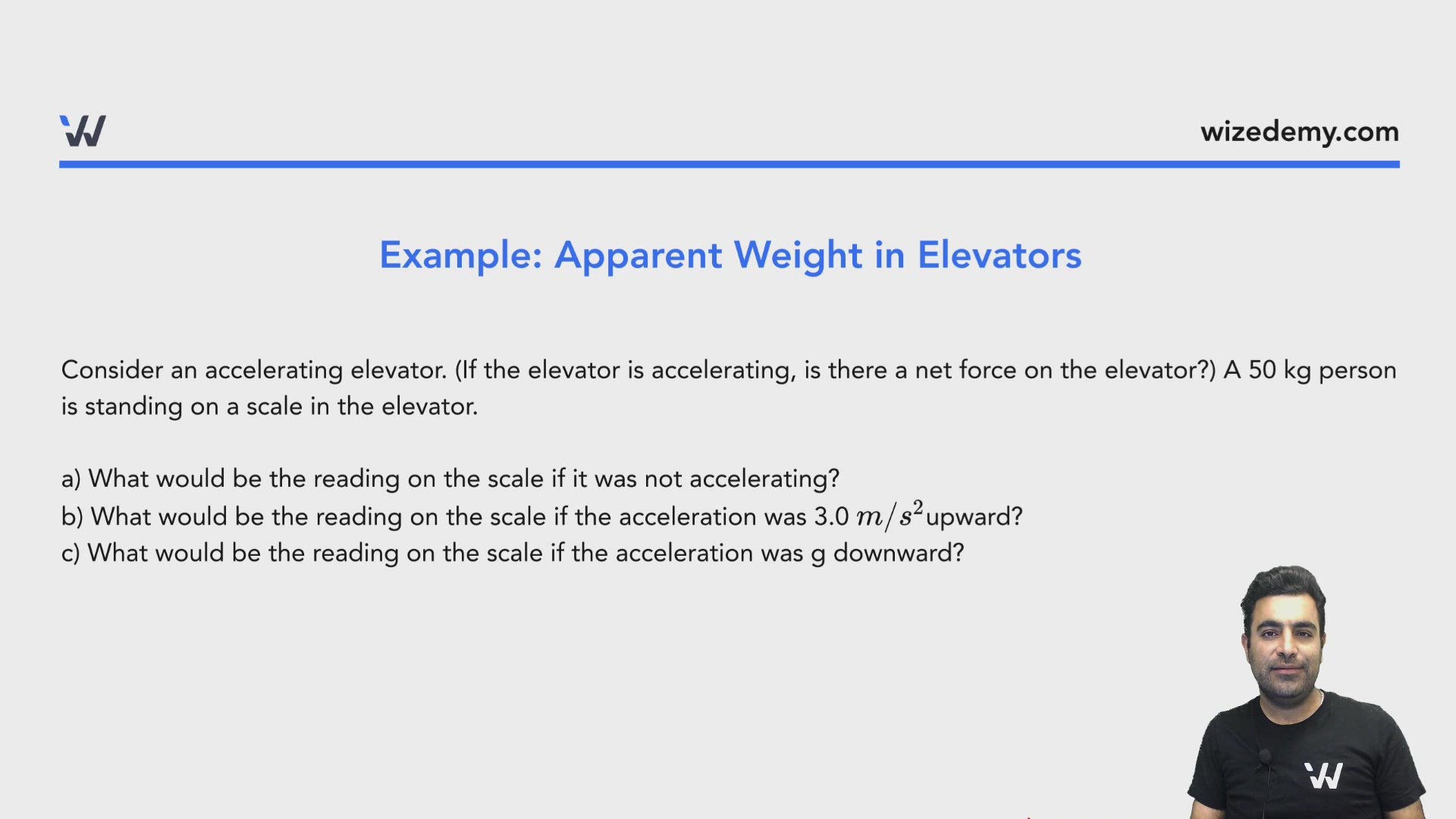
Example: Apparent Weight in Elevators
Consider an accelerating elevator. (If the elevator is accelerating, is there a net force on the elevator?) A 50 kg person is standing on a scale in the elevator.
a) What would be the reading on the scale if it was not accelerating?
b) What would be the reading on the scale if the acceleration was 3.0 upward?
c) What would be the reading on the scale if the acceleration was g downward?

If there is an acceleration, there must be a net force.
Part a)
There is no acceleration, so there is no net force. So N and mg cancel out. That is,
The weight on a scale is proportional to the normal force, so we find a weight of
Part b)
The elevator is accelerating, so there is a net force:
So the recorded weight is higher if you are accelerating upward. The opposite is true as well: if you are accelerating downward, the normal force will be smaller than mg and the recorded weight is lower.
Part c)
Here's an interesting case! What happens if the elevator happens to be accelerating downward at gravitational acceleration?
The scale will say that you are weightless!
The last case is what the concept of weightlessness refers to. The person still has mass, of course, but the concept of weight comes from the normal force.
A man is standing in an elevator. Find his apparent weight in each case: (that is, find the normal force on the man in each case):
a) The elevator is traveling steadily at
b) The elevator is still.
c) The elevator starts from rest and is accelerating upwards at .
d) The elevator is traveling at and is accelerating downwards at .
e) The elevator is travelling downwards with an acceleration equal to gravitational acceleration (g).
Give all answers in Newtons to two sig figs.