Wize University Physics Textbook (Master) > Geometric Optics
Lenses Ray Diagrams
Popular Courses
MCAT
General Course
PHYSICS 1201A/B
Western University
Grade 12 Physics
Canada High School
Physics 30
Alberta High School
PHY 1122
University of Ottawa
PHYS 142
McGill University
ENGG 212
University of Calgary
PHY132H1
University of Toronto
PHY132H1
University of Toronto
PHYS 102B
University of Victoria
PHYS 111
University of Victoria
PHYSICS 1101A/B
Western University
PHYS-1300
University of Windsor
PHY 1121
University of Ottawa
PHYS 121
University of Waterloo
PHYSICS 1102A/B
Western University
PHYS 206
Concordia University
PHYS 227
University of Calgary
SC/PHYS 2020 3.00
York University
PHYS 116
Queen's University
0:00 / 0:00
Convex and Concave Lenses
Lenses are formed by a transparent material curved on both sides. Light goes through two refractions as it enters and then exits the lens.
Convex (converging) lenses gather the reflected light rays into a single point. They are thicker at the center than at the edges.
Concave (diverging) lenses disperse the reflected light rays. They are thinner at the center than at the edges.
Wize Concept
We use the thin lens approximation where the lens is infinitely thin, so that all rays converge at the focal point.
- The principal axis (or optical axis) is the straight line perpendicular to the lens through its center.
- The focal point, called , is the point where the light rays converge (one on each side).
Note: There is no clear relationship between the radius of curvature and the focal length for lenses.
Ray Diagrams
Ray diagrams are a simplified way of representing the incoming and the refracted light, useful for determining the location and properties of the image formed by the lens.
Step 1: Draw the lens and the principal axis.
Step 2: Label the focal points, one on each side.
Step 3: Draw the object as an arrow.
Step 4: Beginning at the tip of the object, draw at least two out of the three special rays.
Step 5: Extend the rays until they converge: solid lines for actual light rays, and dotted lines for imaginary rays (there is no real light there, it only appears to be coming from there).
Step 6: The tip of the image will be at the intersection point of all the rays.
Special Rays for Convex Lenses
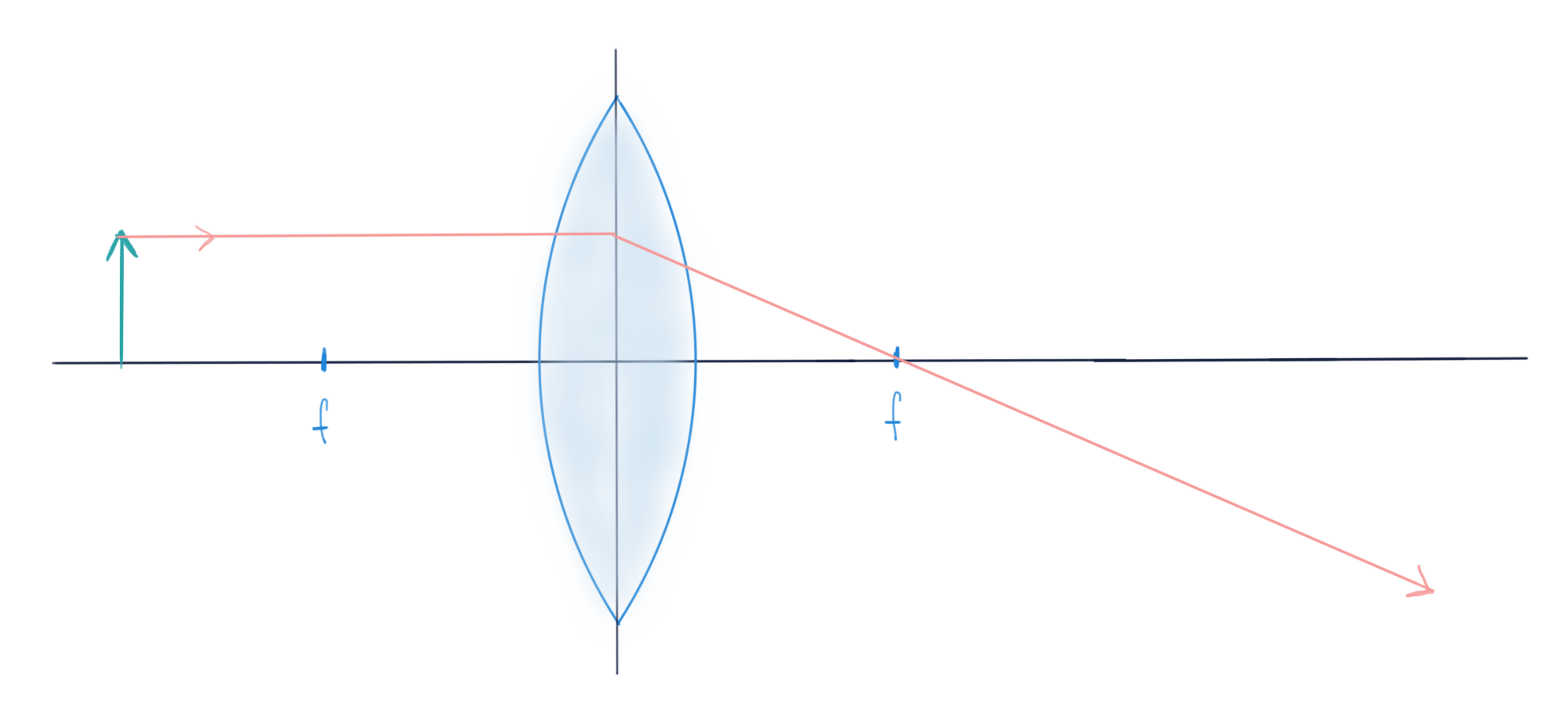
Parallel ray refracts through the focal point on the other side:
Ray through the focal point refracts parallel:
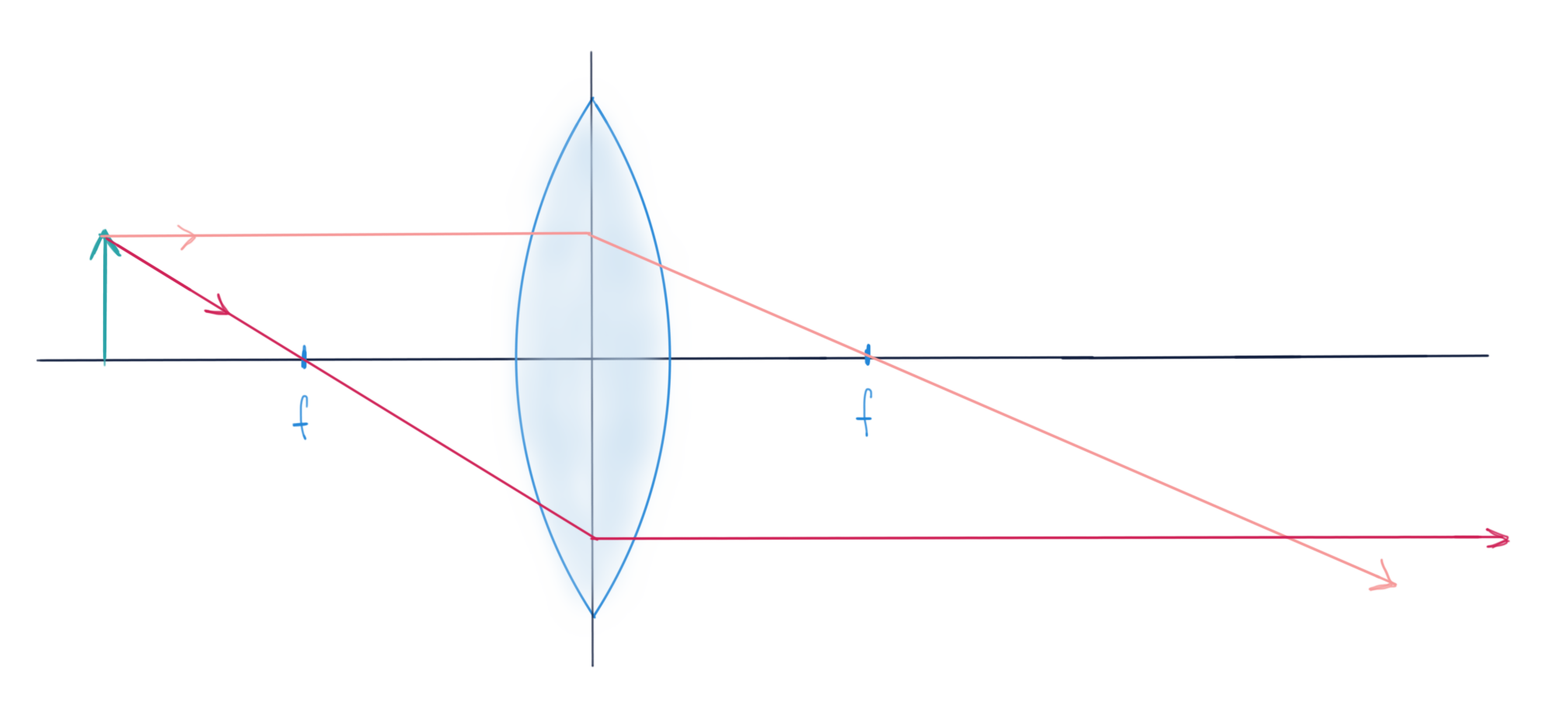
Ray through the center refracts straight through:

Special Rays for Concave Lenses
Parallel ray refracts as if coming from the focal point on the same side

Ray directed towards the focal point on the other side refracts parallel:

Ray through the center refracts straight through:

Wize Concept
Concave lenses always form images that are virtual, upright, smaller, and on the same side as the object between the object and the lens.
0:00 / 0:00
Example: Convex Lens
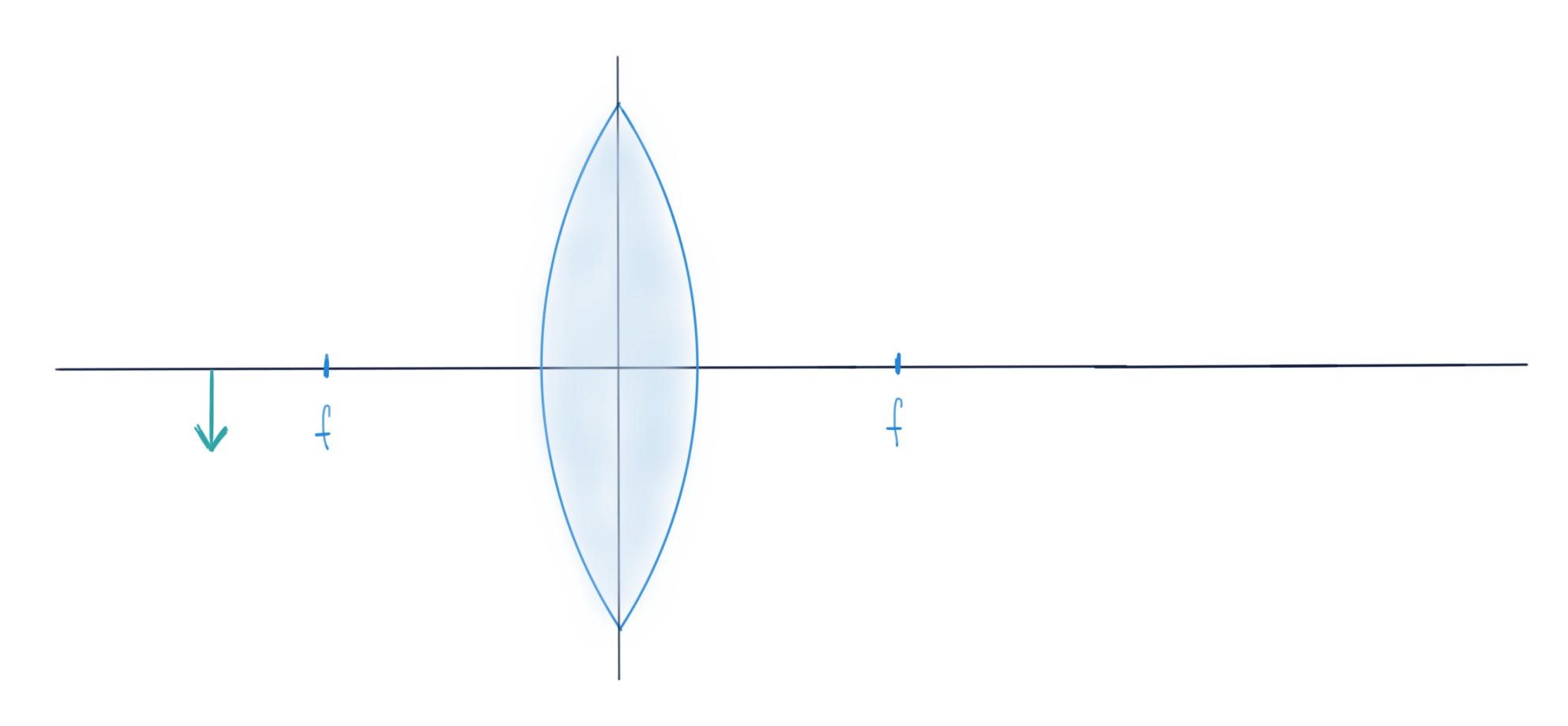
Draw the ray diagram and describe the image if an object is located inside the focal point of a convex lens.

The image is virtual, upright, and larger.

Mark Yourself Question
- Grab a piece of paper and try this problem yourself.
- When you're done, check the "I have answered this question" box below.
- View the solution and report whether you got it right or wrong.
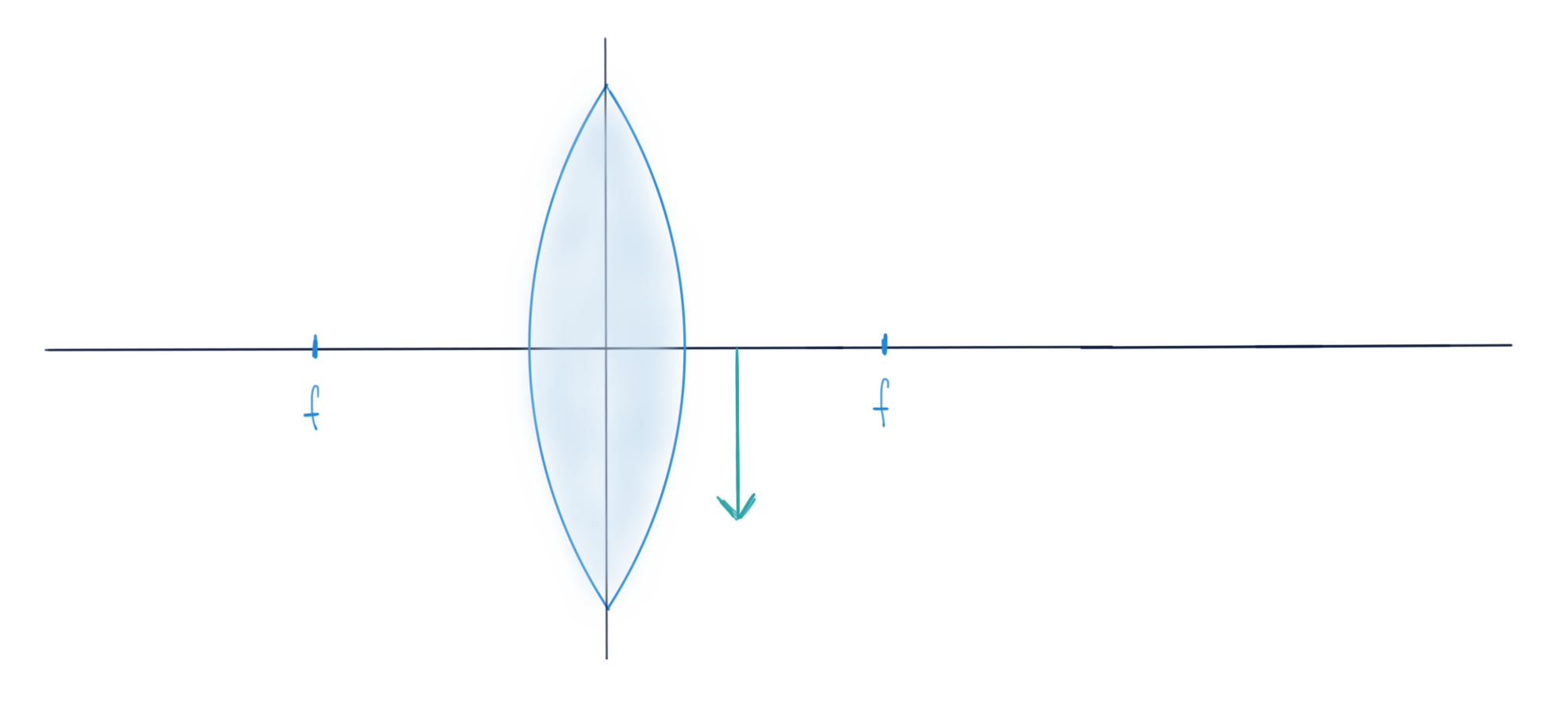
Draw the images formed by the following objects. Describe them as real/virtual, upright/inverted. larger/smaller.