Wize University Statics Textbook (Master) > Force Vectors
Vector Addition of 2D Forces (Components SOHCAHTOA)
Popular Courses
ENGG 130
University of Alberta
CIV100H1
University of Toronto
PCS 211
Toronto Metropolitan University
ENGG 202
University of Calgary
ENGSCI 1022A/B/Y
Western University
GNG 1105
University of Ottawa
PHYS 124
University of Alberta
APSC 111
Queen's University
PHYS 111
University of Waterloo
PCS 120
Toronto Metropolitan University
ENGR 242
Concordia University
PHYS 117
University of British Columbia
PHYC 1190
Dalhousie University
ENGG 212
University of Calgary
ENGR 141
University of Victoria
PHYS-1300
University of Windsor
PHY 1121
University of Ottawa
CE 221
Michigan State University
PHY 1124
University of Ottawa
PHYS 121
University of Waterloo
0:00 / 0:00
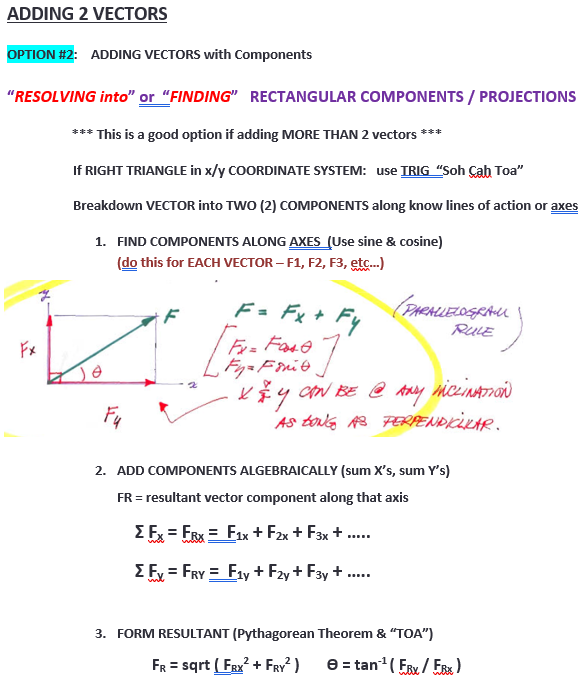
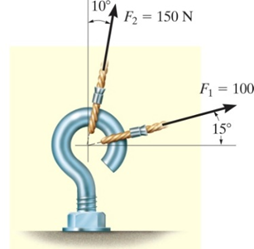
Find the magnitude and direction of the resultant of F1 + F2. Solve using rectangular components (easier than TRIANGLE method)
Write forces in CV form:
F1 = 100cos(15°)i + 100sin(15°)j
= [96.6i + 25.9j] N
F2 = 150sin(10°)i + 150cos(10°)j
= [26i + 147.7j] N
Find resultant force:
Fr = sum i's and sum j's
= 122.6i + 173,6j
Magnitude:
Fr mag = sqrt(122.62 + 173.62) = 213 N
Direction:
Fr dir = angle = tan-1(173.6/122.6) = 54.8°
(ANS: 213 N @ 54.8°)

Mark Yourself Question
- Grab a piece of paper and try this problem yourself.
- When you're done, check the "I have answered this question" box below.
- View the solution and report whether you got it right or wrong.
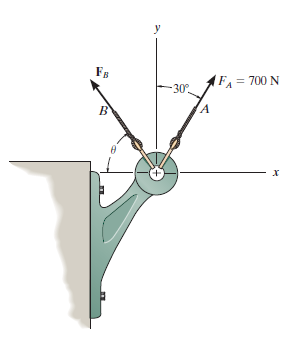
Determine the magnitude and direction of the resultant force acting on the bracket. Use Fb = 600N and Θ=20°.