
A Guide to Stoichiometry Problems and Equations for College Chemistry
In this study guide article, we’ll review the most important equations required in stoichiometry for introductory college chemistry and show you step-by-step how you can use these equations to solve a stoichiometric problem.
What is stoichiometry?
Stoichiometry allows us to predict the quantities of products or reagents across a chemical reaction. This is done in a few steps:
- Calculate the number of moles of the reagents (a.k.a reactant).
- Calculate the number of moles of the products using the stoichiometric ratio (i.e. stoichiometric coefficients in a balanced chemical equation).
- Calculate the mass or pressure of the products.
Equations for solving a stoichiometric problem
There are a few equations that you need to know for stoichiometry problems!. Once you understand these equations and use the simple steps above, you’ll be able to solve any stoichiometry problem.
Our Wize Chem Prof, Avneet, has put together a summary of these equations for you in the diagram below:

These equations allow you to figure out the number of moles of any reactant based on other information you might have including mass (in grams), molar mass (grams per mole), concentration (moles per liter), volume (liters), number of atoms or molecules, Avogadro’s constant, pressure (kPa), volume (liters), gas constant, and temperature.
Wize Prof Tip: Remember moles are the central unit as the diagram above indicates.
By figuring out what information is given to you in the problem you are given, you can figure out which equation you need to use, and if you need to rearrange it to solve for the missing quantity.

The first equation is n = m/MW (number of moles is equal to mass in grams over molar mass in grams per mol). Here you might be able to solve for the moles of a product and then rearrange the equation to solve for the mass of a product. To get the molar mass of an element you have to refer to the periodic table.
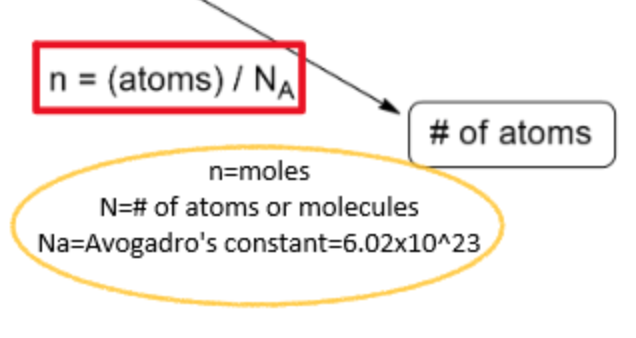
The second equation is n = N/ NA (number of moles equals number of atoms over Avogadro's constant which is 6.02 X 10²³). Now, this one would be helpful if you are asked to solve for the molecules or how many molecules there are of a product. So you would first have to solve for moles and then you can use this equation to solve for the number of molecules of that product.
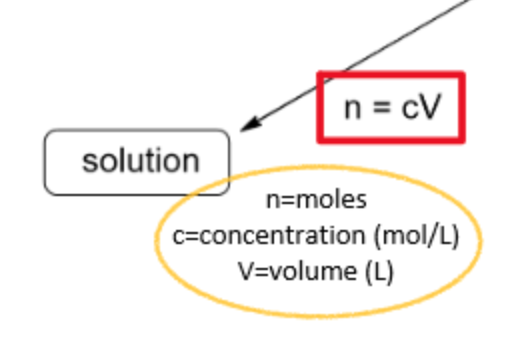
The third one is n = cV (number of moles equals concentration in moles per liter times volume in liters). If you take moles per liter multiplied by volume in liters the liters cancel out and you will be left with only moles.
Wize Prof Tip: Sometimes you might see the units of the concentration written as a capital M, that is just another way of writing moles per liter so keep that in mind.

The fourth equation is n = PV/RT. This is just the ideal gas law (PV=nRT) rearranged to solve for moles (n)!
When solving for moles, the number of moles equals the pressure in kilopascals (kPa) times volume in liters divided by R (the gas constant), multiplied by the temperature in kelvins (K).
Wize Prof Tip: Make sure you memorize the gas constant and remember that T is your temperature and it has to be entered in kelvin.
Another equation that will be helpful is ρ = mV (density equals to mass divided by volume). This is helpful to convert between the mass and volume of a pure substance. For example, if you're given a density and a volume you can solve for the mass of a product or reactant (a.k.a. reagent).
Found this summary helpful? Get more chemistry help with the full Wize General Chemistry Course for College.
Solving an example stoichiometric problem
Use the coefficients of the balanced reaction along with our equations that convert mass, volume, and concentration into moles to predict the quantities of reactants and products in a chemical reaction.
To answer any stoichiometry problem, focus on converting to and from moles!
Steps to take to solve a stoichiometric problem
Follow these 4 steps to solve our example problem:
- Step 1: Make sure the chemical reaction you are given is balanced. If it is not, you’ll have to balance it.
- Step 2: Convert the values given in the problem for a reactant or product to the number of moles of that reactant or product.
- Step 3: Use the stoichiometric coefficients from the balanced reaction to find the number of moles of the unknown you are being asked for.
- Step 4: Convert the number of moles of your unknown to a mass, or whatever quantity you are being asked for.
Working through an example problem step-by-step
Example problem
2.6g of sodium metal (Na) reacts with water to form NaOH and H2 according to the unbalanced reaction below. Once the reaction is complete, how many grams of NaOH are formed?

Wize Prof Tip: On an exam, your prof will NOT specify if an equation is balanced or unbalanced. Always double-check that the equation is balanced. If it's not, balance the equation before continuing! The equation must be balanced in order to get the correct answer!
Step-by-step solution
Step 1: Balance the reaction
On the left, you have one sodium atom and on the right you also have one sodium atom so this is balanced.
On the left, you have one oxygen on the right you also have one oxygen atom.
On the left, you have two hydrogen atoms and on the right you have three hydrogen atoms. On the right, you can see that there's one hydrogen on its own so that's going to make the number of hydrogens on the right side be an odd number which you don't want so multiply this by 2 to make an even number.
Now you have two sodium atoms so just change this to a 2 as well.
Now, you have 2 oxygen atoms on the left so you have to change this to a 2 on the right as well.
Here is the balanced equation:

Step 2: Convert the given quantity (sodium) of a reactant into moles
You have the mass which is 2.6 grams for sodium. First, you want to find the moles of sodium using this equation n = m/MW.

Step 3: Use the stoichiometric coefficients to find moles of reactant (sodium hydroxide)
Now that you have the moles of sodium you can use the stoichiometric coefficients of the two substances from the balanced chemical reaction to figure out the moles of sodium hydroxide using a simple ratio as shown below.

Step 4: Convert moles of sodium hydroxide into mass
Now you can find the mass using this equation n = m/MW again. But this time you’ll have to rearrange it a little to solve for mass (m), since you already have the moles (n) and you can get the molar mass of sodium hydroxide (MW) from the periodic table (add the molar mass of Na + O + H which is equal to 39.997g/mol).

And there you have it! This reaction will yield 4.5g of sodium hydroxide.
This example is pretty straightforward and simple. To get more chemistry help and work through more complicated problems with step-by-step solutions check out the Wize General Chemistry Course, which covers 24 units, with over 47 hours of step-by-step video content and over 220 practice problems to help you test your understanding and prepare for exams!
For more college chemistry help:

Study with Us
The help you need to get the grades you want.
Previous Blog
LSAT Prep Timeline: When to Start and What to Study
Next Blog
How to Study When You Don’t Want to
Other posts you might like:
Studying
What to Do if You’re Failing a Class in College
No one wants to fail a class at college or university, but what happens if you are failing a class i... Read More
L
Lindy Ledohowski