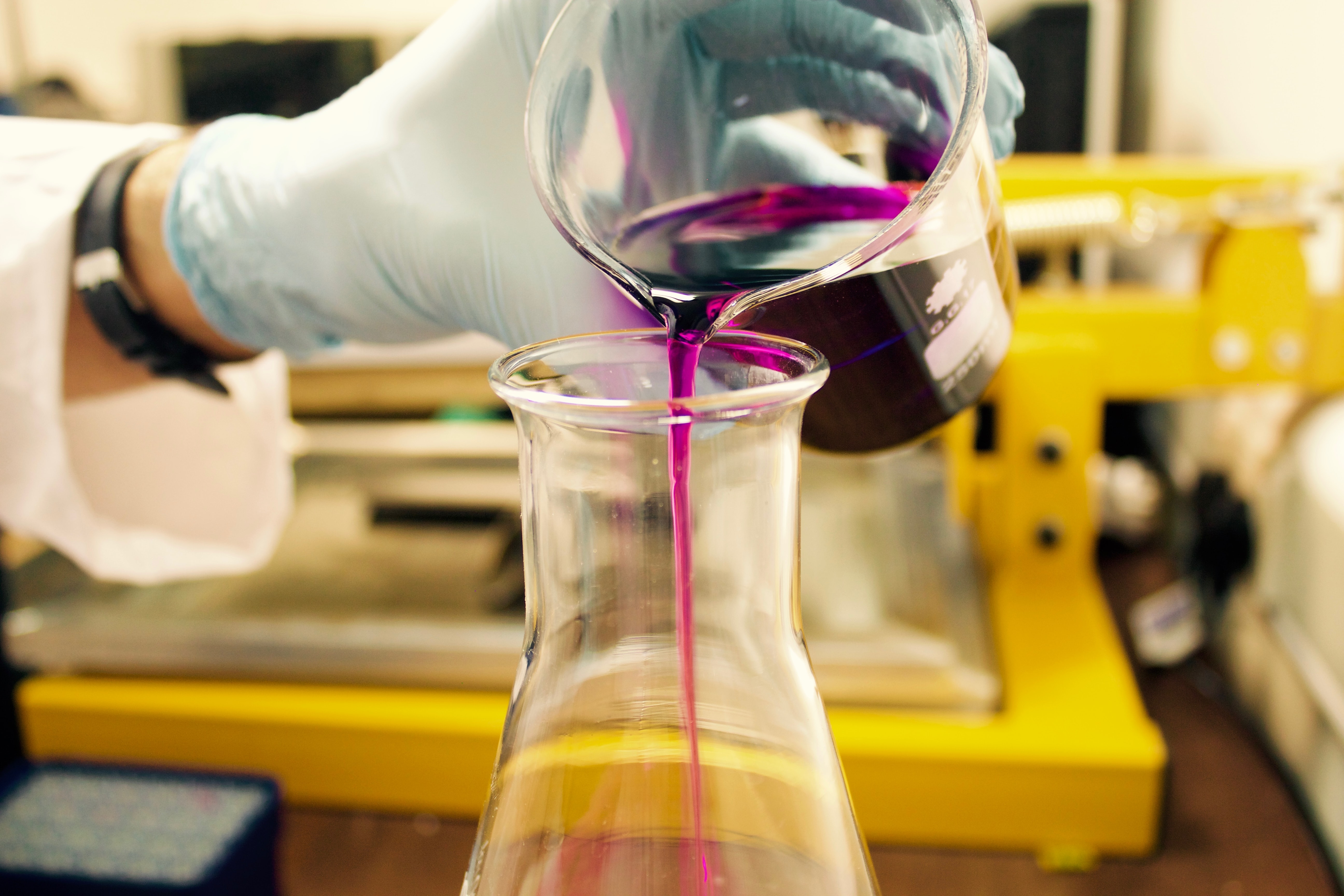
Chemistry is one of the oldest scientific disciplines. It is known as “the central science.” All physical sciences intersect with Chemistry at some point. Chemistry majors study the substances that make up everything we can touch, smell, taste, and swirl in a beaker.
Consequently, career options for Chemists are incredibly diverse. Opportunities abound in business, manufacturing, research, academia, and government. You might work in a lab running assays on drug candidates, or in the field analyzing water samples, or in an office running simulations and crunching statistics. Maybe you’ll find yourself in government working on grant allocations and scientific funding.
Where you take your Chemistry career depends on what kind of contribution you want to make. Maybe you want to help combat climate change, or develop new treatments for cancer. Maybe you just want to formulate the ultimate smudge-proof lipstick. There’s a Chemistry career for al of that.
Chemistry is everywhere, and so are the opportunities for Chemistry majors.
What is Chemistry, Exactly?
Before looking closely at what types of jobs you might be able to find as a Chemistry major or Chemistry graduate, it’s important that we get onto the same page in what we’re talking about when we talk about Chemistry.
Chemistry is the science that deals with the properties, composition, and structure of substances (defined as elements and compounds), the transformations they undergo, and the energy that is released or absorbed during these processes.
Importantly, Chemistry majors and Chemists looks closely at the interactions between various substances. Most often we think about that happening in a science lab under controlled substances, but Chemistry is at play in fermentation processes as brewers develop the next great microbrew, and Chemistry is also to thank for what that great chef invents in combining ingredients in innovative new ways.
Are Chemistry majors in demand?
The job market for Chemists is growing at 6% according to the U.S. Bureau of Labor Statistics (BLS). That’s slightly faster than the average for all occupations. Because Chemistry jobs exist within so many industries, demand varies based on your individual career path.
Which field of Chemistry has the most job opportunities?
Chemistry majors tend to concentrate in a particular field. The American Chemical Society (ACS) defines the primary areas of Chemistry as:
Analytical Chemistry: The science of obtaining, processing, and communicating information about the composition and structure of matter.
Biological/BioChemistry: The study of the structure, composition, and chemical reactions of substances in living systems.
Chemical Engineering: The translation of processes developed in the lab into practical applications for the commercial production of products.
Inorganic Chemistry: The study of properties and behavior of inorganic compounds, including metals, minerals and organometallic compounds.
Organic Chemistry: The study of the structure, properties, and reactions of compounds and materials that contain carbon atoms.
Physical Chemistry: The study of how matter behaves on a molecular and atomic level and how chemical reactions occur.
Organic Chemistry is widely considered to have the most career opportunities. We are, after all, carbon-based beings. Studying O-chem leads to careers in pharmaceuticals, biotech, academic research, forensics, polymers, and many other actively growing fields. The majority of Organic Chemistry majors find work in pharmaceuticals and research. Organic Chemistry is also one of those required courses for students planning on taking the MCAT and going to Med School.
Chemical Engineering offers many opportunities with high-earning potential. While Chemical Engineering is a separate major from Chemistry, there is lots of overlap. Chemical Engineering and Materials Science are natural next steps for Chemistry majors to advance their careers. Chemistry for Engineers is often how this major is identified at a specific university.
Where can I look for Chemistry jobs?
There are thousands of Chemistry job listings on the major job portals, like Indeed.com, LinkedIn, and Monster. Check out C&EN Jobs to find job postings listed by field. Chemjobber offers down and dirty insight into the Chemistry job market, as well as job postings. For jobs in specific fields like Physical or Organometallic Chemistry, check relevant journals for job listings.
Is Chemistry a high-paying degree?
According to BLS, the mean salary for Chemists is $89k (132k Canadian dollars). This is a bit lower than the mean salary for STEM careers as a whole: $95k (CA$130k). However the range for Chemistry jobs is wide. The top 10% earn an average of $134k (CA$184k) while the bottom 10% earn $48k (CA$66k).
Chemistry opportunities range from hourly lab-tech jobs to C-suite management positions. Keep in mind that average earnings do not reflect individual stories. So take all stats with a grain of NaCl.
Industries with the highest levels of employment of Chemists:
Top paying industries for Chemists:

What are common jobs for Chemistry majors?
Analytical Chemists perform qualitative and quantitative analysis of substances. This involves lab technique, data analysis, interpretation, and working in teams. Analytical Chemists work in diverse fields from medical research to textiles.
Biochemists work in laboratories, generally in medical research and drug development. They specialize in biochemical processes. This is an area with excellent job growth and earning potential.
Chemical Technicians work in laboratories to support research, medical testing, manufacturing, QA/QC, and more. These tend to be lower-earning jobs that don’t require advanced degrees, and may offer on-the-job training.
Forensic Scientists analyze physical evidence to identify substances. They use lab technique and critical thinking to help solve crimes. Could get gruesome.
Synthetic Chemists use their knowledge and lab technique to create new compounds for a specific purpose. They work in many industries including medicine, agrochemicals, and personal care products.
Chemical Engineers create and refine processes for manufacturing chemicals. This is a high-paying field, usually requiring an advanced degree. Chemical Engineers may work in the office, in the lab, or at manufacturing facilities.
Materials Scientists apply Chemistry and other disciplines to the analysis and creation of new and existing materials. Like Chemical Engineering, this is a field where Chemistry majors can expand on their learning with postgraduate study and career development.
What can you do with a Bachelors Degree in Chemistry?
Most Chemistry majors pursue advanced degrees. Many jobs require specialized study and research experience. The good news is you may actually get paid to get a Masters or PhD by working under a postdoc at a research university. And you get the honorary title of “lab rat.”
Grads with a BA or BS in Chemistry do have options without an advanced degree. Some of these jobs will provide you with research experience, and may pay for you to obtain a degree while you work.
Typical jobs for Chemistry majors without an advanced degree include:
- Entry-level Chemist
- Lab Technician
- Analytical Chemist
- Research Assistant
- QA/QC Chemist
- Chemistry Teacher
- Food Chemist
- Textile Chemist
Many Chemistry majors go into non-lab careers where their scientific literacy is in demand. These include jobs in law, marketing, technical writing, and journalism.
Chemistry majors develop skills valuable in all kinds of non-STEM careers. These include critical thinking, understanding statistics, working in teams, and project management.
How Can I maximize my undergraduate Chemistry experience?
Chemistry majors tackle some of the most notoriously difficult courses. Organic Chemistry is wildly complex, and requires intensive study and lab hours. Wizeprep can help you manage your course load with Chemistry study materials, video lessons, and practice questions. We offer live and on-demand help for specific courses at your college.
Wizeprep can help you make the most of your study time. This means you’ll have more time to connect with mentors, find internship opportunities, and make those connections that lead to a rewarding career after graduation.
And if you want more tips on Chemistry, check out this video all about stoichiometry!
And if that's not enough stoichiometry, then read this post on why this topic matters so much for people studying Chemistry.

Study with Us
The help you need to get the grades you want.
Previous Blog
Advice from Fellow Students on Becoming Socials Entrepreneurs
Next Blog
How and When to Choose a Double Major
Other posts you might like:
Student Life
What to Consider Before Dropping a Class
What to Consider Before Dropping a Course Dropping a class can be intimidating and, frankly, quite t... Read More
K
Kaitlyn Han