Create a free account to get started

Unlock full course notes by signing up

  • Video lessons taught by top educators
  • Practice questions with guided solutions
  • Written review notes for reference
  • Expert answers anytime from course tutors

Curve Sketching

Combining our knowledge of the first and second derivatives lets us sketch the graph of functions by hand. We will put together the techniques of finding asymptotes, intervals of increase/decrease, extrema, intervals of concavity, and inflection points.


Procedure for completely Sketching a Curve

  1. Find the domain of f(x)f(x).
  2. Find the yy-intercepts and (if possible) thexx-intercepts.
  3. Find all the vertical, horizontal and slant asymptotes. The line y=mx+by = mx + b is a slant asymptote of the graph of f(x)f(x) if either lim⁡x→−∞[f(x)−(mx+b)]=0  or  lim⁡x→+∞[f(x)−(mx+b)]=0\lim_{x\rightarrow -\infty}\bigg[f(x)-(mx+b)\bigg]=0 \ \text{ or } \ \lim_{x\rightarrow +\infty}\bigg[f(x)-(mx+b)\bigg]=0 (You might have to do long division)
  4. Compute f′(x)f'(x). Use it to find all the critical points and singular points of f(x)f(x). Use this information to find the intervals of increase and decrease and extrema.
  5. Computef′′(x)f''(x). Find the points for which f′′(x)=0f''(x) = 0 or f′′(x)f''(x) does not exist. Use this information to find the intervals of concavity and inflection points.
  6. Plot all relevant points, asymptotes, and use the information gathered to plot the graph of f(x)f(x).


Create a free account to get started

Unlock full course notes by signing up

  • Video lessons taught by top educators
  • Practice questions with guided solutions
  • Written review notes for reference
  • Expert answers anytime from course tutors

Example: Curve Sketching

Sketch the function


f(x)=x33−x\displaystyle f\left(x\right)=\frac{x^3}{3}-x


1) Find the Domain


f(x)f(x)is a polynomial so the domain is (−∞,∞)(-\infin,\infin)


2) Find the intercepts


x intercept:   ⟹  f(x)=0=x33−x=x(x23−1)  ⟹  x=0 and x23−1=0  ⟹  x=0,−3,3\displaystyle\implies f(x)=0=\frac{x^3}{3}-x=x(\frac{x^2}{3}-1) \implies x=0 \text{ and } \frac{x^2}{3}-1=0 \implies x=0,-\sqrt{3},\sqrt{3}


y intercept:   ⟹  f(0)=033−0=0  ⟹  y=0\displaystyle \implies f(0)=\frac{0^3}{3}-0=0\implies y=0


3) Find the Asymptotes


f(x)f(x) is a polynomial and has no asymptotes.


4) Critical points and intervals of Increasing/decreasing


f′(x)=x2−1f'(x)=x^2-1


f′(x)=x2−1=0  ⟹  (x−1)(x+1)=0  ⟹  x=−1,1f'(x)=x^2-1=0 \implies (x-1)(x+1)=0 \implies x=-1,1


f′(x)>0 if x is in (−∞,−1) or (1,∞)f'(x)>0 \text{ if }x\text{ is in }(-\infin,-1) \text{ or } (1,\infin)


f′(x)<0 if x is in (−1,1)f'(x)<0 \text{ if } x\text{ is in }(-1,1)


5) Inflection points and intervals of Concavity


f′′(x)=2xf''(x)=2x


f′′(x)=2x=0  ⟹  x=0f''(x)=2x=0 \implies x=0


f′′(x)>0 if x>0f''(x)>0 \text{ if } x>0


f′′(x)<0 if x<0f''(x)<0 \text{ if } x<0


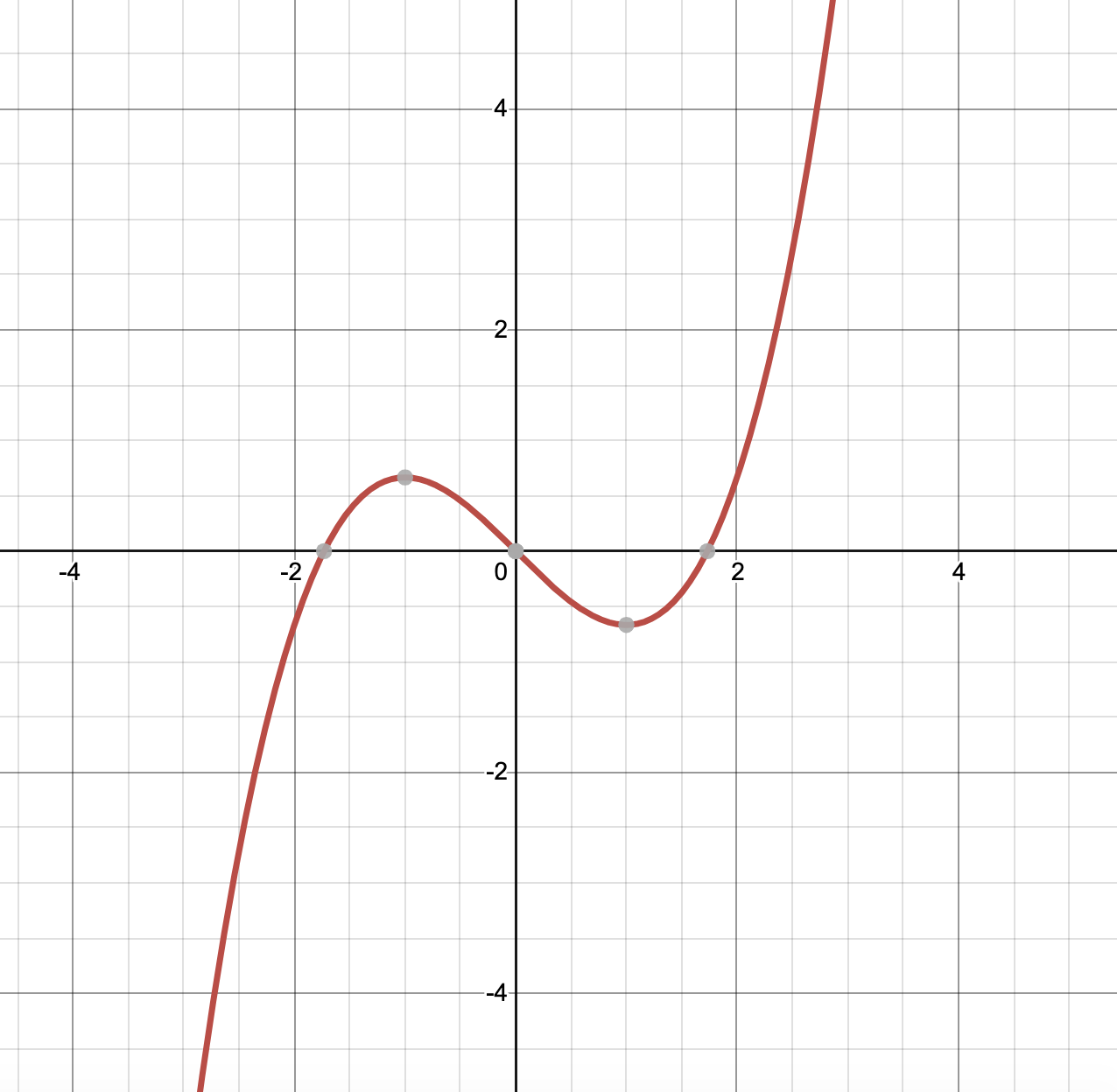
6) Plot points, asymptotes, and Graph
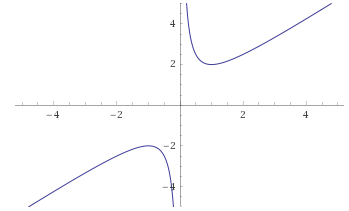

Image illustrating Example


Mark Yourself Question

  1. Grab a piece of paper and try this problem yourself.
  2. When you're done, check the "I have answered this question" box below.
  3. View the solution and report whether you got it right or wrong.

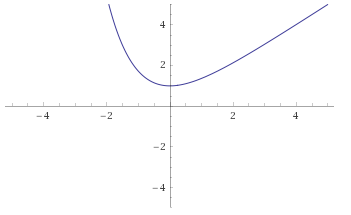
Sketch of the graph of f(x)=1x2+1\displaystyle f(x)=\frac{1}{x^2+1}. The first and the second derivatives are

f′(x)=−2x(x2+1)2 and f′′(x)=6x2−2(x2+1)3\boxed{f^{\prime}(x)=\frac{-2x}{\left(x^{2}+1\right)^{2}}\quad\text{ and }\quad f^{\prime\prime}(x)=\frac{6x^{2}-2}{\left(x^{2}+1\right)^3}}


Create a free account to get started

Unlock full course notes by signing up

  • Video lessons taught by top educators
  • Practice questions with guided solutions
  • Written review notes for reference
  • Expert answers anytime from course tutors

Practice: Curve Sketching From Derivatives

The first derivative f′(x)f'\left(x\right) is depicted below


Illustration for practice question: Practice: Curve Sketching From Derivatives


Mark Yourself Question

  1. Grab a piece of paper and try this problem yourself.
  2. When you're done, check the "I have answered this question" box below.
  3. View the solution and report whether you got it right or wrong.

List the critical points of f(x)f\left(x\right) and classify them as a max, min, or neither.

Create a free account to get started

Unlock full course notes by signing up

  • Video lessons taught by top educators
  • Practice questions with guided solutions
  • Written review notes for reference
  • Expert answers anytime from course tutors

Extra Practice