Wize University Calculus 1 Textbook > Applications of Differentiation
Critical Points and Extrema
Popular Courses
CALCULUS 1000A/B
Western University
Calculus 1
University Study Guides
AP Calculus (AB) Exam Prep Course
AP Exam Prep
MATH 209
Concordia University
MATH 100A
University of British Columbia
MATH 100C
University of British Columbia
MATH 1LS3
McMaster University
MATH 249
University of Calgary
MATH 265
University of Calgary
Calculus 1
General Course
MATH 140
McGill University
MATH 121
Queen's University
MAT135H1
University of Toronto
MATH*1080
University of Guelph
MATH 134
University of Alberta
Calculus 1
University Study Guides
MATH 154
University of Alberta
MAT 1320
University of Ottawa
MATH 100
University of Alberta
MATH 100B
University of British Columbia
0:00 / 0:00
Critical Points and Extrema
Since our first derivative can tell us intervals of increasing/decreasing, it can also give us locations of Extrema.
Critical Points
A critical point of a function is a point ,in its domain, for which
Singular Points
A singular point of a function is a point ,in its domain, for which does not exist.
Relative Extrema
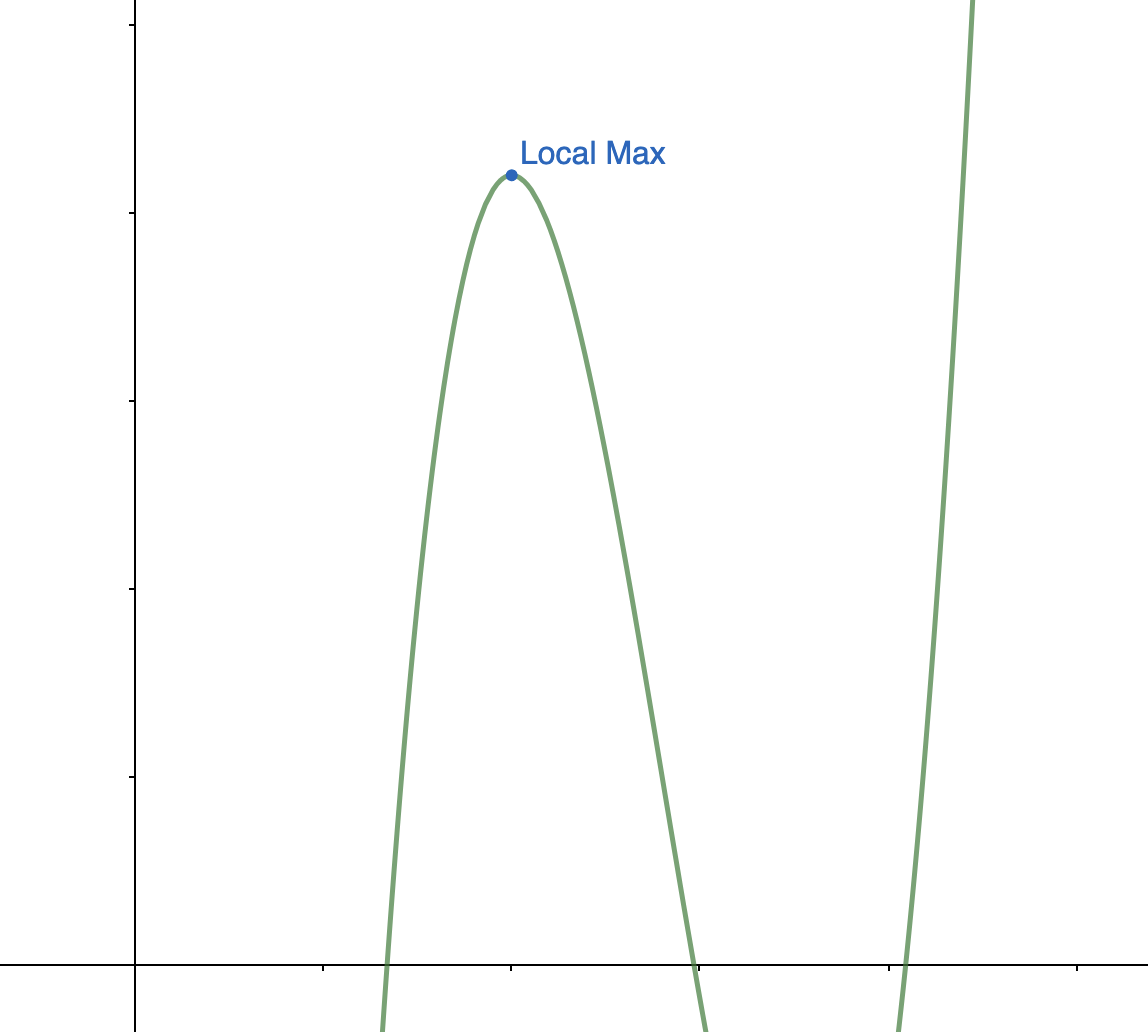
A function has a relative (local) maximum at a point , in its domain, if there is a small interval , around , such that for every in .
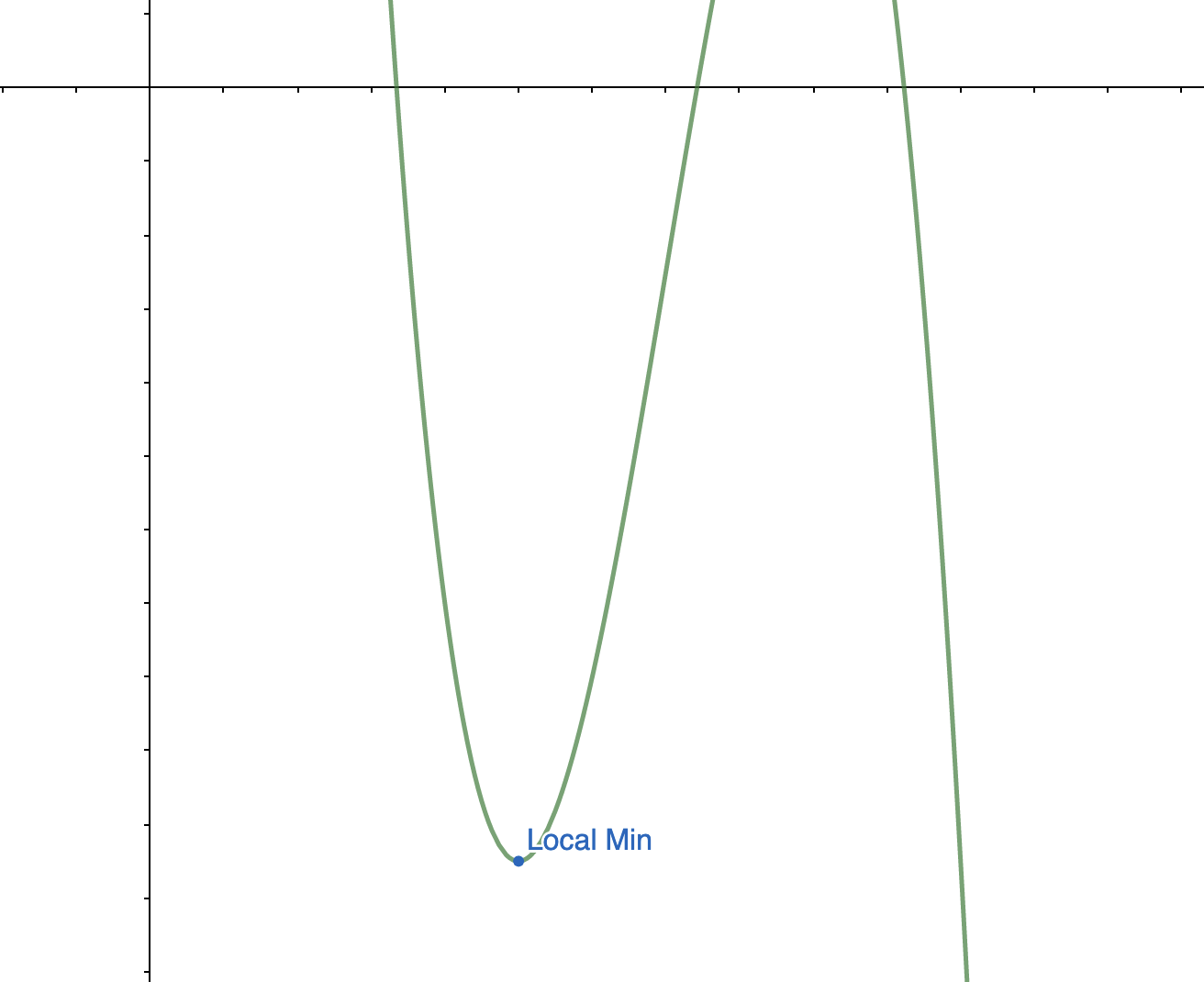
A function has a relative (local) minimum at a point , in its domain, if there is a small interval , around , such that for every in .
Wize Tip
Relative extrema occur at either critical points or singular points!
Example: Critical Points and Extrema
Find the critical points and extrema of .
Taking the derivative of the given function, we get
Critical points: set
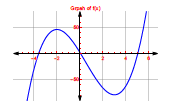
Setting implies that which are the two values for . Now, consider the following table

From the table above, we can conclude that the given function is increasing on and and decreasing on . Therefore has a relative maximum at and a relative minimum at .
Conclusion: is relative maximum, is relative minimum.
Find the critical points for