
Activity-Based Costing
Activity-based costing (ABC) is a method of assigning overhead cost to products by groups of activities (cost pools) rather than using a single overhead rate like in job-order costing. This method is especially important for companies that make different products.
In ABC, each cost pool or department has an expected overhead cost and an expected activity (the cost driver) and the first step in solving a question is to determine the overhead rate for each department.
For Example:

If Product A requires 2 assemblies and 1 inspection, we would assign overhead based on the rates we found:
Overhead = (2 x $5) + (1 x $25) = $35
Advantages and Limitations of ABC
Advantages
Since ABC uses multiple cost pools instead of just one, it is more accurate in estimate product costs.
Leads to more control of overhead costs because spending can be traced back to each department.
Leads to better management decisions
Limitations
ABC is more expensive to use than traditional costing methods
Some arbitrary allocation will always exist, it is impossible to have a cost driver to account for every dollar of overhead spent
Who should use ABC?
Companies that have product lines that differ greatly from each other
Companies whose overhead costs make up a large portion of total manufacturing costs
Companies whose manufacturing process has recently changed significantly
Example: Traditional Costing
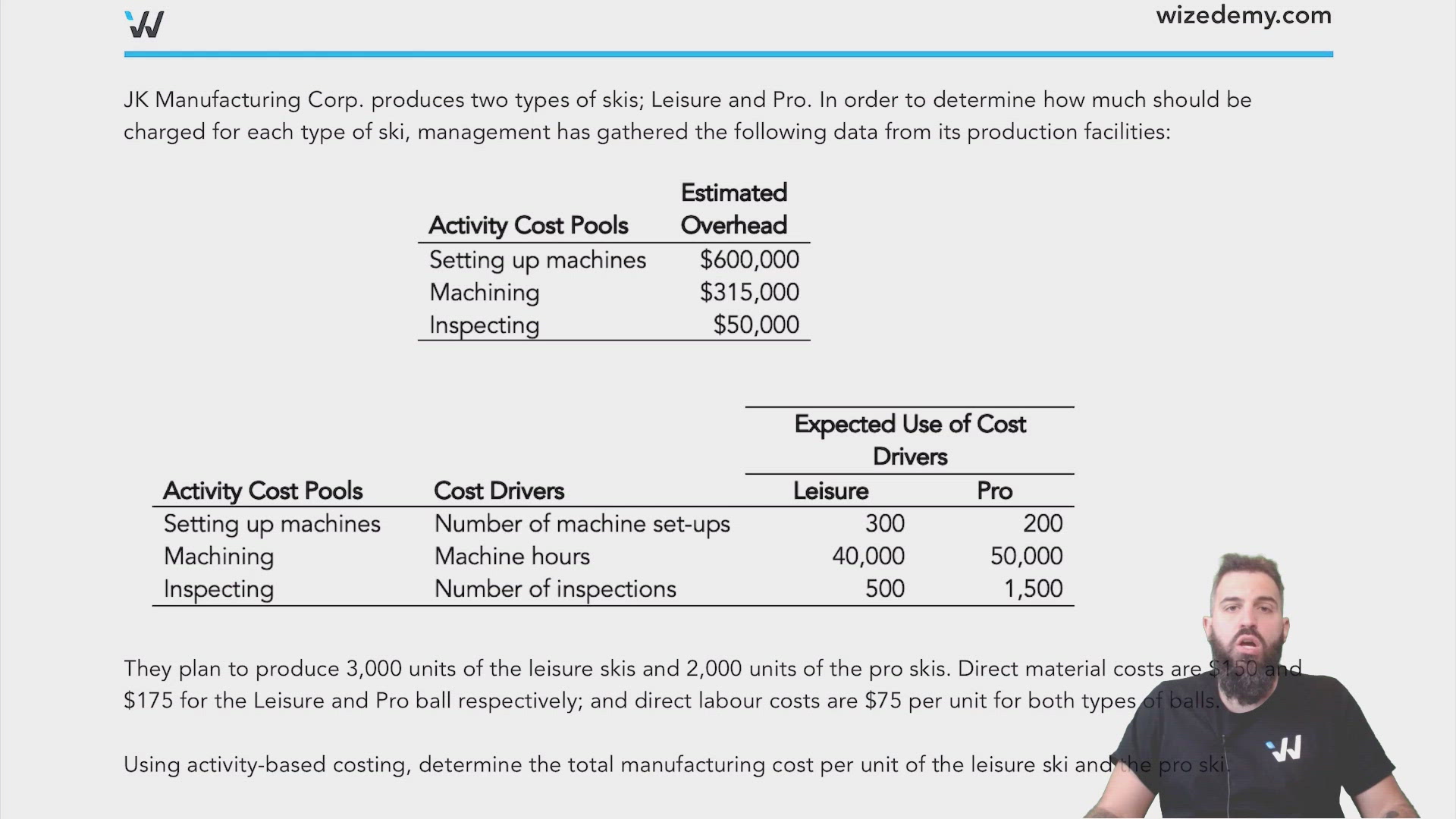
JK Manufacturing Corp. produces two types of skis; Leisure and Pro. In order to determine how much should be charged for each type of ski, management has gathered the following data from its production facilities:

They plan to produce 3,000 units of the leisure skis and 2,000 units of the pro skis. Direct material costs are $150 and $175 for the Leisure and Pro ball respectively; and direct labour costs are $75 per unit for both types of balls.
Using activity-based costing, determine the total manufacturing cost per unit of the leisure ski and the pro ski.