Create a free account to get started

Unlock full course notes by signing up

  • Video lessons taught by top educators
  • Practice questions with guided solutions
  • Written review notes for reference
  • Expert answers anytime from course tutors

Pre-Equilibrium

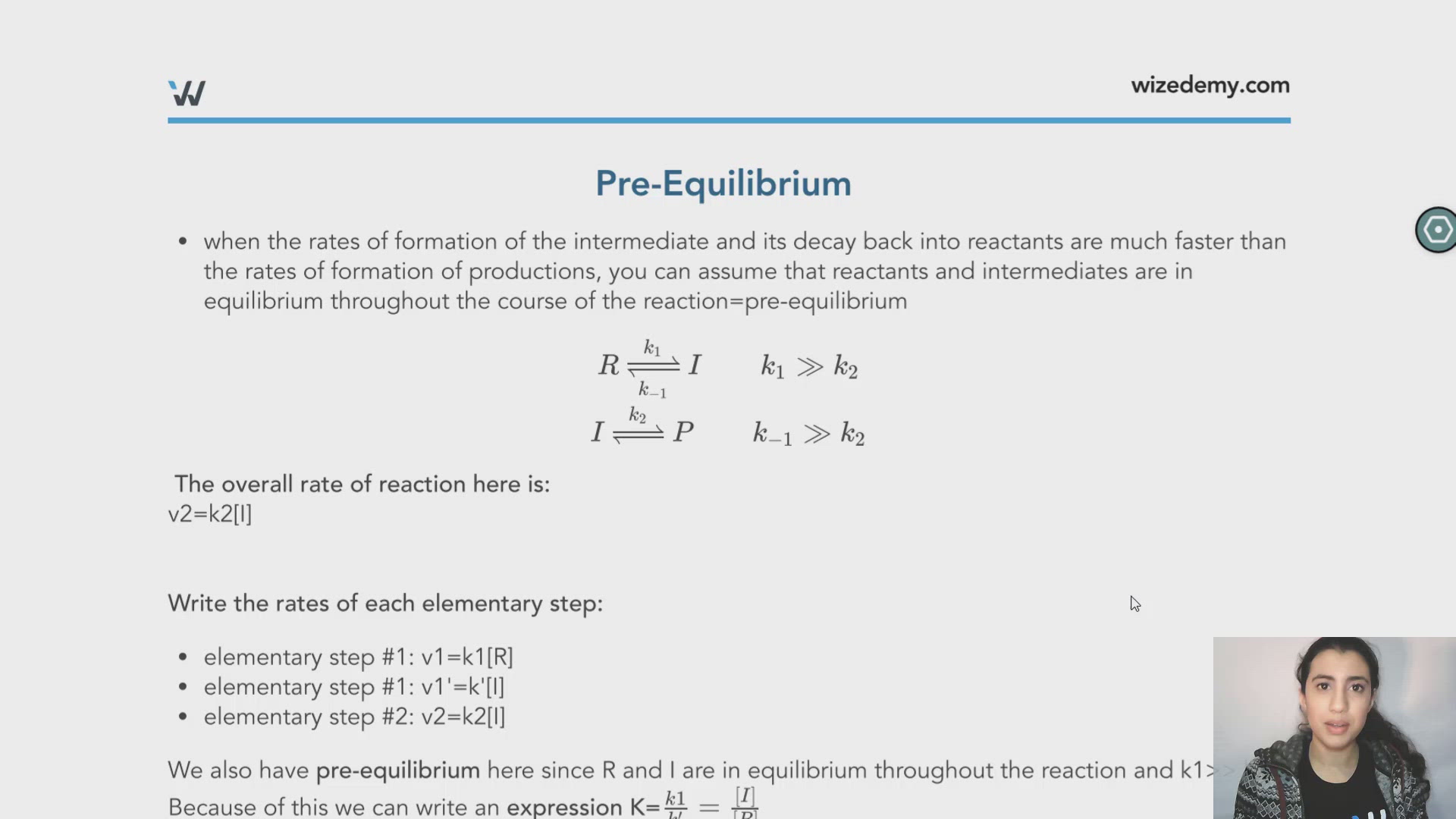
  • when the rates of formation of the intermediate and its decay back into reactants are much faster than the rates of formation of products, you can assume that reactants and intermediates are in equilibrium throughout the course of the reaction=pre-equilibrium

R⇌k−1k1Ik1≫k2R \xrightleftharpoons[k_{-1}]{k_1}I \hspace{20pt} k_1 \gg k_2

I⇌k2Pk−1≫k2I \xrightleftharpoons{k_2}P \hspace{20pt} k_{-1} \gg k_2

The overall rate of reaction here is:

v2=k2[I]


Write the rates of each elementary step:

  • elementary step #1: v1=k1[R]
  • elementary step #1: v1'=k'[I]
  • elementary step #2: v2=k2[I]

We also have pre-equilibrium here since R and I are in equilibrium throughout the reaction and k1>> k2


Because of this we can write an expression K=k1k′=[I][R]\frac{k1}{k'}=\frac{\left[I\right]}{\left[R\right]}

Now we can solve for our intermediate (I):


k1[R]k′=[I]\frac{k1\left[R\right]}{k'}=\left[I\right]


Now take the overall rate of reaction we have and plug in the expression for the intermediate:

v=v2=k2[I]

v=v2=k1k2[R]/k'


Could let K=k1k2/k' to simplify it:

v(overall)=K[R]


This was much faster than standard state approximation! We got the same answer by using pre-equilibrium and we were able to do this because there was an equilibrium between the reactants and intermediate!


Mark Yourself Question

  1. Grab a piece of paper and try this problem yourself.
  2. When you're done, check the "I have answered this question" box below.
  3. View the solution and report whether you got it right or wrong.

Write a rate law for the formation of NH3BH3 which involves only the concentration of reactants and rate constants.

B2H6+2NH3→2H3N−BH3‾\underline{B_2H_6+2NH_3\to2H_3N-BH_3}

B2H6⇋k−1k12BH3k1≫k2B_2H_6 \xleftrightharpoons[k_{-1}]{k_1}2BH_3 \hspace{20pt} k_1 \gg k_2

2NH3+2BH3→k22H3N−BH3k−1≫k22NH_3+2BH_3 \xrightarrow{k_2}2H_3N-BH_3 \hspace{20pt} k_{-1} \gg k_2


Create a free account to get started

Unlock full course notes by signing up

  • Video lessons taught by top educators
  • Practice questions with guided solutions
  • Written review notes for reference
  • Expert answers anytime from course tutors