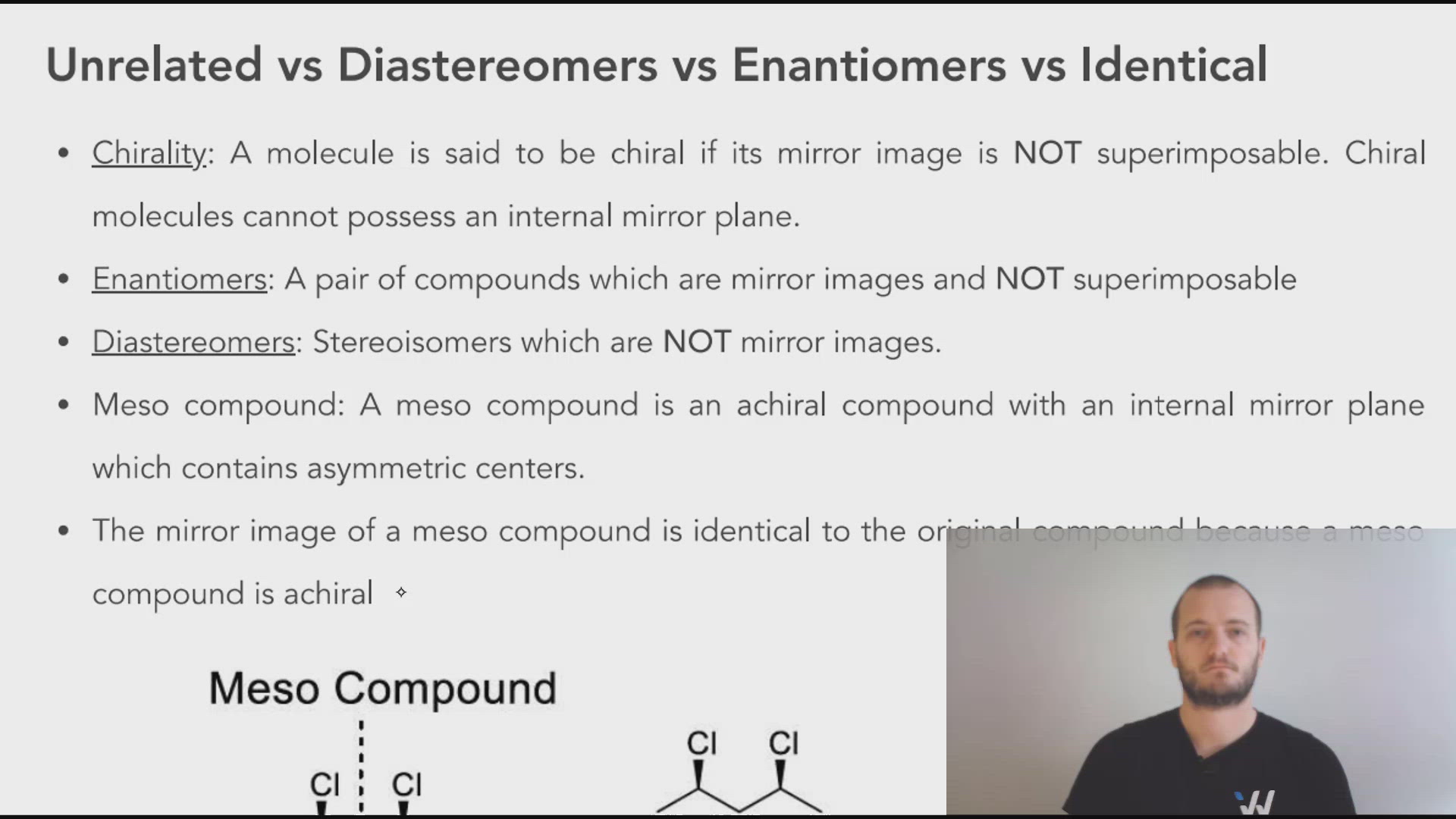
Unrelated vs Diastereomers vs Enantiomers vs Identical
- Chirality: A molecule is said to be chiral if its mirror image is NOT superimposable.
- Chiral molecules have chiral centres but cannot possess an internal mirror plane.
- Enantiomers: A pair of compounds which are mirror images and NOT superimposable
- Diastereomers: Stereoisomers which are NOT mirror images.
- Meso compound: A meso compound is an achiral compound with an internal mirror plane which contains chiral centers.
- The mirror image of a meso compound is identical to the original compound because a meso compound is achiral

Notice that if we take a chiral molecule with two chiral centers and change one of the centers we create a diastereomer but if we change all the chiral centers we create an enantiomer.

Enantiomers vs Diastereomers
Steps for Identifying Chirality in Molecules
- Do the molecules have the same bond connectivity?
- If no, they are unrelated compounds
- If yes, move on to step 2
- Are the compounds superimposable?
- If yes, they are identical
- If no, the molecules are stereoisomers (D or E)
- Are the compounds mirror images?
- If no, the compounds are diastereomers
- If yes, the compounds are enantiomers