Create a free account to get started

Unlock full course notes by signing up

  • Video lessons taught by top educators
  • Practice questions with guided solutions
  • Written review notes for reference
  • Expert answers anytime from course tutors

Arrhenius Equation

  • Rates of reaction are highly temperature dependent! Imagine the speed of ice melting at 0°C vs 40°C
  • Svante Arrhenius discovered a simple equation that relates the rate of a chemical reaction to the temperature which it is performed at. The Arrhenius equation is shown below.

ln⁡k=ln⁡A−EaRT\ln k=\ln A-\frac{Ea}{RT}


k=Ae−Ea/RTk=Ae^{-E_a/RT}

  • k is still the rate constant
  • A is called the pre-exponential factor, it is unique for all reactions and is constant across all temperatures. It is related to the probability of a successful collision.
  • T is temperature and R is the Gas constant
  • Ea is the activation energy, which is shown below graphically
Image illustrating Arrhenius Equation


  • Activation energy, Ea, is the amount of energy it takes to get to the products
  • The Arrhenius equation on its own is not very useful because of the pre-exponential factor A is difficult to calculate. However by dividing one rate by another and rearranging we end up with the following equation. Notice that A has been cancelled out and is no longer necessary.

ln⁡(k1k2)=−EaR(1T1−1T2)\ln \bigg(\cfrac{k_1}{k_2}\bigg)=-\cfrac{E_a}{R}\bigg(\cfrac{1}{T_1}-\cfrac{1}{T_2}\bigg)

  • We can use this equation to compare the rate of a reaction at two different temperatures.

a. A chemical reaction increases its rate by a factor of 15 when it is warmed from room temperature to 100oC. What is the activation energy of this process? R = 8.314 J/Kmol

ln⁡(k1k2)=−EaR(1T1−1T2)\ln \bigg(\cfrac{k_1}{k_2}\bigg)=\cfrac{-E_a}{R}\bigg(\cfrac{1}{T_1}-\cfrac{1}{T_2}\bigg)

Ea=−ln⁡(k1k2)R(1T1−1T2)=ln⁡(115)(8.314JK−1mol−1)(1298K−1373K)=33.4kJmol−1E_a=\cfrac{-\ln\bigg(\cfrac{k_1}{k_2}\bigg)R}{\bigg(\cfrac{1}{T_1}-\cfrac{1}{T_2}\bigg)}=\cfrac{\ln \bigg(\cfrac{1}{15}\bigg)(8.314 JK^{-1}mol^{-1})}{\bigg(\cfrac{1}{298K}-\cfrac{1}{373K}\bigg)}=33.4kJmol^{-1}

Create a free account to get started

Unlock full course notes by signing up

  • Video lessons taught by top educators
  • Practice questions with guided solutions
  • Written review notes for reference
  • Expert answers anytime from course tutors

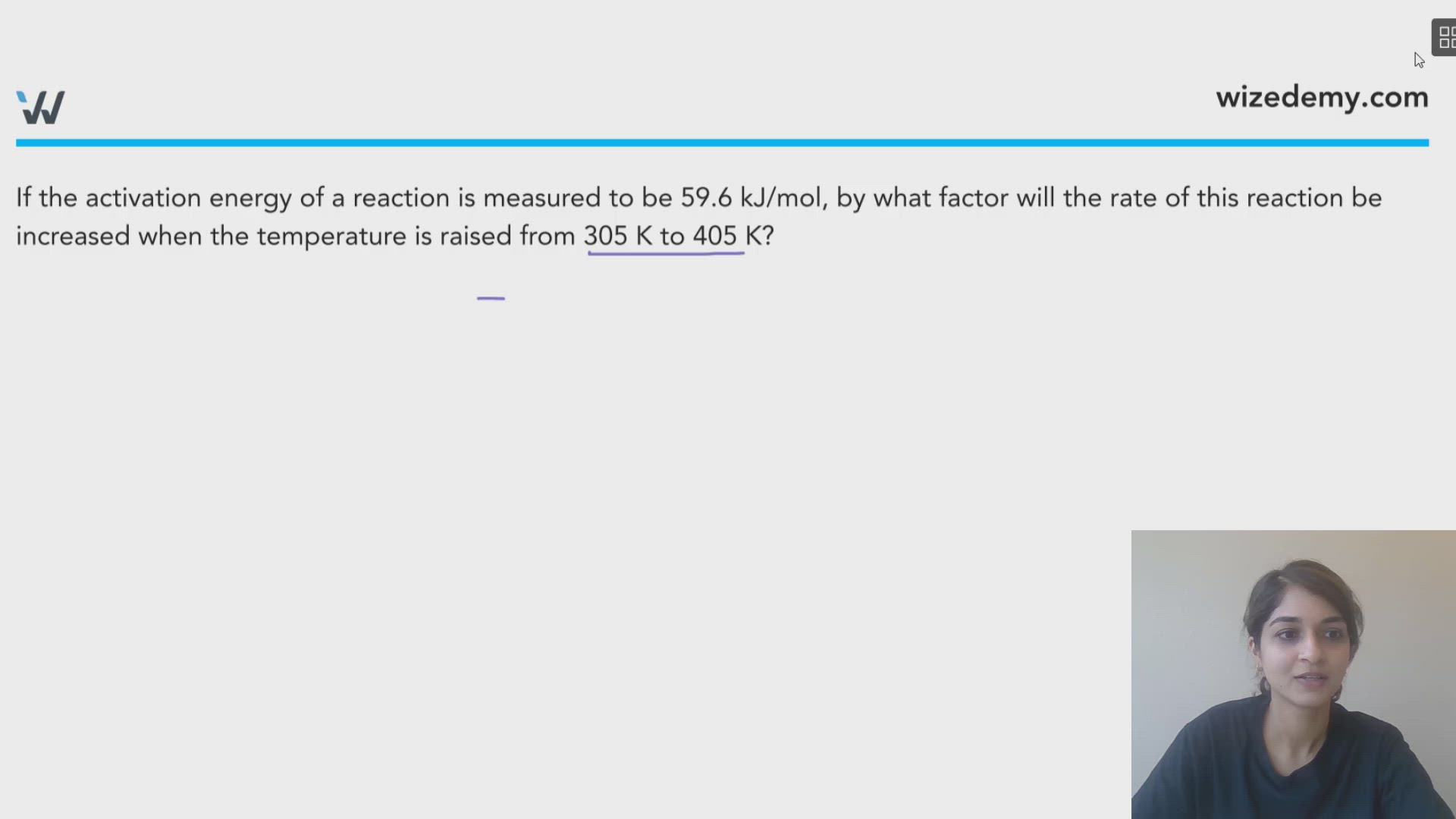
If the activation energy of a reaction is measured to be 59.6 kJ/mol, by what factor will the rate of this reaction be increased when the temperature is raised from 305 K to 405 K?


We start with the adapted Arrhenius equation,

ln⁡(k1k2)=−EaR(1T1−1T2)\ln \bigg(\cfrac{k_1}{k_2}\bigg)=-\cfrac{E_a}{R}\bigg(\cfrac{1}{T_1}-\cfrac{1}{T_2}\bigg)

the question is asking for the ratio of k2 to k1

k1k2=e−5.8=3.02×10⁻³\frac{k_1}{k_2}=e^{-5.8}=3.02\times 10^{-3}


k2k1=13.02×10−3=331\frac{k_2}{k_1}=\frac{1}{3.02\times10^{-3}}=331

The reaction will be 331 times faster at 405 K than it will be at 305 K. That's quite a bit!

Mark Yourself Question

  1. Grab a piece of paper and try this problem yourself.
  2. When you're done, check the "I have answered this question" box below.
  3. View the solution and report whether you got it right or wrong.

A Schiff base reaction between 3-propanone and aniline proceeds with rate constants of 0.0065 M-1 s -1 and 0.0084 M-1 s -1 at 30oC and 80oC respectively. Determine the activation energy and preexponential factor for this reaction.


Create a free account to get started

Unlock full course notes by signing up

  • Video lessons taught by top educators
  • Practice questions with guided solutions
  • Written review notes for reference
  • Expert answers anytime from course tutors

Extra Practice