
Arrhenius Equation
- Rates of reaction are highly temperature dependent! Imagine the speed of ice melting at 0°C vs 40°C
- Svante Arrhenius discovered a simple equation that relates the rate of a chemical reaction to the temperature which it is performed at. The Arrhenius equation is shown below.
- k is still the rate constant
- A is called the pre-exponential factor, it is unique for all reactions and is constant across all temperatures. It is related to the probability of a successful collision.
- T is temperature and R is the Gas constant
- Ea is the activation energy, which is shown below graphically

- Activation energy, Ea, is the amount of energy it takes to get to the products
- The Arrhenius equation on its own is not very useful because of the pre-exponential factor A is difficult to calculate. However by dividing one rate by another and rearranging we end up with the following equation. Notice that A has been cancelled out and is no longer necessary.
- We can use this equation to compare the rate of a reaction at two different temperatures.
a. A chemical reaction increases its rate by a factor of 15 when it is warmed from room temperature to 100oC. What is the activation energy of this process? R = 8.314 J/Kmol
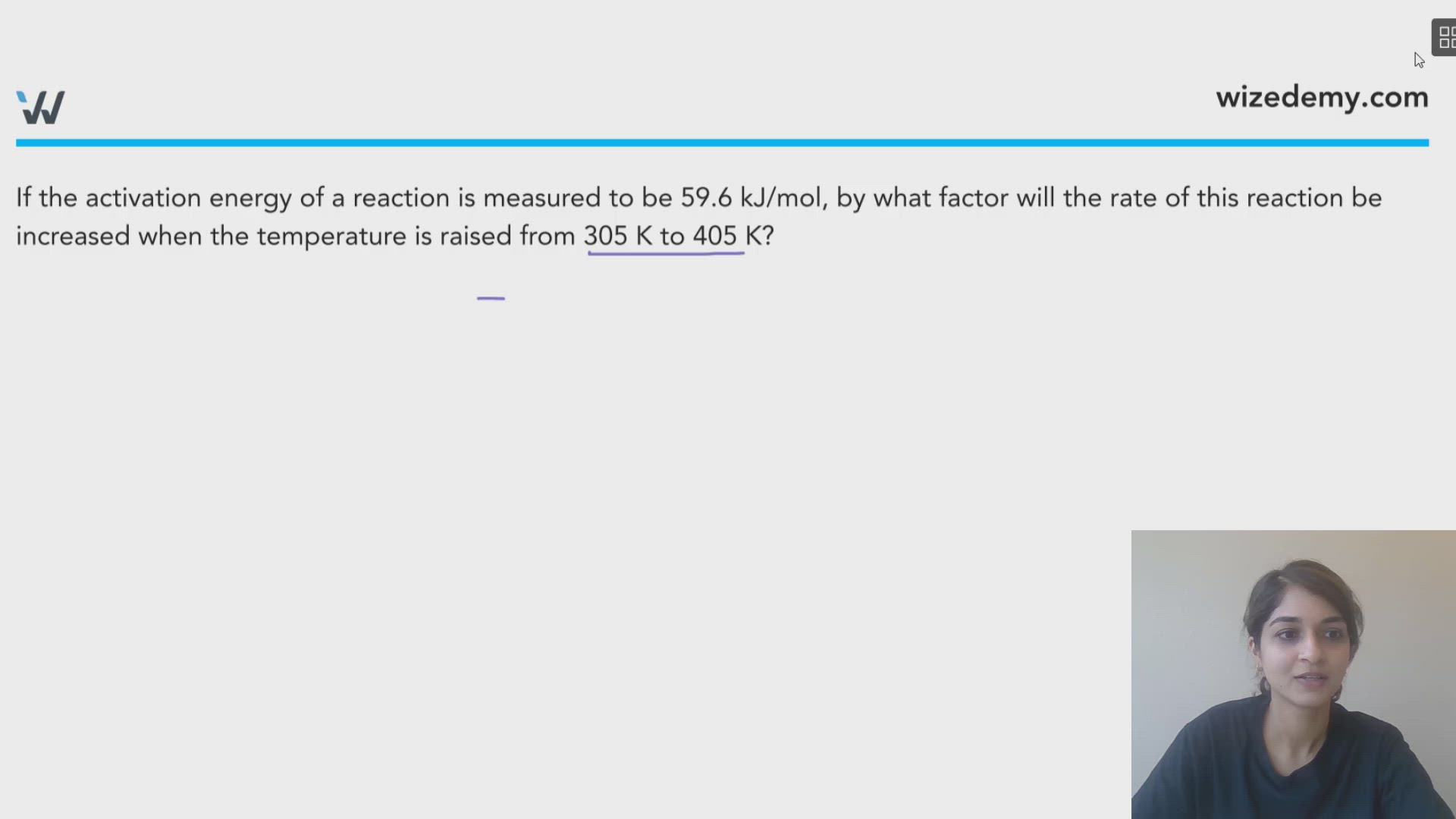
If the activation energy of a reaction is measured to be 59.6 kJ/mol, by what factor will the rate of this reaction be increased when the temperature is raised from 305 K to 405 K?
We start with the adapted Arrhenius equation,
the question is asking for the ratio of k2 to k1
The reaction will be 331 times faster at 405 K than it will be at 305 K. That's quite a bit!