Atomic Line Spectra
Emission and Absorption
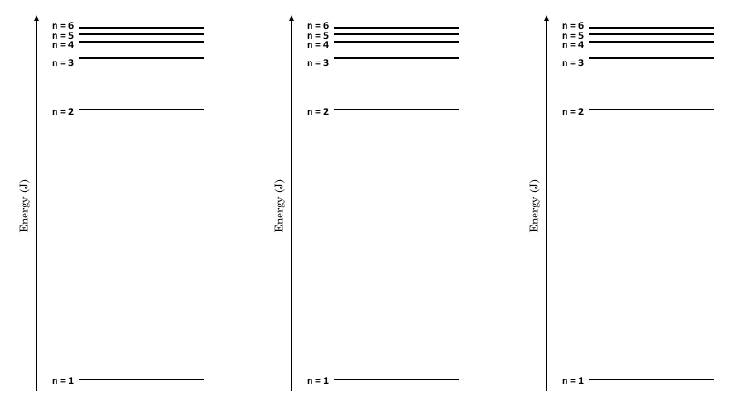
Note: n=1 is ground state, all other n levels are excited states
Emission Spectra
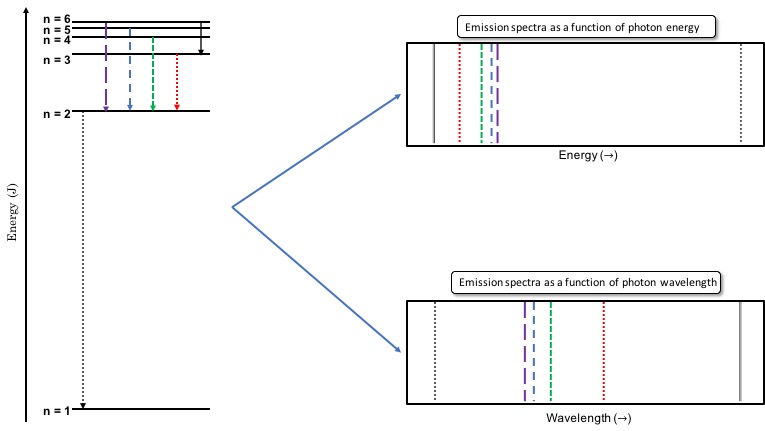

Relating Electronic Transitions to Emission Spectra
Bohr Model of the Hydrogen Atom

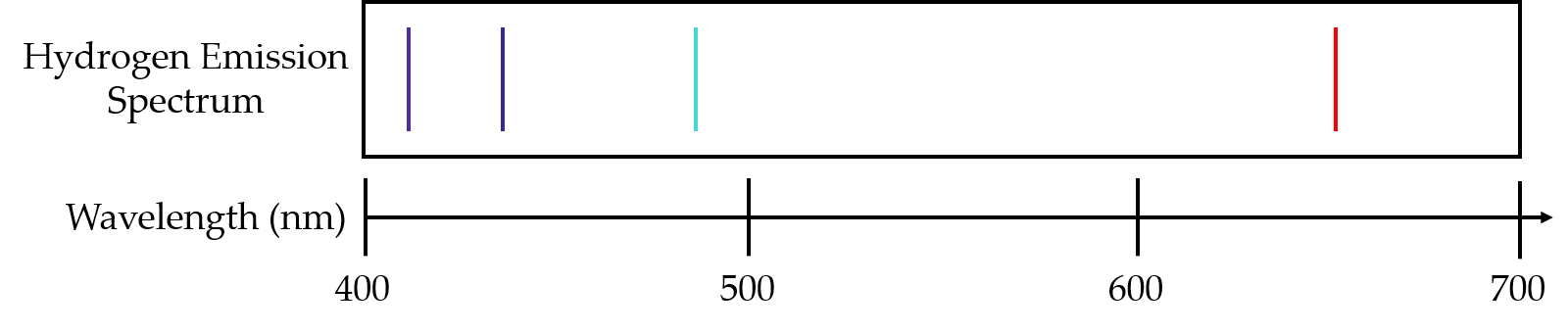
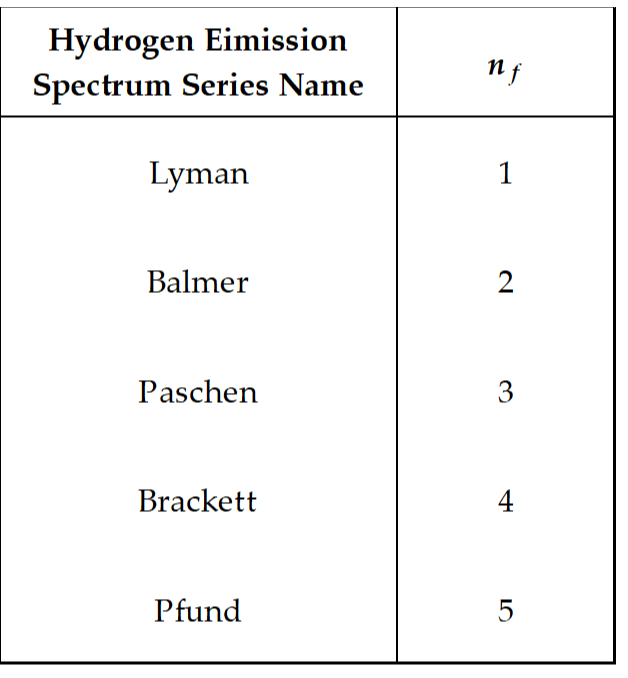
Hydrogen Emission Spectral Series:

Example: Removing an Electron
What wavelength of light corresponds to the 4th ionization energy of Beryllium?
Can start by solving for the energy difference for this transition:
The 4th I.E. of Be corresponds to , which is a transition from n = 1 to n = infinity for a one-electron species .
Therefore,
Now you can solve for the wavelength that the energy difference corresponds to:
λ=5.704x10⁻⁹ m
1nm=1x10⁻⁹m
Divide meters value by 1x10⁻⁹ to get nm
λ=5.704nm
