
Price Floor
A price floor is a lower limit on the price that producers can legally charge consumers.
The best example is the minimum wage law, where the government prevents employers from paying a wage below a certain amount.

The reason why a price floor is above equilibrium is because it is meant to protect the producers. Example: If bananas are currently selling for $3 per kilogram the government can put a price floor at $4 (which means the supermarket has to charge at least $4) so that the farmers make more money.
In the diagram below, if the equilibrium wage is at $10 per hour, the government can put a minimum wage (price floor) at $15 per hour to protect the workers. When we are talking about supply and demand for labor, the supply is the workers willing to work at that job and the demand is the company that wants to hire workers.

Inefficiencies of Price Floors
Price Floors lead to:
- ________ for the product in the market place. In the diagram above, there would be a surplus of ________workers. The quantity of workers actually hired would be ________
- Black market activity - sometimes employers cannot afford to pay their workers the minimum wage so they hire some people illegally at a lower wage and pay them cash (under the table).
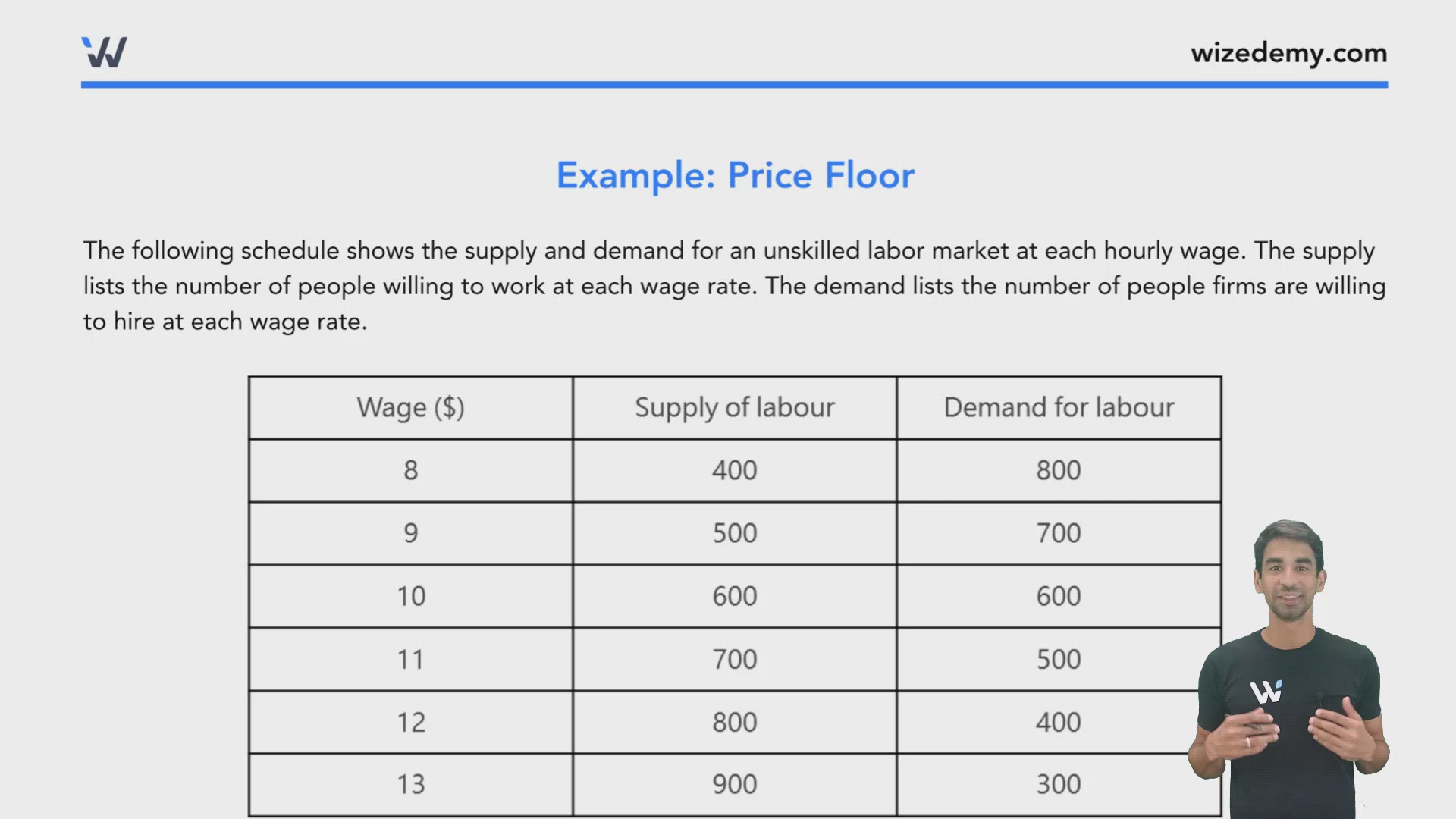
Example: Price Floor
The following schedule shows the supply and demand for an unskilled labor market at each hourly wage. The supply lists the number of people willing to work at each wage rate. The demand lists the number of people firms are willing to hire at each wage rate.
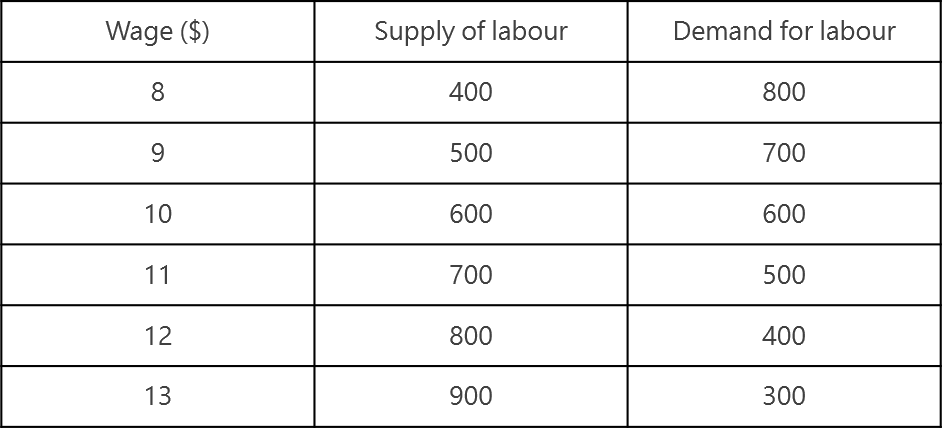
Suppose that the government imposes a minimum wage of $13 an hour. How many people will be unemployed?
600 workers.
At $13 the supply of labor is 900 and the demand for labor is 300. This means there is an excess supply of 900 - 300 = 600 workers. These workers will be unemployed. This is because 900 people are willing to work, but the firm can only afford to hire 300 workers. The excess supply is always the number of people unemployed.