
Price Elasticity of Demand
Inelastic
- Means you are insensitive to the price
- If price rises, the quantity demanded will fall by only a little bit. Example: Medicine
Elastic
- Means you are sensitive to the price
- If price rises, the quantity demanded will fall by a lot. Example: Pepsi
Point Price Elasticity of Demand
- For products that have inelastic demand, the absolute value of Price Elasticity of Demand (Ed) will be ________ than 1 Example: If the price of medicine increases by 50% and the quantity demanded falls by 10% (notice percentage change in quantity is smaller than percentage change in price), then what would be the price elasticity of demand?
Elasticity of demand = -10% / 50% = -0.2
The absolute value of -0.2 is 0.2 which is less than 1 (meaning inelastic).
- For products that have elastic demand, the absolute value of Ed will be ________ than 1 Example: If the price of Pepsi increases by 5% and the quantity demanded falls by 50% (notice percentage change in quantity is larger than percentage change in price), then what would be the price elasticity of demand?
Elasticity of demand = -50% / 5% = -10
The absolute value of -10 is 10 which is greater than 1 (meaning elastic).
- For products that have unit elastic demand, the absolute value of Ed will be ________ to 1 Example: If the price of oranges increases by 5% and the quantity demanded falls by 5% (notice percentage change in quantity is equal to percentage change in price), then what would be the price elasticity of demand?
Elasticity of demand = -5% / 5% = -1
The absolute value of -1 is 1 which is unit elastic (in the real world there's no example of products with unit elastic demand, it's just a concept.
For products with different types of demand, the absolute value of the Price Elasticity of Demand will have different values:
Percentage Change
In the examples above the percentage changes were given. If they give you just a change (without percentages) you can use the following formula to convert to percentages:
Example: If the quantity changes from 40 to 50 units what is the percentage change?
Percentage change = (50 - 40) / 40 * 100 = 25%
Example: Point Elasticity with Numbers and Equations
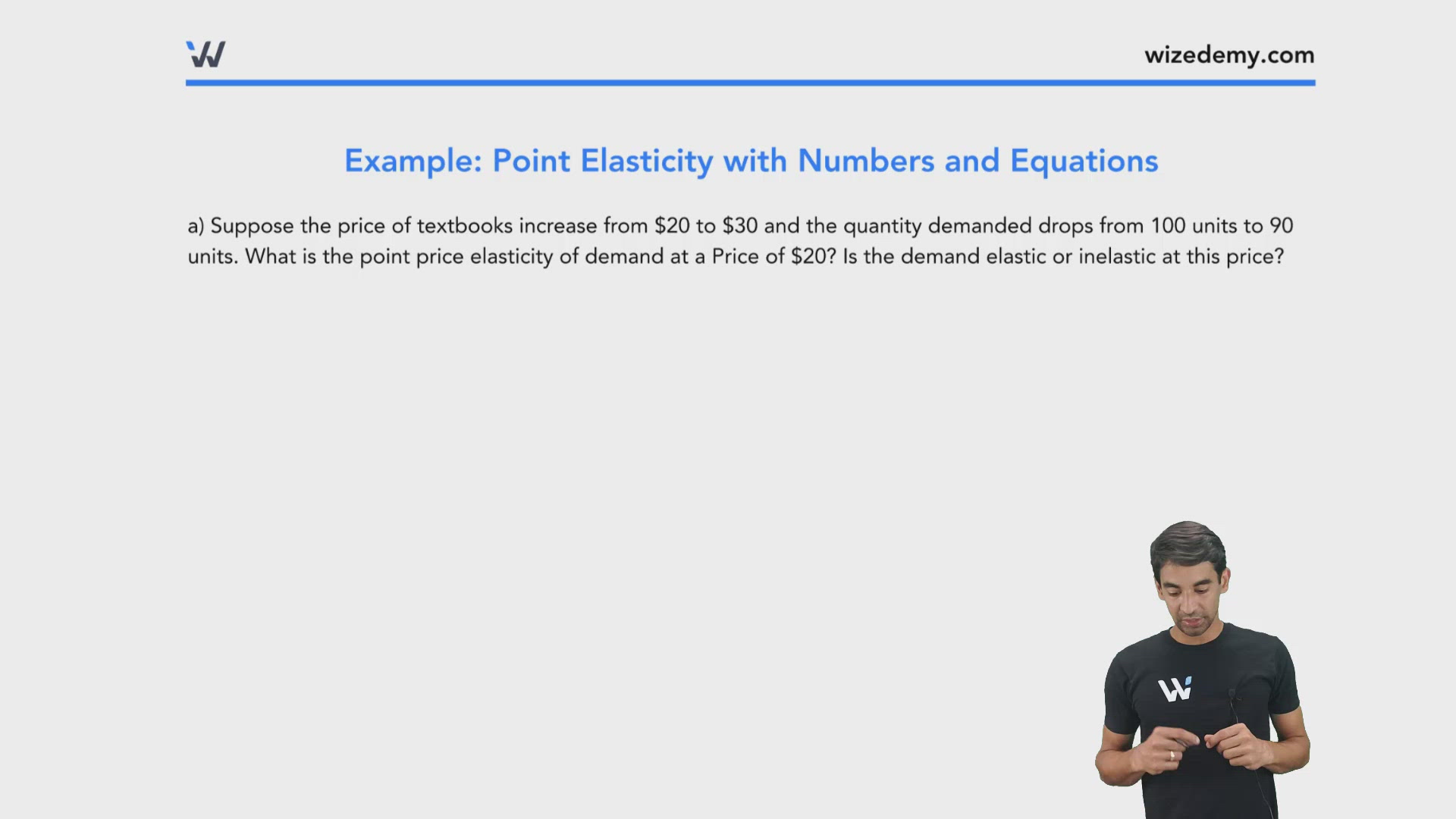
a) Suppose the price of textbooks increase from $20 to $30 and the quantity demanded drops from 100 units to 90 units. What is the point price elasticity of demand at a Price of $20? Is the demand elastic or inelastic at this price?
Point price elasticity of demand (point Ed) =
% Change in P =
% Change in Q =
Point Ed =
Point Ed = -0.2 which is inelastic (absolute value is less than 1)
b) If the demand equation is P = 70 – 2Q, what is the price elasticity of demand at a price of $40?
First lets plug in price of 40 in the demand equation to get the quantity:
40 = 70 - 2Q
2Q = 30
Q = 15
Since they only gave you one price, you can just make up any number for a second price and plug in to the demand so that you can get the corresponding quantities (you can always do this). For example let's plug the second price as $50:
50 = 70 - 2Q
2Q = 20
Q = 10
Now we have 2 prices and 2 quantities so we can find the percentage changes:
% Change in P =
% Change in Q =
Point price elasticity of demand (point Ed) =
Point Ed =
Point Ed = -1.33 which is elastic (absolute value is greater than 1)