Imports
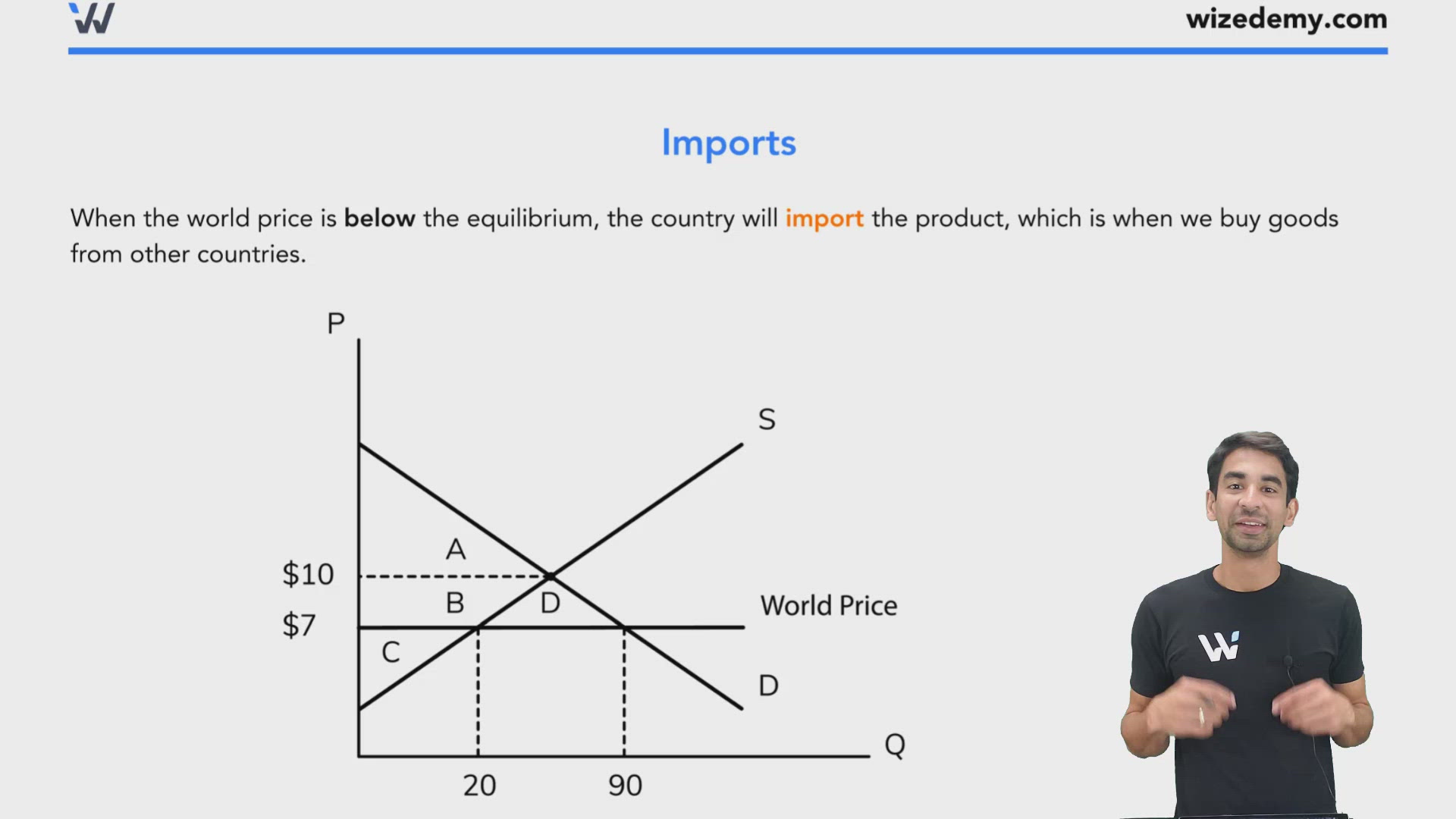
When the world price is below the equilibrium, the country will import the product, which is when we buy goods from other countries.

- At the world price of $7 the domestic demand is ________ units and domestic supply is ________ units.
- The imports are equal to the excess ________
- In the diagram above, the imports = ________ units.
- With trade, the consumer surplus is everything above the price but below the demand until the quantity of 90 since that is the quantity consumers are getting in total. This is the triangle A + B + D.
- With trade, producer surplus is everything below the price but above the supply until a quantity of 20 because that's all the domestic producers are selling. This is the triangle C.
Before Trade After Trade Change
Consumer Surplus ________ ________ ________
Producer Surplus ________ ________ ________
Total Surplus ________ ________ ________
Imports with Tariff
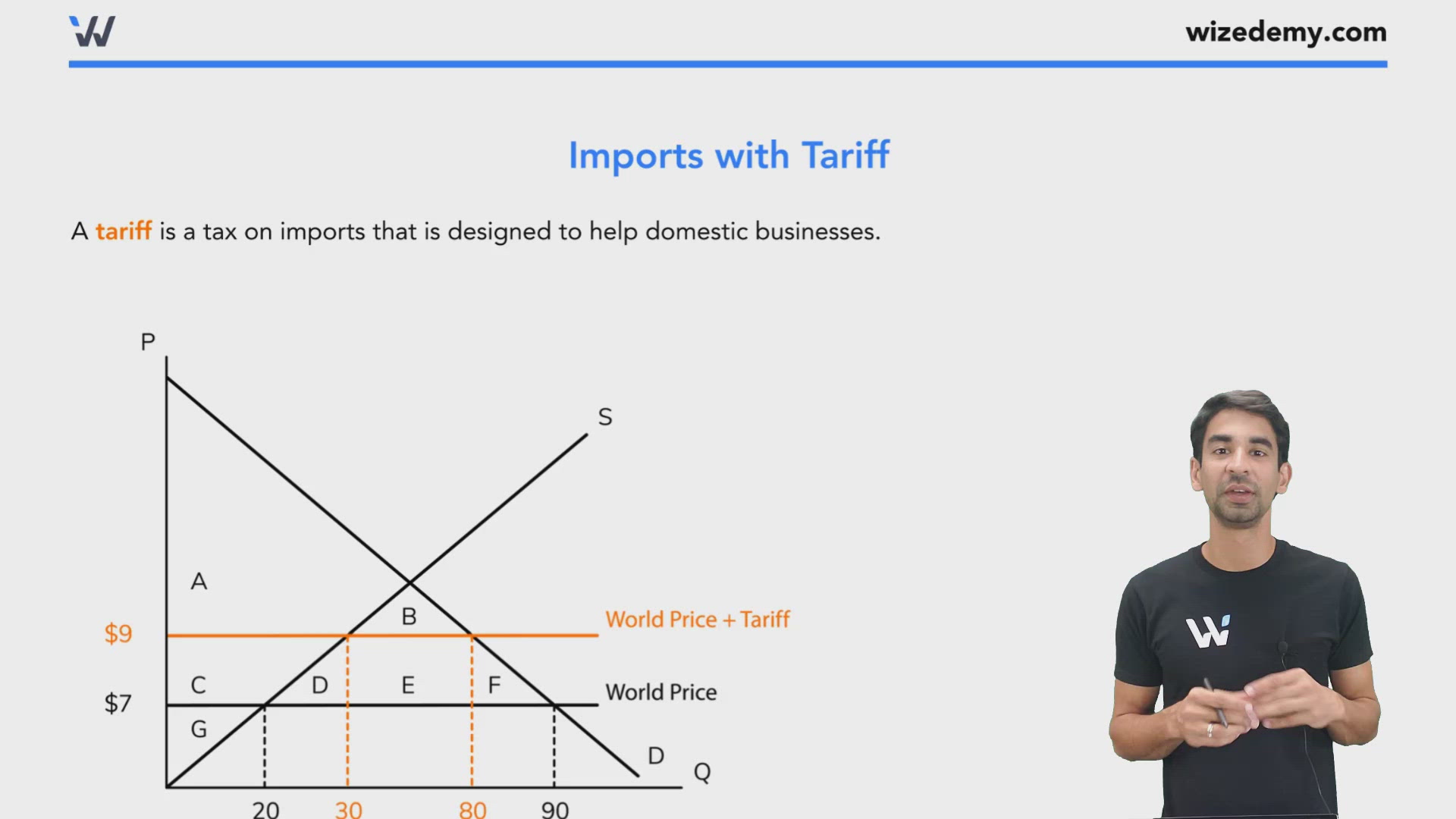
A tariff is a tax on imports that is designed to help domestic businesses.

- In the diagram above, the world price was $7 with free trade and then the government put a $2 tariff that raises the price to $9.
- With a tariff, the quantity demanded is ________ units and the domestic supply is ________ units so the imports are ________ units.
- The consumer surplus is everything above the price of $9 but below the demand until a quantity of 80 (since that is the quantity consumers are getting in total) which is the triangle A + B.
- The producer surplus is everything below the price of $9 but above the supply until a quantity of 30 (since that is the quantity domestic producers are selling) which is the triangle C + G.
- The government tariff revenue is the tariff multiplied by the imports (because the government doesn't tax the domestic businesses). This would be ________ which is the rectangle E. These areas can be summarized below:
Before Tariff (Free Trade) After Tariff Change
Consumer Surplus ________ ________ ________
Producer Surplus ________ ________ ________
Government Revenue ________ ________ ________
Total Surplus ________ ________ ________
Example: Tariff
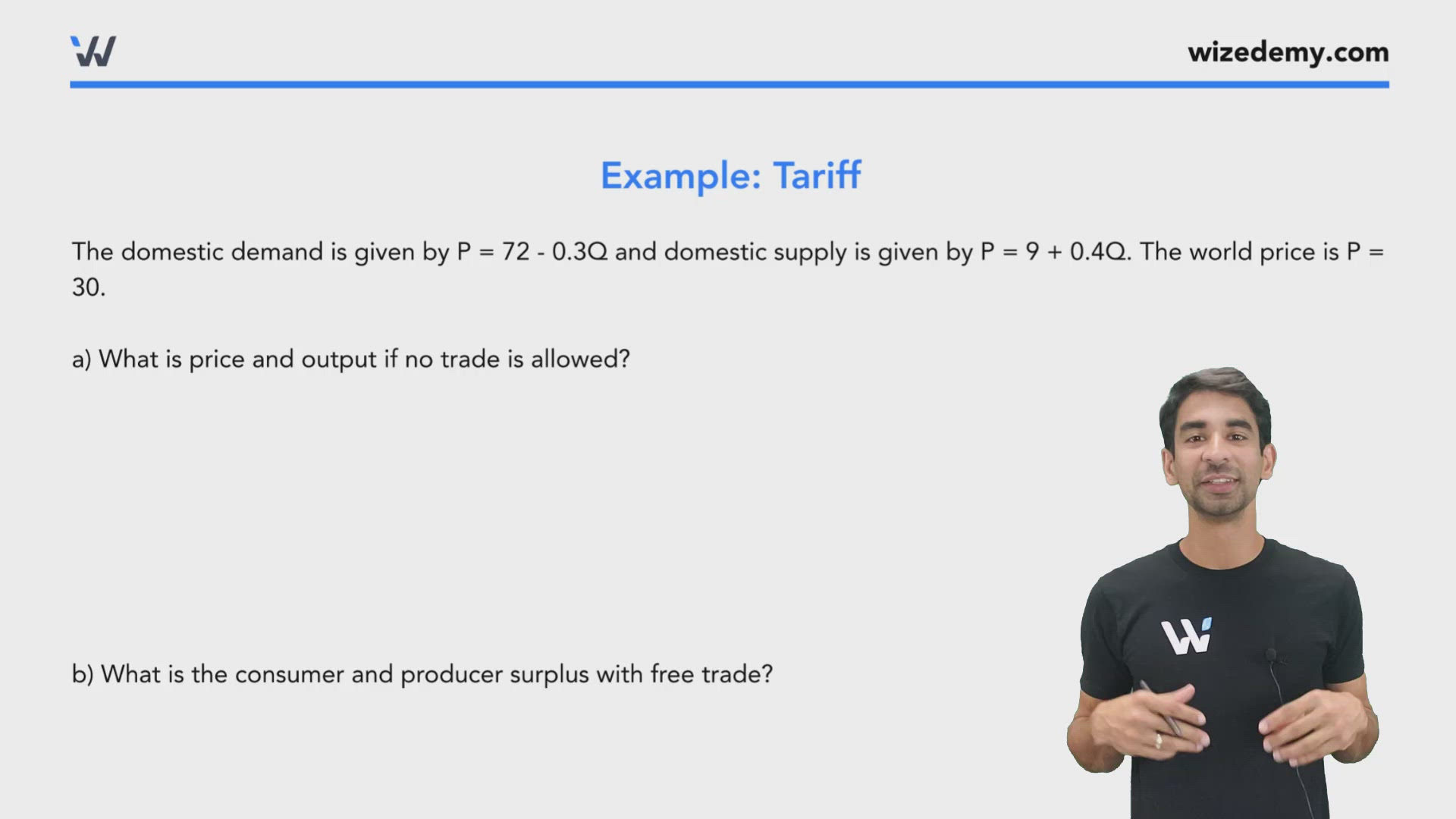
The domestic demand is given by P = 72 - 0.3Q and domestic supply is given by P = 9 + 0.4Q. The world price is P = 30.
a) What is price and output if no trade is allowed?
This is just regular equilibrium:
72 - 0.3Q = 9 + 0.4Q
63 = 0.7Q
Q = 90
P = 9 + 0.4(90) = 45
b) What is the consumer and producer surplus with free trade?
Plug 30 as the price in to both demand and supply equations
Supply:
30 = 9 + 0.4Q
0.4Q = 21
Q = 52.5
Demand:
30 = 72 - 0.3Q
0.3Q = 42
Q = 140
Consumer surplus = 140 * (72 - 30) * 1/2 = $2940
Producer surplus = 52.5 * (30 - 9) * 1/2 = $551.25
c) What is consumer surplus, producer surplus, tariff revenue and deadweight loss if there is a $3 tariff?
New price will be 30 + 3 = 33
Plug 33 in demand and supply as the price
Supply:
33 = 9 + 0.4Q
0.4Q = 24
Q = 60
Demand:
33 = 72 - 0.3Q
0.3Q = 39
Q = 130
Consumer surplus = 130 * (72 - 33) * 1/2 = $2535
Producer surplus = 60 * (33 - 9) * 1/2 = $720
Imports = 130 - 60 = 70
Tariff Revenue = tariff * imports = $3 * 70 = $210
DWL = (7.5 * 3 * 1/2) + (10 * 3 * 1/2) = $26.25