
Geometric Series
A geometric series is the sum of the terms of a geometric sequence.
The sum of the first terms of a geometric series (called the partial sum) is given by:
Note: an equivalent formula can be written using the first term, , and the th term, :
Example
Consider the geometric sequence
What is the associated geometric series? ________
What is the common ratio? ________
What is the sum of the first 4 terms of this series?
The first term is , and we want to find the sum of the first terms:
When is small, we can easily check:
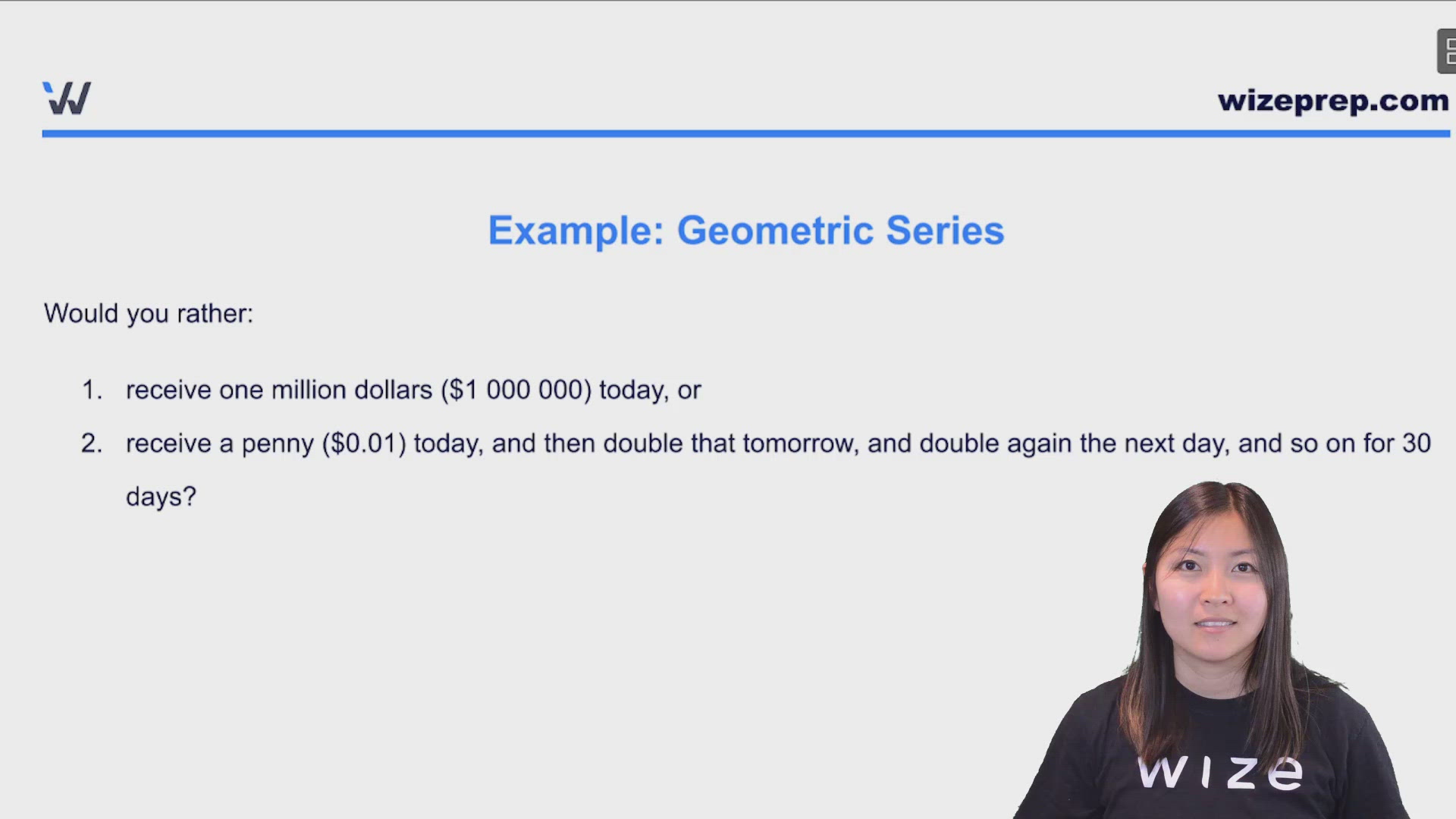
Example: Geometric Series
Would you rather:
- receive one million dollars ($1 000 000) today, or
- receive a penny ($0.01) today, and then double that tomorrow, and double again the next day, and so on for 30 days?
Let's use geometric series to calculate the total amount of money received in the second scenario, where days.
In this scenario, the geometric series is:
The first term of the series corresponds to the amount on the first day:
The common ratio is how much we multiply the amount by every day:
Therefore, by waiting 30 days, the second scenario allows you to receive more than 10 times what is offered in the first scenario!
This is the power of geometric growth, which is the same exponential growth but with discrete steps (not continuous).
Summary - Geometric Series
A geometric series is when we sum up (add up) all the terms in a geometric sequence.
The nth partial sum of a geometric series is when we add up the first n numbers in the geometric sequence. There are two formulas that calculate the nth partial sum.
Formula #1
where,
- is the nth partial sum
- is the first term in the geometric sequence
- is the common ratio between terms in the geometric sequence (we get this by dividing any number in the geometric sequence by the previous number)
Formula #2
where,
- is the nth partial sum
- (or ) is the n+1 term in the geometric sequence
- (or ) is the first term in the geometric sequence
- is the common ratio between terms in the geometric sequence (we get this by dividing any number in the geometric sequence by the previous number)