Create a free account to get started

Unlock full course notes by signing up

  • Video lessons taught by top educators
  • Practice questions with guided solutions
  • Written review notes for reference
  • Expert answers anytime from course tutors

Limit Basics

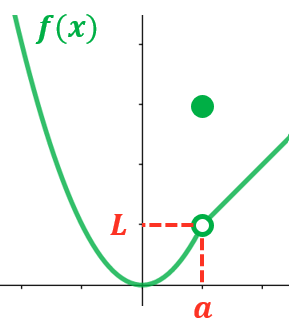
When we talk about limits we look for what is happening close to a function at a certain value of xx. The question is: What happens to a function's output (the yy value) as we approach a certain input (the xx value)?


Definition of a Limit

Let f(x)f\left(x\right) be a function and let aa and LL be real numbers.


If f(x)f\left(x\right) approaches LL as xx approaches aa then we say f(x)f\left(x\right) has limit LL and denote it as


lim⁡x→af(x)=L\displaystyle\boxed{\lim_{x\rightarrow a}f(x)=L}


Note: We read this as "the limit as xx approaches aa of f(x)f(x) equals LL".


Image illustrating Limit Basics


Create a free account to get started

Unlock full course notes by signing up

  • Video lessons taught by top educators
  • Practice questions with guided solutions
  • Written review notes for reference
  • Expert answers anytime from course tutors

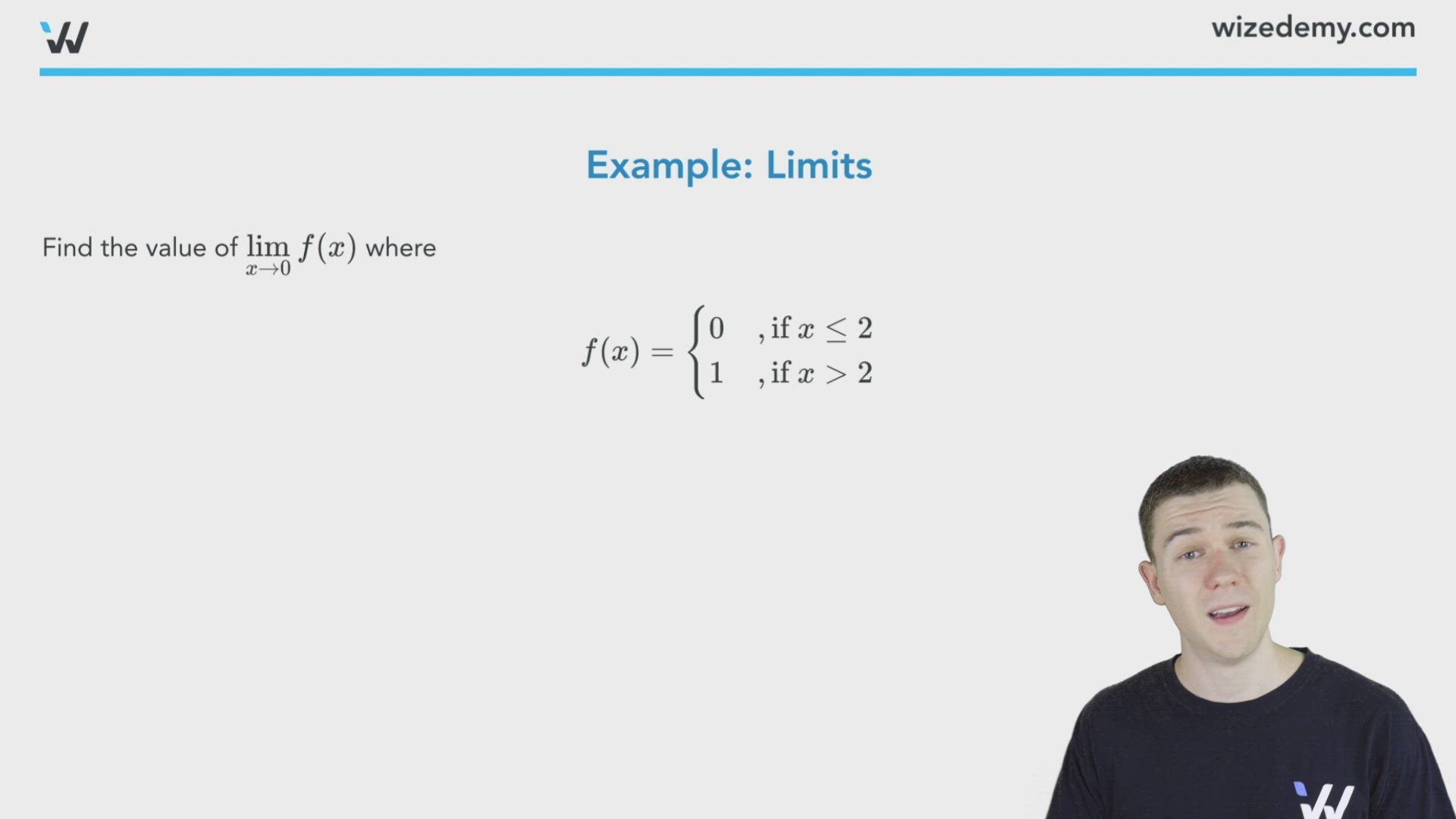
Example: Limits

Find the value of lim⁡x→0f(x)\displaystyle\lim_{x\rightarrow0}f(x) where

f(x)={0,if x≤21,if x>2f(x)= \begin{cases} 0 & , \text{if } x \leq 2\\ 1 & , \text{if } x > 2 \end{cases}


Notice how as xx "approaches" 00, we are located in the first row of the piecewise function (x≤2)\left(x\le2\right).

So, lim⁡x→0f(x)=0\displaystyle\lim_{x\rightarrow0}f(x)=0.

Extra Practice