
Transformations of Cubic Functions
Let be the parent function for a cubic polynomial function.
If , then the following is true:
Point Mapping
If the point is a point on , then the point on the transformed function becomes:
Example
Let's graph function , stating the following:
- The transformations applied to the parent function
- Domain & Range
- End Behaviour
- -Intercepts & Multiplicity
The table of values for the parent function :
Domain:
Range:
The transformations applied to the parent function:
Therefore, every point (x, y) on will transform to
Sketch & the table of values for :

Domain:
Range:
End Behaviour:
- As
- As
-Int.:
Multiplicity of -int: Odd multiplicity of 3

Example: Transformations of Cubic Functions
Identify the transformations applied to the function and graph the function.
The table of values for the parent function is:
The table of values and graph of :


Transformations of Quartic Functions
Let be the parent function for a quartic polynomial function.
If , then the following is true:
Point Mapping
If the point is a point on , then the point on the transformed function becomes:
Example
Let's graph function , stating the following:
- The transformations applied to the parent function
- Domain & Range
- End Behaviour
- X-Intercepts & Multiplicity
The table of values for the parent function :
Domain:
Range:
The transformations applied to the parent function:
Therefore, every point (x, y) on will transform to
Sketch & the table of values for :
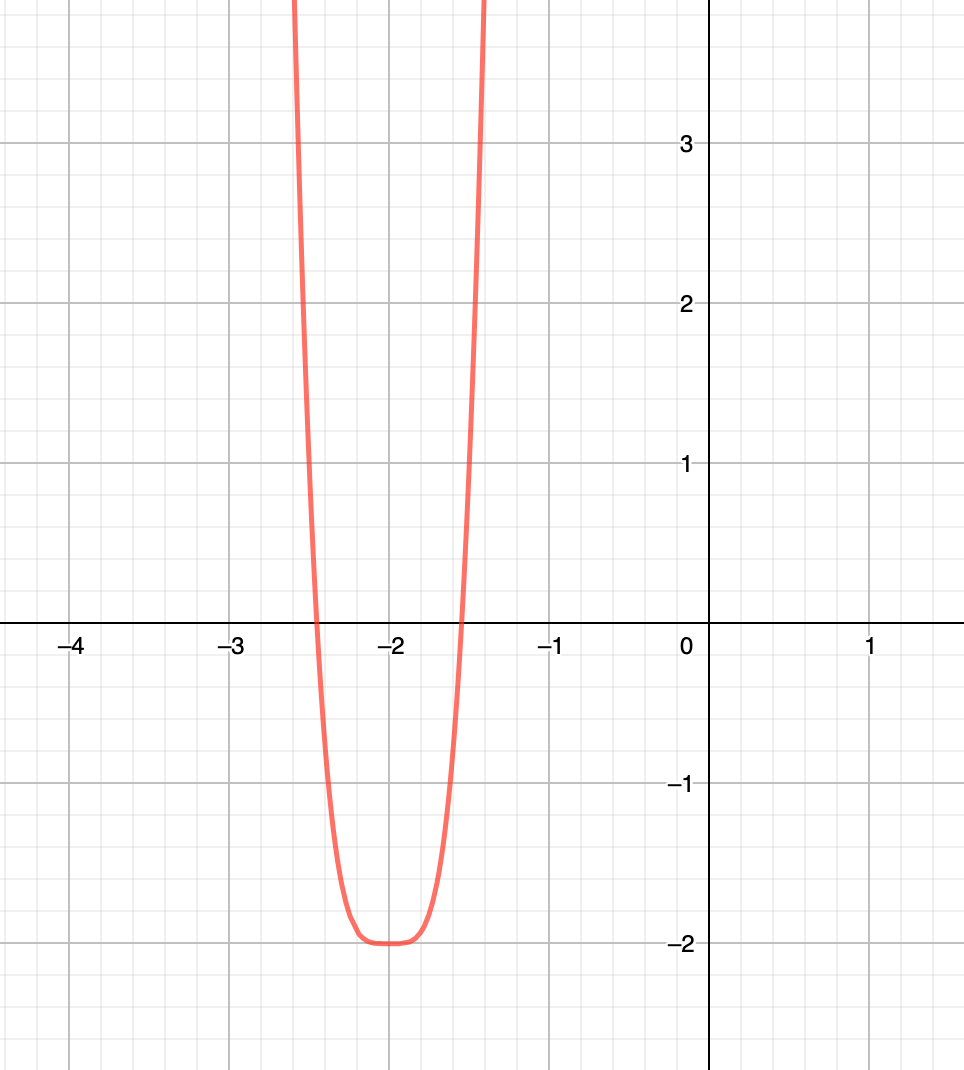
Domain:
Range:
End Behaviour:
- As
- As
-Int.:
Mutliplicity: Odd multiplicity of 1 for

Example: Transformations of Quartic Functions
Identify the transformations applied to the function and graph the function.
The table of values for the parent function is:
The table of values and graph of :
