Create a free account to get started

Unlock full course notes by signing up

  • Video lessons taught by top educators
  • Practice questions with guided solutions
  • Written review notes for reference
  • Expert answers anytime from course tutors

Remainder Theorem, Factor Theorem, & Rational Root Theorem


Factoring polynomials of degree 3 or higher requires the use of polynomial division along with 3 important theorems:

Remainder Theorem

Let y=f(x) y=f(x)~ be a polynomial function of degree nn. If f(x) ÷ (x−a)f(x)~\div~(x-a), then the remainder, rr, is:

f(a)=r\boxed{f(a)=r}


Example 1


Find the remainder of x3−5x+1x^3-5x+1 when it is divided by (x−2)(x-2).


Using the remainder theorem, find f(2):f(2):

f(2)=(2)3−5(2)+1=−1             f(2)=(2)^3-5(2)+1\newline{} =-1~~~~~~~~~~~~~

The remainder is -1


Factor Theorem

Let y=f(x) y=f(x)~ be a polynomial function of degree nn. If (x−a)(x-a)is a factor of y=f(x).y=f(x).Then:

f(a)=0\boxed{f(a)=0}

Example 2


Determine if (x+2)(x+2) is a factor of x2+5x+6x^2+5x+6 .


Using the factor theorem:

f(−2)=(−2)2+5(−2)+6=0                   f(-2)=(-2)^2+5(-2)+6\newline{} =0~~~~~~~~~~~~~~~~~~~


Since the remainder is 0, then (x+2)(x+2) is a factor of x2+5x+6x^2+5x+6

Rational Root Theorem

If f(x)=axn+bxn−1+ ... +cx+df(x)=ax^n+bx^{n-1}+~...~+cx+d is divided by (x−a)(x-a), then the possible roots of f(x) f(x)~ are:

{Factors of dFactors of a}\Bigg\{\frac{\text{Factors of d}}{\text{Factors of a}} \Bigg\}


Example 3


Determine all the roots for y=2x3+x−5y=2x^3+x-5.


Using the rational root theorem:

{Factors of -5Factors of 2}=±1,51,2=±12,15,1,5\Bigg\{\frac{\text{Factors of -5}}{\text{Factors of 2}}\Bigg\}=\pm\displaystyle\frac{1,5}{1,2}=\pm\frac{1}{2},\frac{1}{5},1,5


Create a free account to get started

Unlock full course notes by signing up

  • Video lessons taught by top educators
  • Practice questions with guided solutions
  • Written review notes for reference
  • Expert answers anytime from course tutors

Factoring Polynomials (Degree 3+)

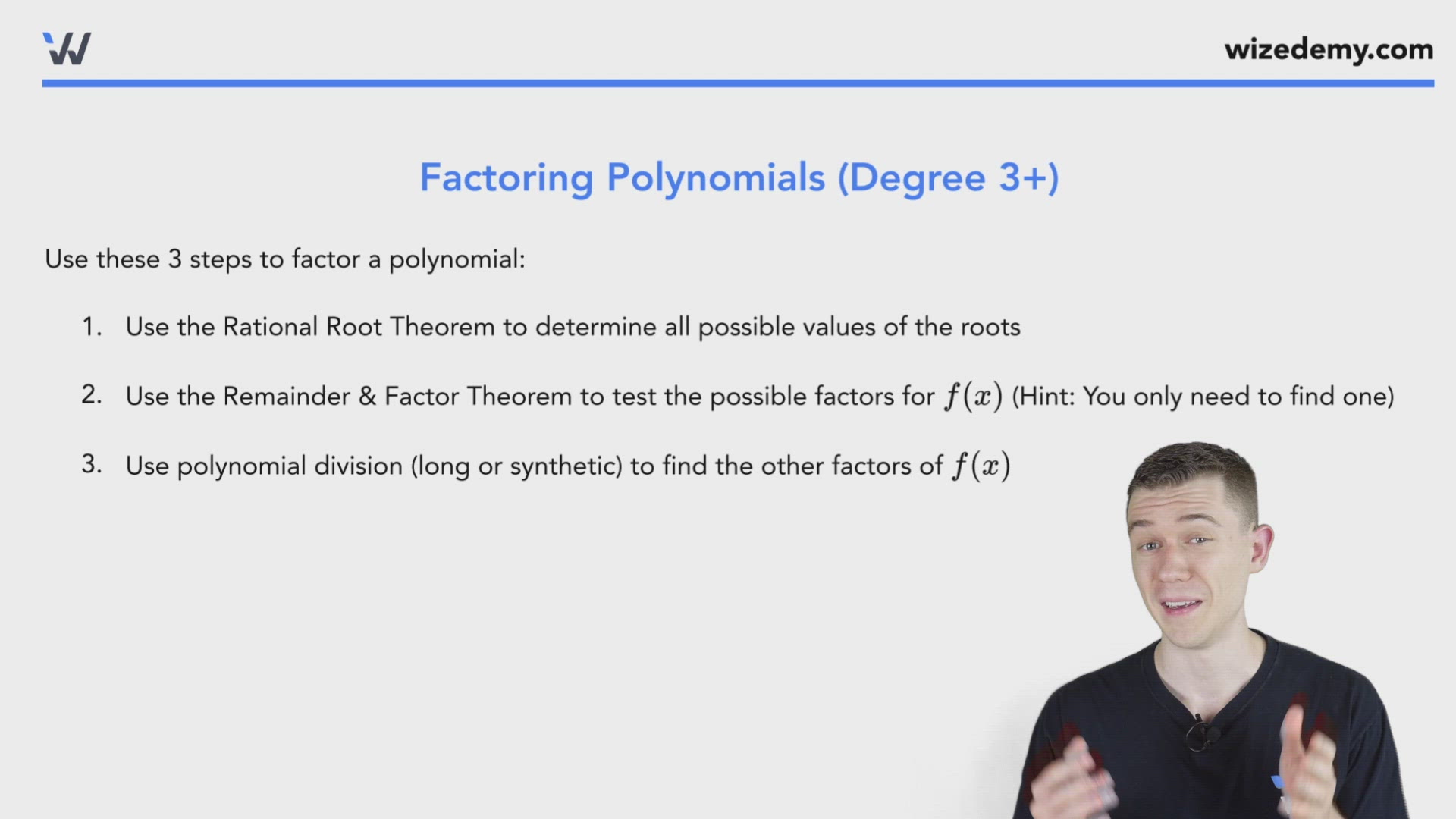
Use these 3 steps to factor a polynomial:

  1. Use the Rational Root Theorem to determine all possible values of the roots
  2. Use the Remainder & Factor Theorem to test the possible factors for f(x)f(x) (Hint: You only need to find one)
  3. Use polynomial division (long or synthetic) to find the other factors of f(x)f(x)

Example

Fully factor f(x)=2x3−2x2−32x+32f(x)=2x^3-2x^2-32x+32


Step 1.

Use the Rational Root Theorem to determine all possible values of the roots


Factors of 32: 1, 2, 4, 8, 16, 32

Factors of 2: 1, 2


All possible factors are:

±1,2,4,8,16,321,2=±12,1,2,4,8,16,32\pm\frac{1, 2, 4, 8, 16, 32}{1, 2}=\pm\frac{1}{2},1, 2, 4, 8, 16, 32


Step 2.

Use the Remainder & Factor Theorem to test the possible factors for f(x)f(x) (Hint: You only need to find one)


x=12‾\underline{x=\frac{1}{2}}:

f(12)=2(12)3−2(12)2−32(12)+32=−14−16+32                     ≠0                                            f\bigg(\frac{1}{2}\bigg)=2\bigg(\frac{1}{2}\bigg)^3-2\bigg(\frac{1}{2}\bigg)^2-32\bigg(\frac{1}{2}\bigg)+32\newline{}\newline{} =-\frac{1}{4}-16+32~~~~~~~~~~~~~~~~~~~~~\newline{}\newline{} \neq0~~~~~~~~~~~~~~~~~~~~~~~~~~~~~~~~~~~~~~~~~~~


Since x=12 x=\frac{1}{2}~ does not give a remainder of 0, then (2x−1) (2x-1)~ is not a factor of f(x)


x=1‾\underline{x=1}:

f(1)=2(1)3−2(1)2−32(1)+32=0                                   f(1)=2(1)^3-2(1)^2-32(1)+32\newline{} =0~~~~~~~~~~~~~~~~~~~~~~~~~~~~~~~~~~~


Since x=1 x=1~ gives a remainder of 0, then (x−1)(x-1) is a factor


Step 3.

Use polynomial division (long or synthetic) to find the other factors of f(x)f(x)

(2x3−2x2−32x+32) ÷ (x−1)(2x^3-2x^2-32x+32)~\div~(x-1)


2−2−32321↓203220−320\begin{array}{r| c c c c} &2&-2&-32&32\\ 1&\downarrow&2&0&32\\ \hline &2&0&-32&0 \end{array}

The quotient becomes:

2x2−32=2(x2−16)                        =2(x−4)(x+4)2x^2-32=2(x^2-16)\newline{} ~~~~~~~~~~~~~~~~~~~~~~~~=2(x-4)(x+4)


The division statement becomes:

(2x3−2x2−32x+32)=(x+1)2(x−4)(x+4)(2x^3-2x^2-32x+32)=(x+1)2(x-4)(x+4)


Create a free account to get started

Unlock full course notes by signing up

  • Video lessons taught by top educators
  • Practice questions with guided solutions
  • Written review notes for reference
  • Expert answers anytime from course tutors

Example: Factoring Polynomials (Degree 3+)


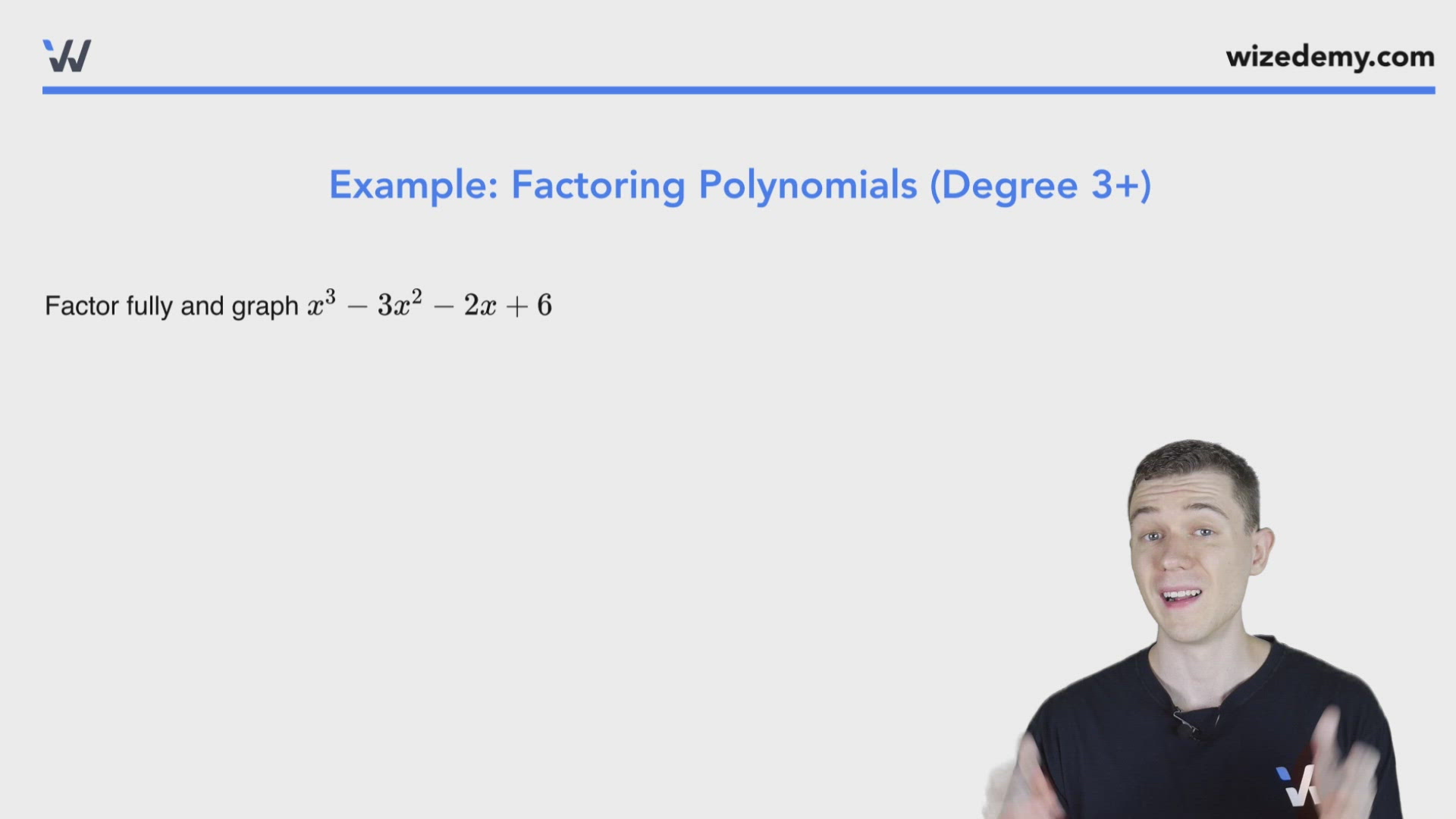
Factor fully and graph x3−3x2−2x+6x^3-3x^2-2x+6


Step 1.

Use the Rational Root Theorem to determine all possible values of the roots.


Factors of 6: 1, 2, 3, 6

Factors of 1: 1


All possible roots are:

±1,2,4,8,16,321=±1,2,3,6\pm\frac{1, 2, 4, 8, 16, 32}{1}=\pm1, 2, 3, 6


Step 2.

Use the Remainder & Factor Theorem to test the possible factors for f(x)f(x). (Hint: You only need to find one)


x=1‾\underline{x=1}:

(1)3−3(1)2−2(1)+6=1−3−2+6=2\begin{array}{rcl} (1)^3-3(1)^2-2(1)+6&=&1-3-2+6\\ &=&2 \end{array}

x = 1 is not a possible root


x=3‾\underline{x=3}:

(3)3−3(3)2−2(3)+6=27−27−6+6=0\begin{array}{rcl} (3)^3-3(3)^2-2(3)+6&=&27-27-6+6\\ &=&0 \end{array}

Therefore, x=3x=3 is a root and (x−3)(x-3) is a factor


Step 3.

Use polynomial division (long or synthetic) to find the other factors of f(x).f(x).


(x3−3x2−2x+6) ÷ (x−3)(x^3-3x^2-2x+6)~\div~(x-3)


1−3−263↓30−610−20\begin{array}{r| c c c c} &1&-3&-2&6\\ 3&\downarrow&3&0&-6\\ \hline &1&0&-2&0 \end{array}

The quotient becomes:

x2−2=(x−2)(x+2)\begin{array}{rcl} x^2-2&=&(x-\sqrt{2})(x+\sqrt{2})\\ \end{array}


The division statement becomes:

x3−3x2−2x+6=(x−3)(x−2)(x+2)\begin{array}{rcl} x^3-3x^2-2x+6&=&(x-3)(x-\sqrt{2})(x+\sqrt{2})\\ \end{array}

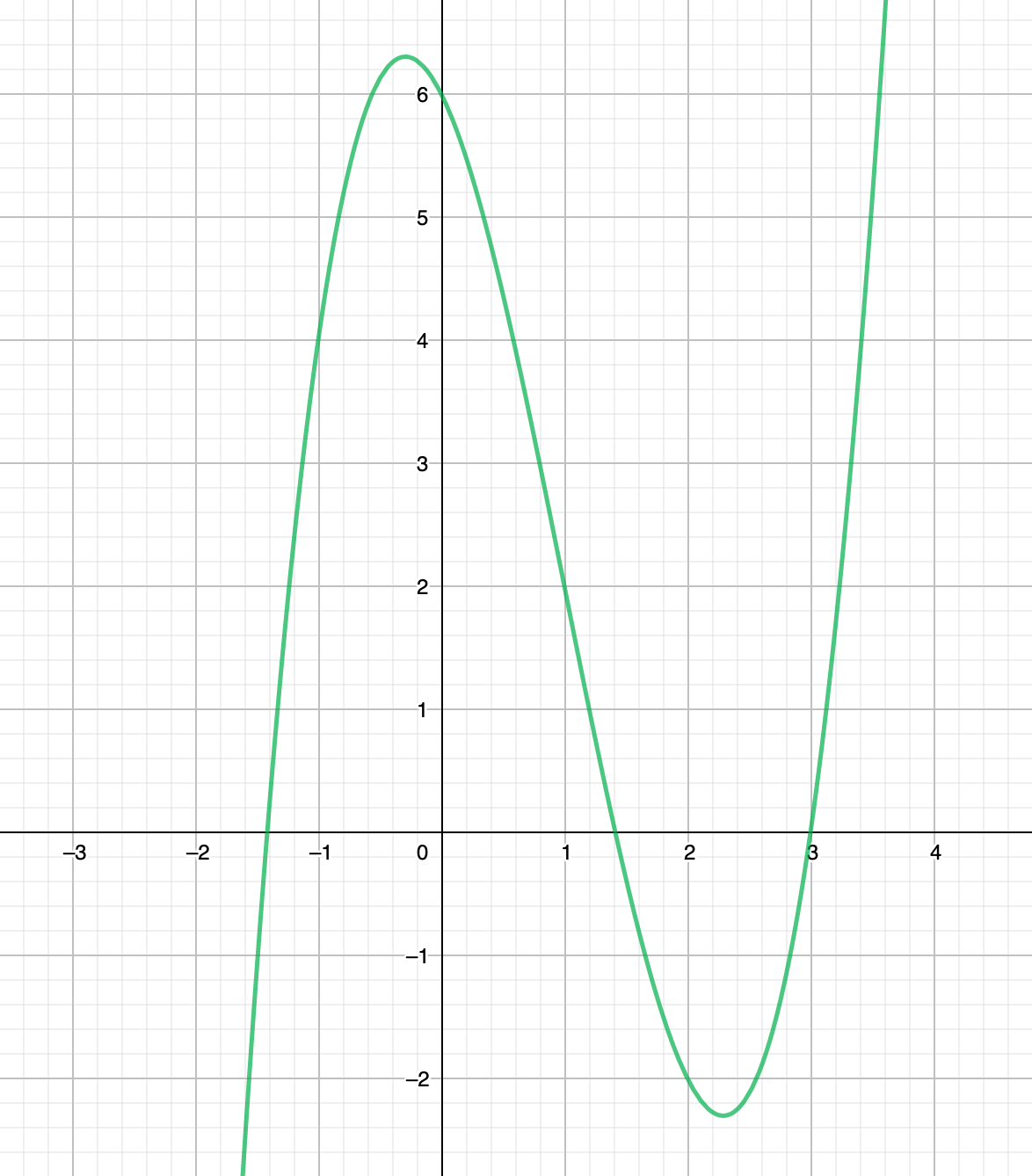
The graph:

Image illustrating Example


Practice: Factoring Polynomials (Degree 3+)

True or False: A factor of 2x4+12x3−x2+8x−32x^4+12x^3-x^2+8x-3 is (x−3)(x-3)

Create a free account to get started

Unlock full course notes by signing up

  • Video lessons taught by top educators
  • Practice questions with guided solutions
  • Written review notes for reference
  • Expert answers anytime from course tutors

Practice: Factoring Polynomials (Degree 3+)

Fully factor x4+x3−13x2−25x−12x^4+x^3-13x^2-25x-12.

Create a free account to get started

Unlock full course notes by signing up

  • Video lessons taught by top educators
  • Practice questions with guided solutions
  • Written review notes for reference
  • Expert answers anytime from course tutors

Practice: Factoring Polynomials (Degree 3+)

The remainder when x3+ax2+bx+1 x^3+ax^2+bx+1~ is divided by (x - 5) is -14. When x3+ax2+bx+1x^3+ax^2+bx+1 is divided by (x+1), the remainder is -2.


What are the values of a and b?

Your answers

Create a free account to get started

Unlock full course notes by signing up

  • Video lessons taught by top educators
  • Practice questions with guided solutions
  • Written review notes for reference
  • Expert answers anytime from course tutors