Create a free account to get started

Unlock full course notes by signing up

  • Video lessons taught by top educators
  • Practice questions with guided solutions
  • Written review notes for reference
  • Expert answers anytime from course tutors

Rolle's Theorem

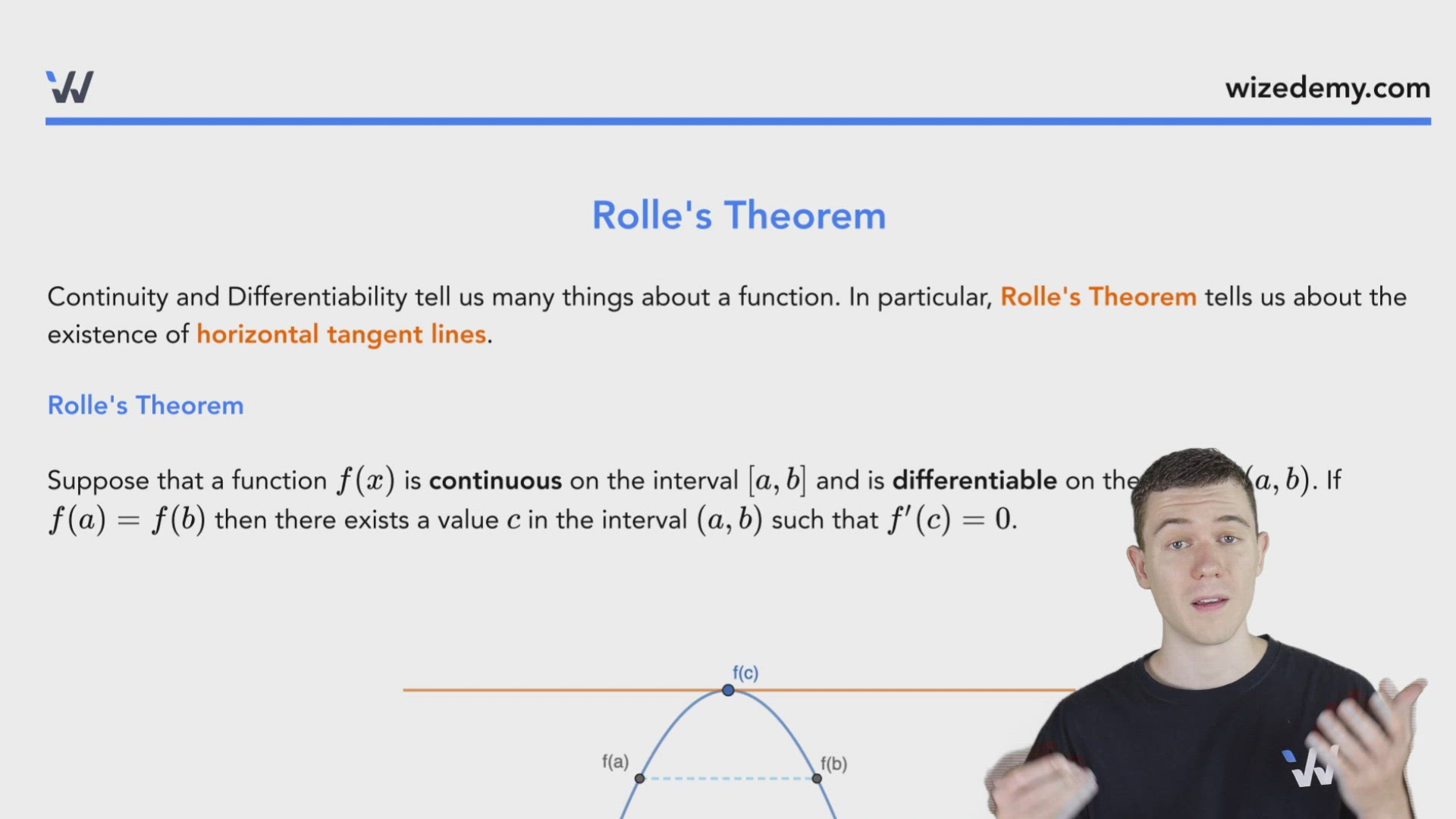
Continuity and Differentiability tell us many things about a function. In particular, Rolle's Theorem tells us about the existence of horizontal tangent lines.

Rolle's Theorem

Suppose that a function f(x)f(x) is continuous on the interval [a,b][a,b] and is differentiable on the interval (a,b)(a,b). If f(a)=f(b)f(a)=f(b) then there exists a value cc in the interval (a,b)(a,b) such that f′(c)=0f'(c)=0.


Image illustrating Rolle's Theorem


Note: In other words, since ff is continuous and differentiable, then in between every two points aa and bb with the same image, the function must have a maximum or a minimum.
Create a free account to get started

Unlock full course notes by signing up

  • Video lessons taught by top educators
  • Practice questions with guided solutions
  • Written review notes for reference
  • Expert answers anytime from course tutors

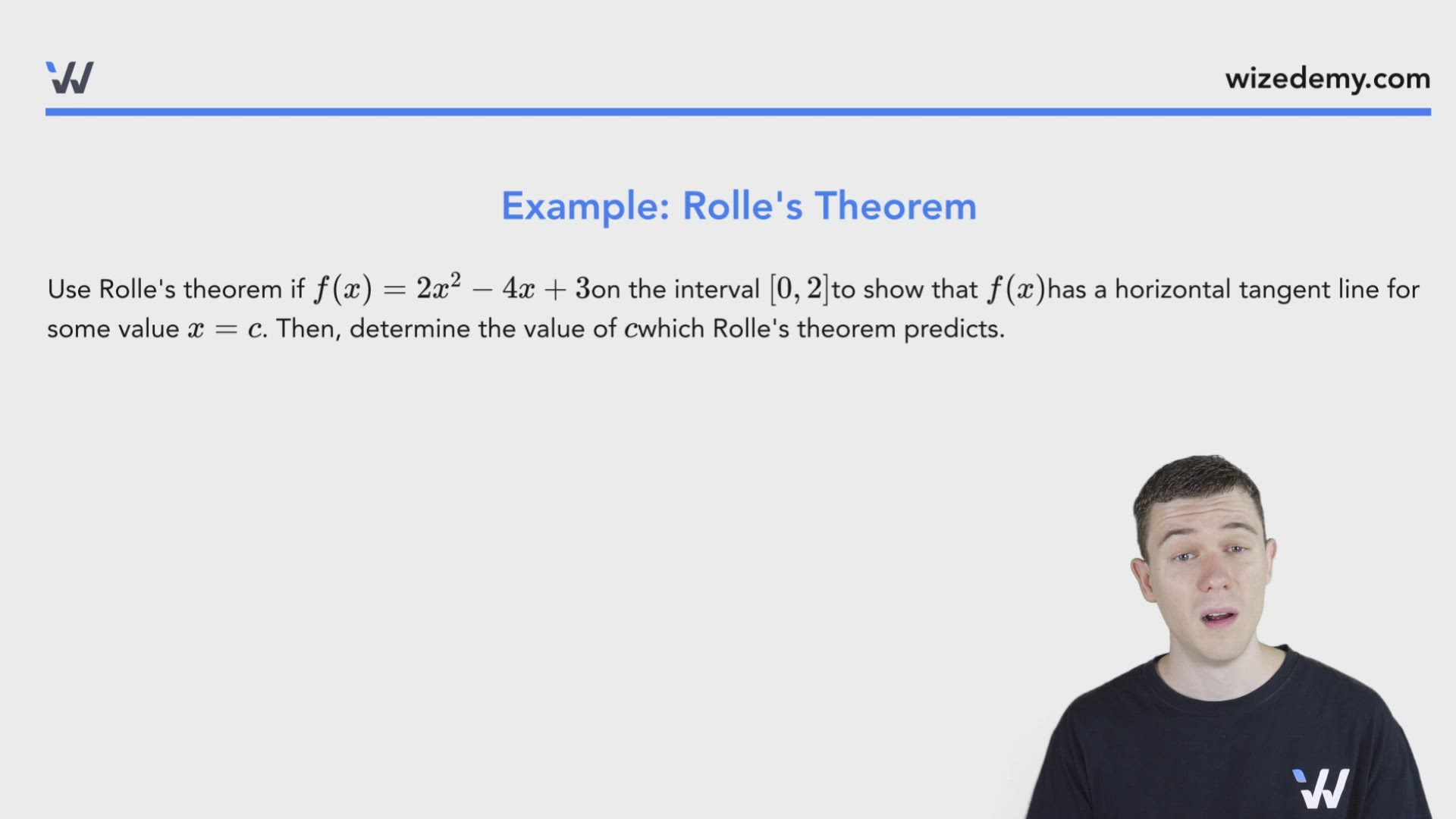
Example: Rolle's Theorem

Use Rolle's theorem if f(x)=2x2−4x+3f(x) = 2x^2-4x+3 on the interval [0,2][0,2]to show that f(x)f(x)has a horizontal tangent line for some value x=cx=c. Then, determine the value of cc which Rolle's theorem predicts.


f(x)f(x)is continuous and differentiable on x in [0,2]x\text{ in }[0,2]. Also, f(0)=f(2)=3f(0)=f(2) = 3, so all of the hypotheses of Rolle's theorem are met with a=0,b=2a=0, b=2.

So, by Rolle's theorem, there must exist some value c  in [0,2]c \ \text{ in }[0,2]such that f′(c)=0f'(c) = 0.


Now, let's find the value of cc.


f′(x)=4x−4f'(x) = 4x-4, and f′(c)=0⇒4c−4=0⇒c=1f'(c) = 0 \Rightarrow 4c-4 = 0 \Rightarrow \boxed{c=1}

Mark Yourself Question

  1. Grab a piece of paper and try this problem yourself.
  2. When you're done, check the "I have answered this question" box below.
  3. View the solution and report whether you got it right or wrong.

The function f(x)=1x2f(x) = \frac{1}{x^2} has no horizontal tangent lines on the interval [−1,1][-1,1] , even though f(−1)=f(1)f(-1)=f(1). Why doesn't this contradict Rolle's Theorem?

Create a free account to get started

Unlock full course notes by signing up

  • Video lessons taught by top educators
  • Practice questions with guided solutions
  • Written review notes for reference
  • Expert answers anytime from course tutors