
Maximum and Minimum on Closed Intervals
A continuous function on a closed interval will always have a largest and smallest value. The values are called Absolute Extrema or Global Extrema.
Absolute Extrema
A function has an absolute maximum at a point in its domain if for every in the domain.
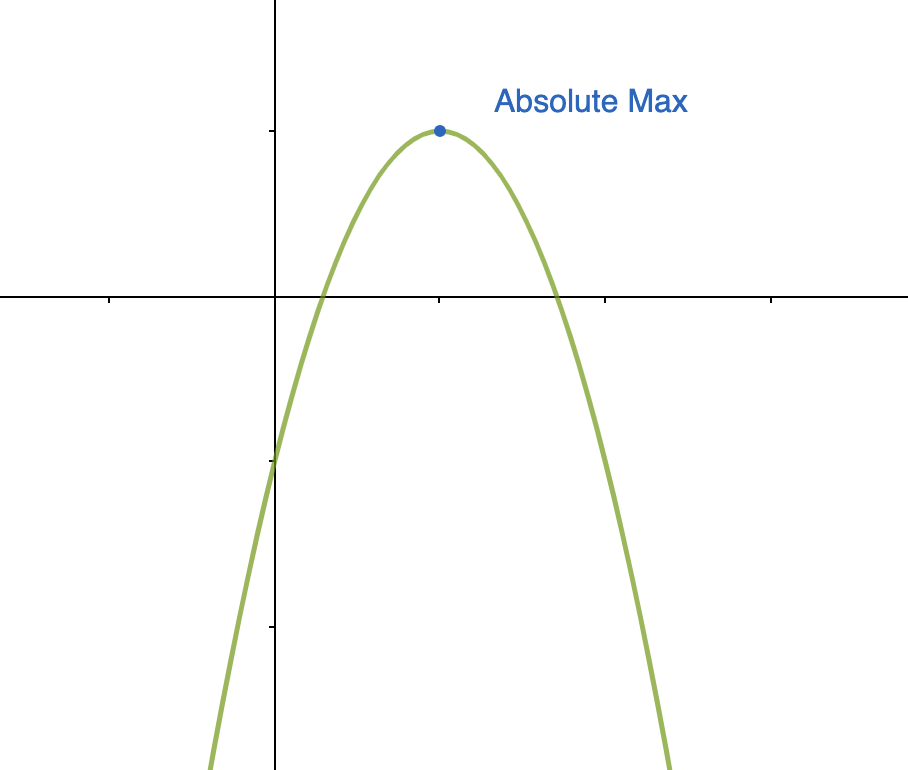
A function has an absolute minimum at a point in its domain if for every in the domain.
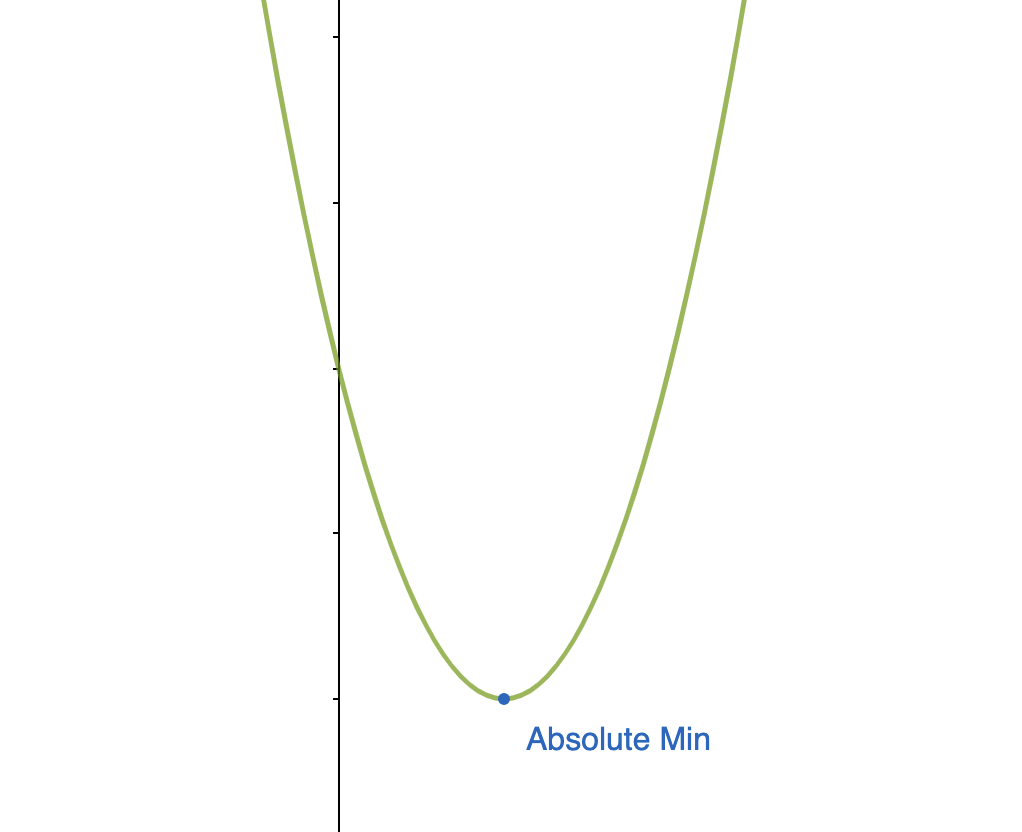
Note: This definition can also be applied to a function on an interval. The absolute extrema are the biggest and smallest value achieved by the function on that interval.
Maximum and Minimum on Closed Intervals
For a continuous function on a closed interval there exists an absolute minimum and an absolute maximum.
Procedure to find the Absolute Extrema of a function on a Closed Interval [a,b]
- Find all critical points and singular points of in the open interval
- Compute at the critical points and singular points and at the endpoints and
- The largest and smallest values found are the absolute maximum and minimum respectively

Example: Finding Absolute Extrema
Find the absolute extrema (max/min) of on the interval .
1. Find all critical points of the function
The first derivative is .
2. Compute the value of the critical points
*If an interval is given, compute the values at these end points
"Sub" in the right end-point:
3. The largest and smallest values that we find are the absolute max and min, respectively
Observe that .
Therefore, the absolute max point is and there is no absolute min point, but instead, as , there is a horizontal asymptote at (all values are above this line)