Convex and Concave Lenses
Lenses are formed by a transparent material curved on both sides. Light goes through two refractions as it enters and then exits the lens.
Convex (converging) lenses gather the reflected light rays into a single point. They are thicker at the center than at the edges.
Concave (diverging) lenses disperse the reflected light rays. They are thinner at the center than at the edges.
- The principal axis (or optical axis) is the straight line perpendicular to the lens through its center.
- The focal point, called , is the point where the light rays converge (one on each side).
Note: There is no clear relationship between the radius of curvature and the focal length for lenses.
Ray Diagrams
Ray diagrams are a simplified way of representing the incoming and the refracted light, useful for determining the location and properties of the image formed by the lens.
Step 1: Draw the lens and the principal axis.
Step 2: Label the focal points, one on each side.
Step 3: Draw the object as an arrow.
Step 4: Beginning at the tip of the object, draw at least two out of the three special rays.
Step 5: Extend the rays until they converge: solid lines for actual light rays, and dotted lines for imaginary rays (there is no real light there, it only appears to be coming from there).
Step 6: The tip of the image will be at the intersection point of all the rays.
Special Rays for Convex Lenses
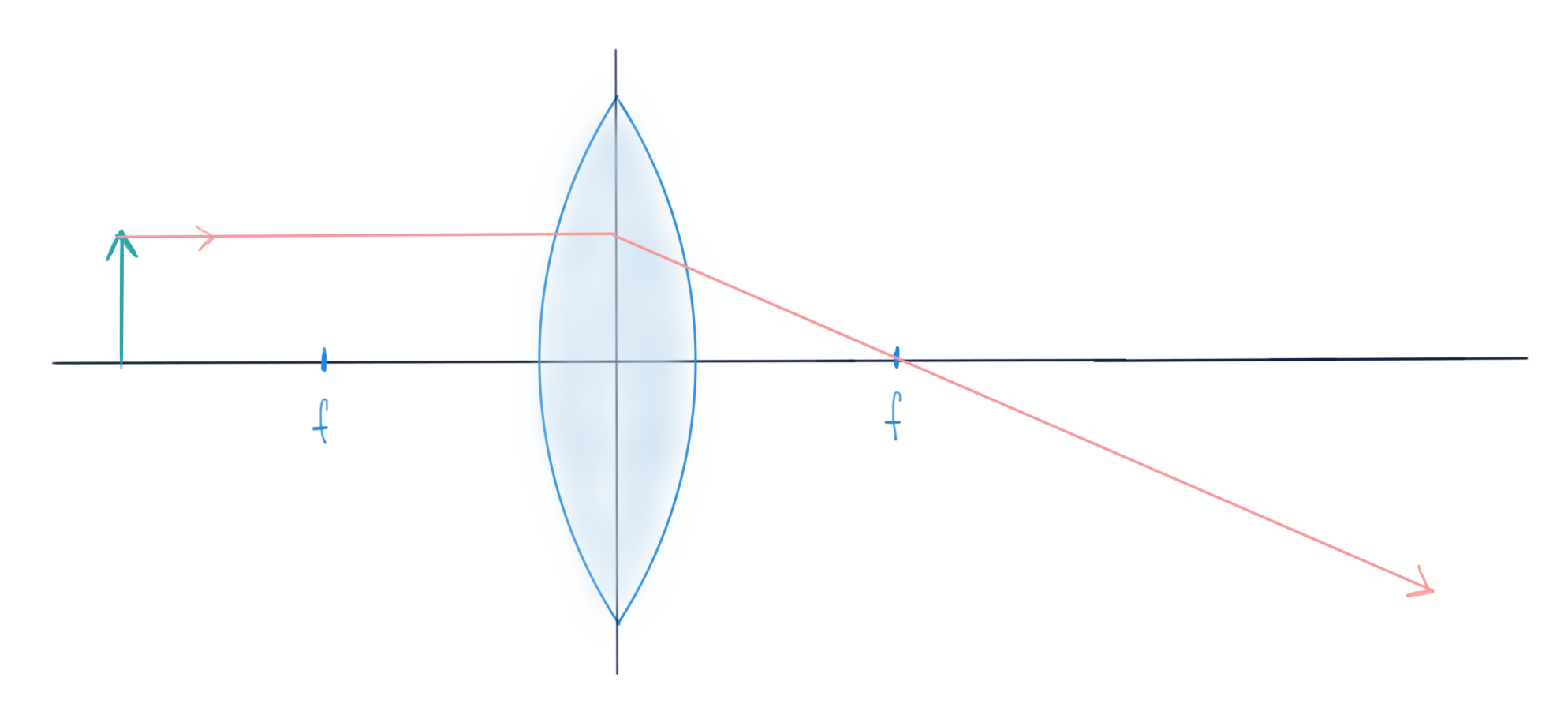
Parallel ray refracts through the focal point on the other side:
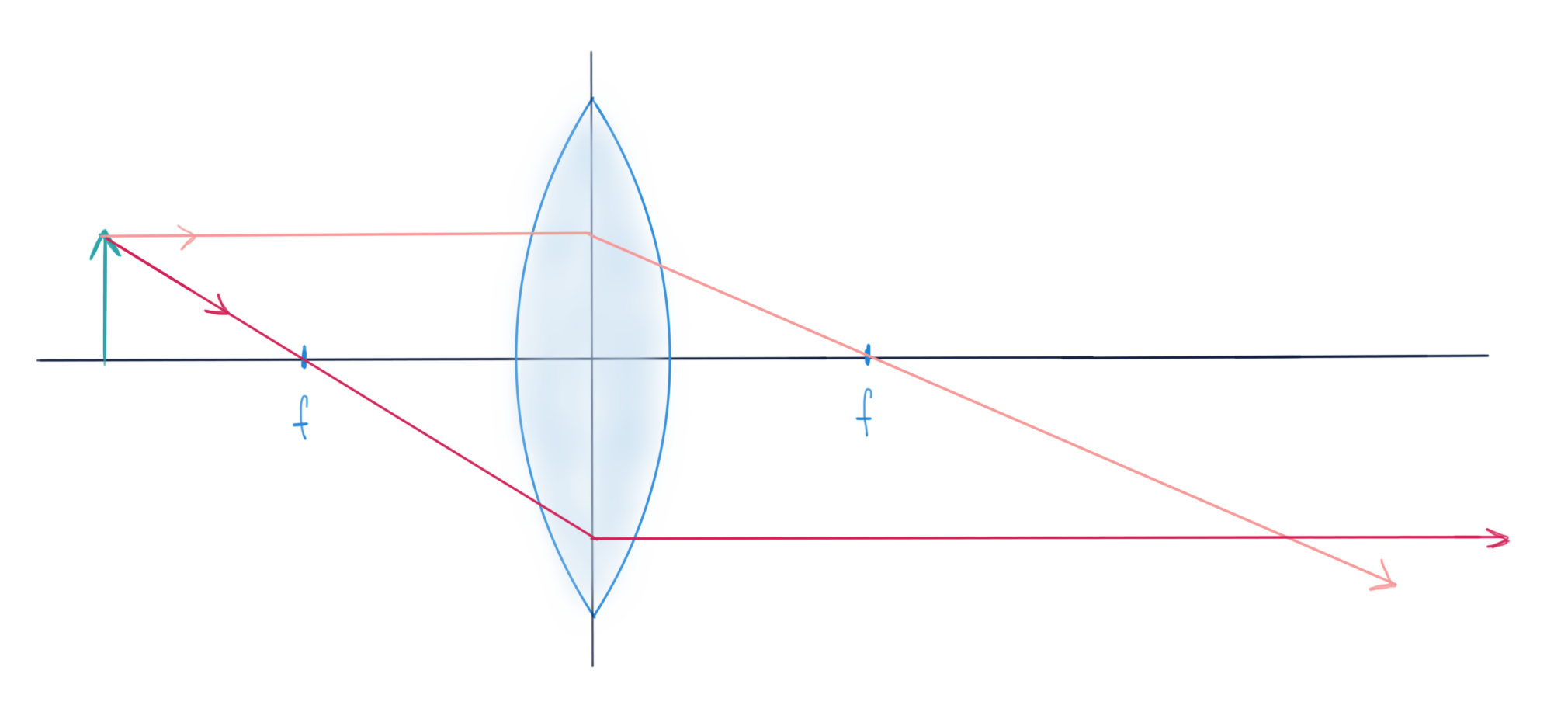
Ray through the focal point refracts parallel:
Ray through the center refracts straight through:

Special Rays for Concave Lenses
Parallel ray refracts as if coming from the focal point on the same side

Ray directed towards the focal point on the other side refracts parallel:

Ray through the center refracts straight through:

Example: Convex Lens
Draw the ray diagram and describe the image if an object is located inside the focal point of a convex lens.

The image is virtual, upright, and larger.