Create a free account to get started

Unlock full course notes by signing up

  • Video lessons taught by top educators
  • Practice questions with guided solutions
  • Written review notes for reference
  • Expert answers anytime from course tutors

Important Definitions

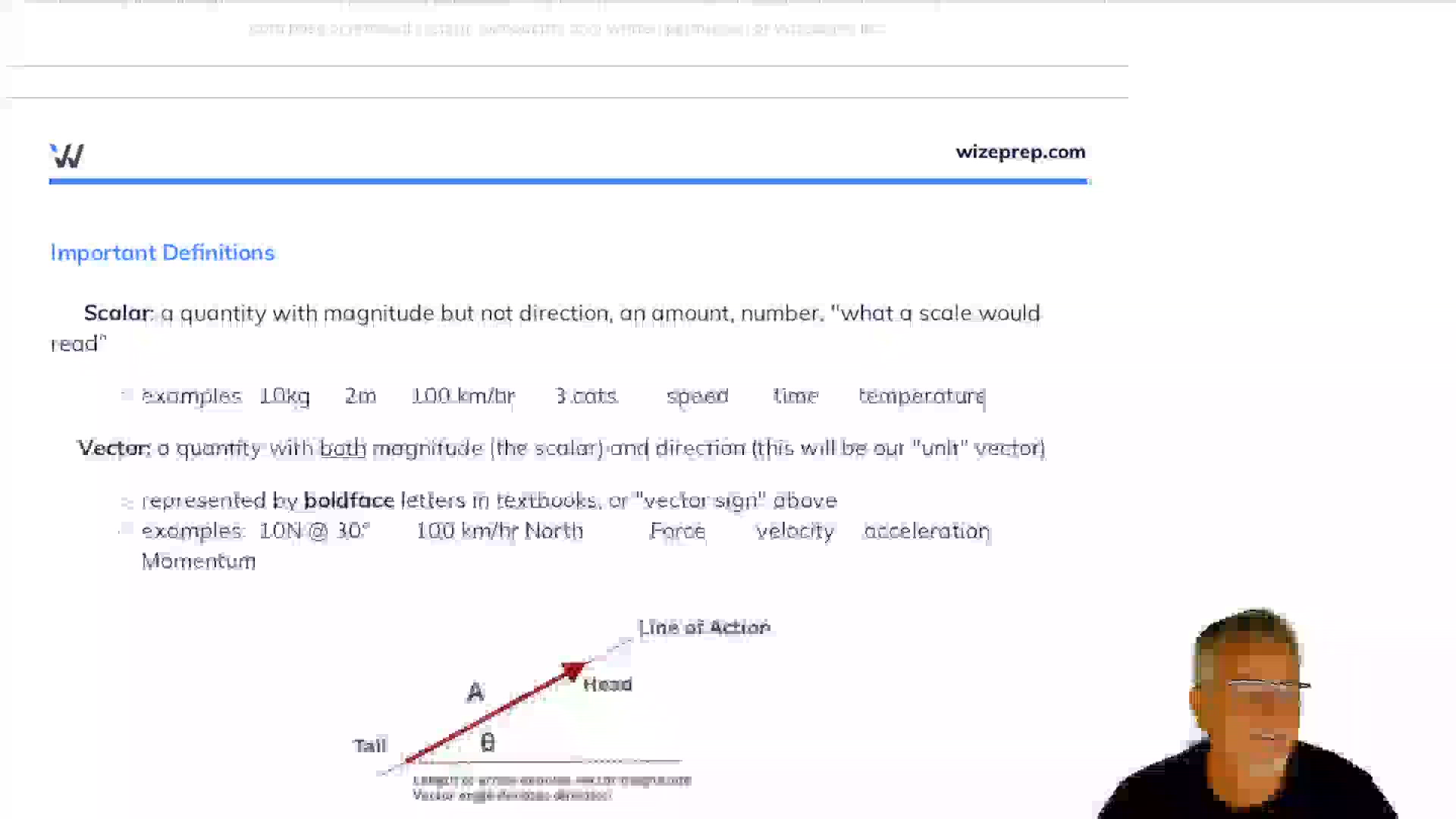
Scalar: a quantity with magnitude but not direction, an amount, number, "what a scale would read"

  • examples: 10kg 2m 100 km/hr 3 cats speed time temperature

Vector: a quantity with both magnitude (the scalar) and direction (this will be our "unit" vector)

  • represented by boldface letters in textbooks, or "vector sign" above
  • examples: 10N @ 30° 100 km/hr North Force velocity acceleration Momentum
Image illustrating Scalars & Vectors - Definitions & Examples


Create a free account to get started

Unlock full course notes by signing up

  • Video lessons taught by top educators
  • Practice questions with guided solutions
  • Written review notes for reference
  • Expert answers anytime from course tutors
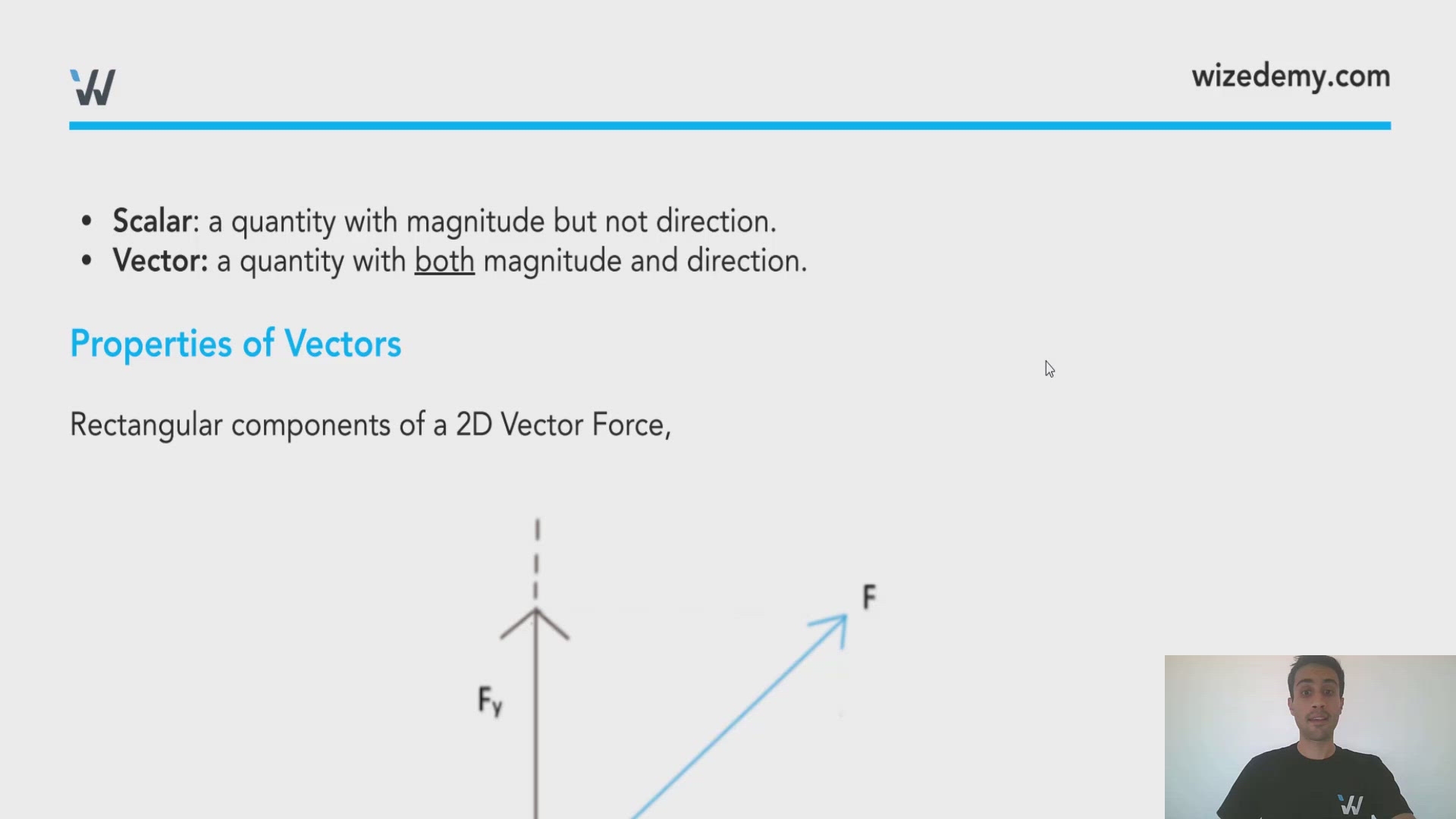
  • Scalar: a quantity with magnitude but not direction.
  • Vector: a quantity with both magnitude and direction.

Properties of Vectors

Rectangular components of a 2D Vector Force,


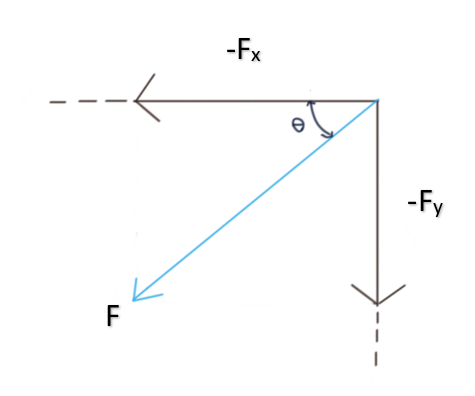
Image illustrating Vectors (2D)


Image illustrating Vectors (2D)

Fx=−Fcos⁡θ and Fy=−Fsin⁡θF_x=-F\cos\theta\quad\text{ and }\quad F_y=-F\sin\theta


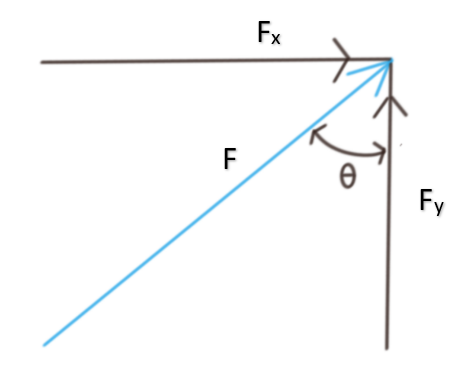
Image illustrating Vectors (2D)

Fx=Fsin⁡θ and Fy=Fcos⁡θF_x=F\sin\theta\quad\text{ and }\quad F_y=F\cos\theta


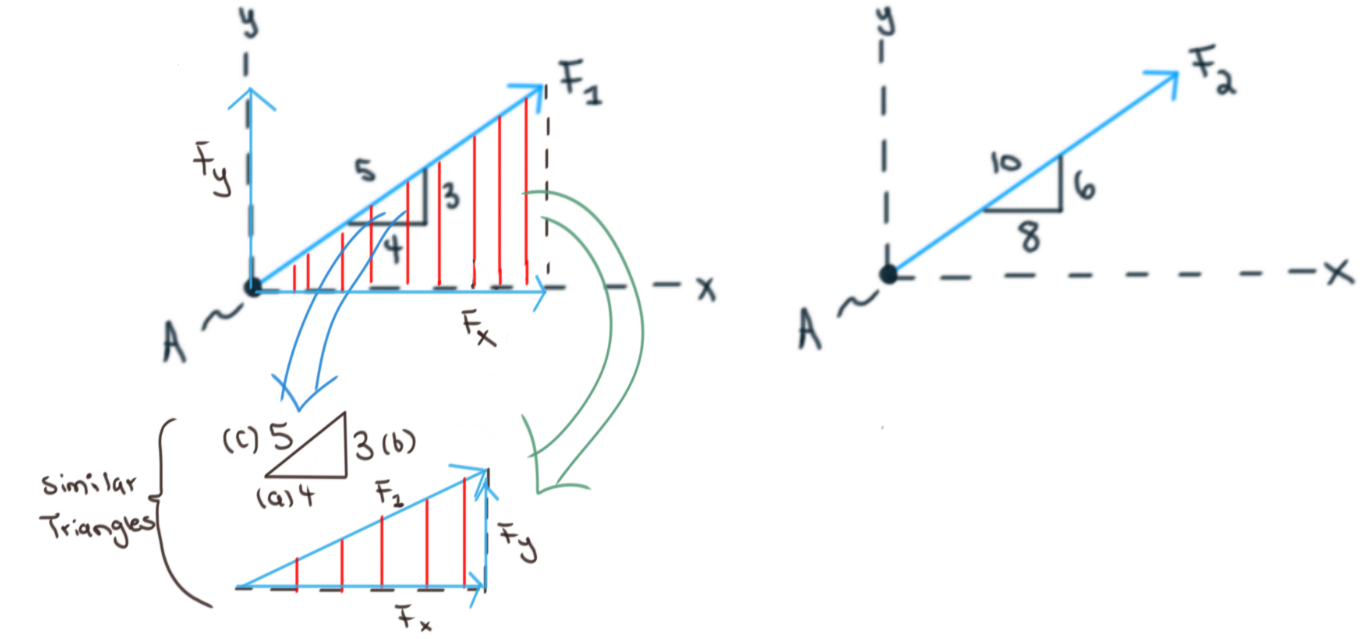
Using a small slope triangle,


Image illustrating Vectors (2D)


FxF1=ac\frac{F_x}{F_1}=\frac{a}{c}

Fx=F1(ac)F_x=F_1\left(\frac{a}{c}\right)


FyF1=bc\frac{F_y}{F_1}=\frac{b}{c}

Fy=F1(bc)F_y=F_1\left(\frac{b}{c}\right)


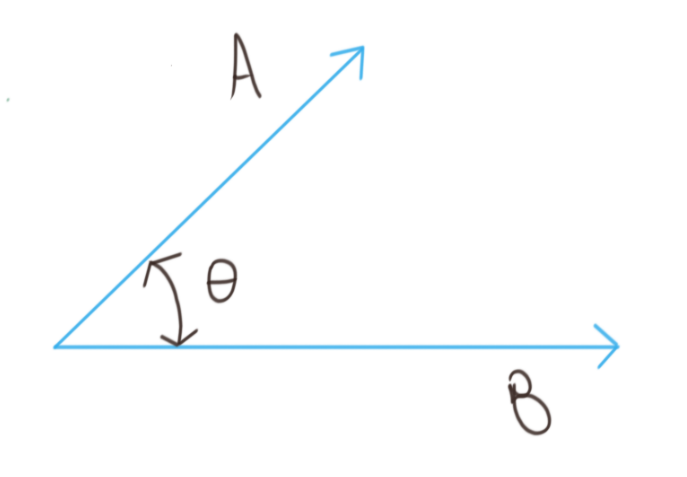
Dot product,


Image illustrating Vectors (2D)


A⃗ ⋅B⃗ =ABcos⁡θ\vec{A}^{\,}\cdot \vec{B}^{\,}=AB\cos\theta

A⃗ ⋅B⃗ =AxBx+AyBy+AzBz\vec{A}^{\,}\cdot \vec{B}^{\,}=A_xB_x+A_yB_y+A_zB_z

θ=cos⁡−1(A⃗ ⋅B⃗ AB)\theta=\cos^{-1}\left(\frac{\vec{A}^{\,}\cdot \vec{B}^{\,}}{AB}\right)


Vector Manipulation


Things you should know:

  • How to break down a vector into perpendicular components
  • How to break down a vector into non-perpendicular component
  • Projecting a vector along a line
  • Finding the angle between two vectors

Q: How to break down a vector into perpendicular components?

A: Basic Trigonometric rules, aka. SOH CAH TOA


Q: How to break down a vector into non-perpendicular components?

A: Sine and cosine laws


Q: How to project a vector along a line

A: Using the dot product


Q: Finding the angle between two vectors

A: Modified dot product


Create a free account to get started

Unlock full course notes by signing up

  • Video lessons taught by top educators
  • Practice questions with guided solutions
  • Written review notes for reference
  • Expert answers anytime from course tutors
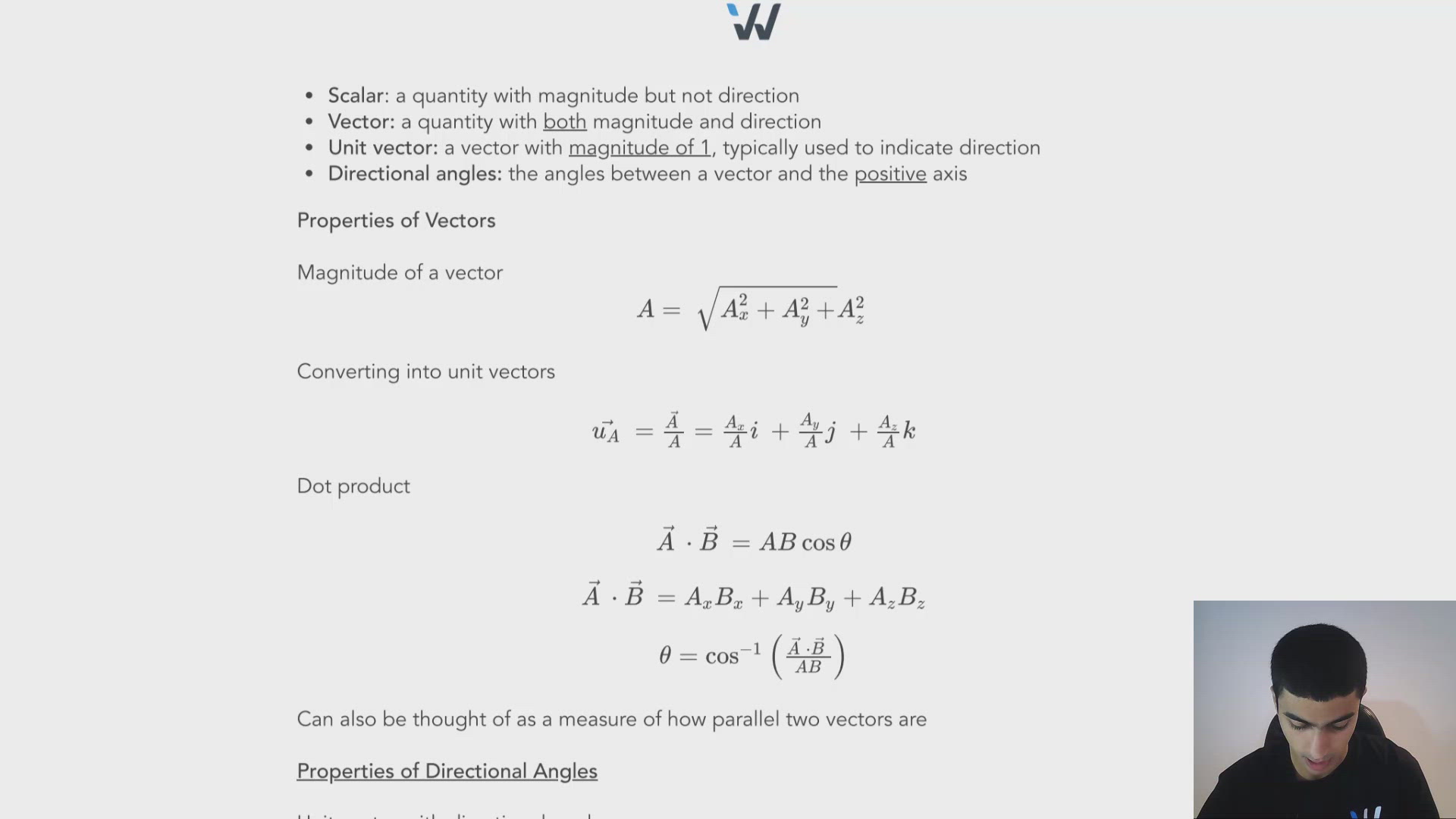
  • Scalar: a quantity with magnitude but not direction
  • Vector: a quantity with both magnitude and direction
  • Unit vector: a vector with magnitude of 1, typically used to indicate direction
  • Directional angles: the angles between a vector and the positive axis

Properties of Vectors


Magnitude of a vector

A= Ax2+Ay 2 +Az2A=\ \sqrt{A_x^{2_{ }}+A_{y\ }^{2\ }+}A_z^2


Converting into unit vectors


uA⃗ =A⃗ A=AxAi +AyAj +AzAk\vec{u_A}^{\,}=\frac{\vec{A}^{\,}}{A}=\frac{A_x}{A}i\ +\frac{A_y}{A}j\ +\frac{A_z}{A}k


Dot product


A⃗ ⋅B⃗ =ABcos⁡θ\vec{A}^{\,}\cdot \vec{B}^{\,}=AB\cos\theta

A⃗ ⋅B⃗ =AxBx+AyBy+AzBz\vec{A}^{\,}\cdot \vec{B}^{\,}=A_xB_x+A_yB_y+A_zB_z

θ=cos⁡−1(A⃗ ⋅B⃗ AB)\theta=\cos^{-1}\left(\frac{\vec{A}^{\,}\cdot \vec{B}^{\,}}{AB}\right)


Can also be thought of as a measure of how parallel two vectors are


Properties of Directional Angles


Unit vector with directional angles

uA⃗ =cos⁡αi+cos⁡βj+cos⁡γk\vec{u_A}^{\,}=\cos\alpha i+\cos\beta j+\cos\gamma k

Relationship between directional angles


cos⁡2α+cos⁡2β+cos⁡2γ=1\cos^2\alpha^{ }+\cos^2\beta+\cos^2\gamma=1


Vector Manipulation


Things you should know:

  • How to break down a vector into perpendicular components
  • How to break down a vector into non-perpendicular component
  • Projecting a vector along a line
  • Finding the angle between two vectors

Q: How to break down a vector into perpendicular components?

A: Basic Trigonometric rules, aka. SOH CAH TOA


Q: How to break down a vector into non-perpendicular components?

A: Sine and cosine laws


Q: How to project a vector along a line

A: Using the dot product


Q: Finding the angle between two vectors

A: Modified dot product

Create a free account to get started

Unlock full course notes by signing up

  • Video lessons taught by top educators
  • Practice questions with guided solutions
  • Written review notes for reference
  • Expert answers anytime from course tutors

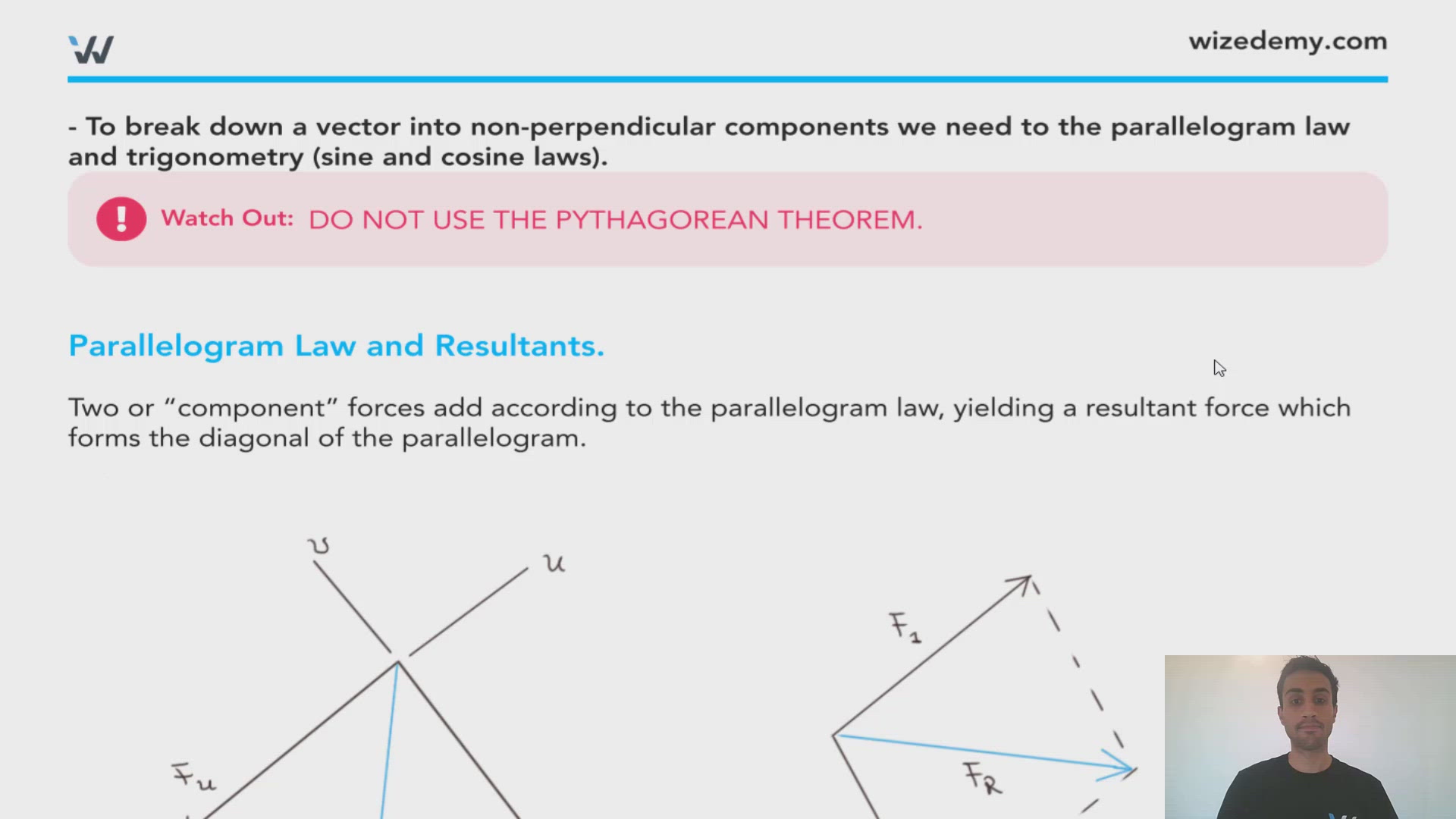
- To break down a vector into non-perpendicular components we need to the parallelogram law and trigonometry (sine and cosine laws).


Parallelogram Law and Resultants.

Two or “component” forces add according to the parallelogram law, yielding a resultant force which forms the diagonal of the parallelogram.
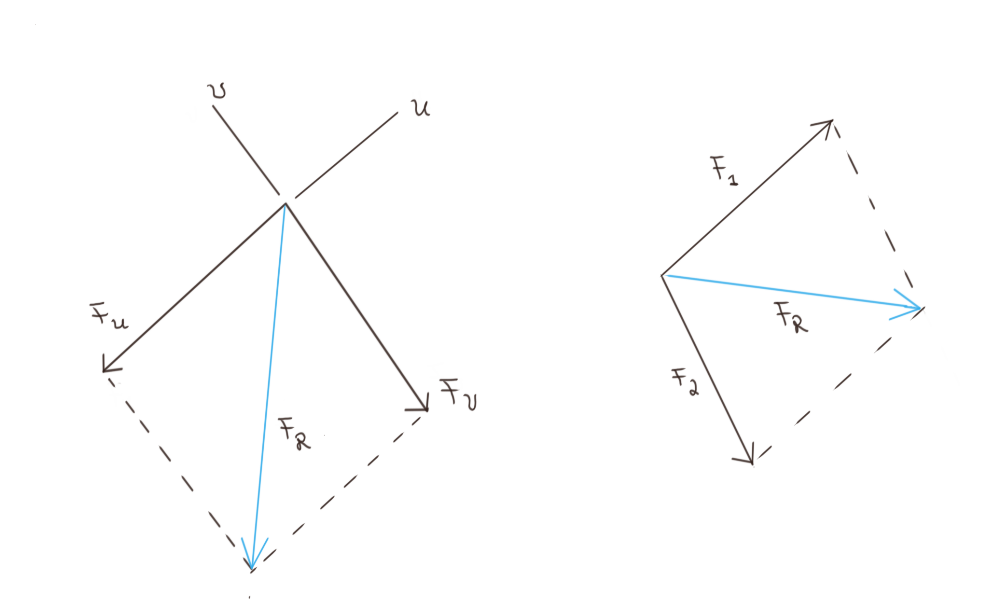
Image illustrating Examples: Scalars and Vectors (Sine and Cosine Laws)


Example

Determine the components of the force along lines AC and BC:
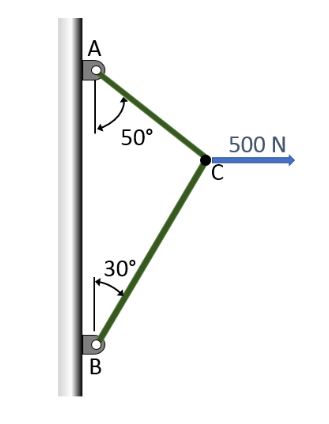

Image illustrating Examples: Scalars and Vectors (Sine and Cosine Laws)


Begin by reconstructing into a triangle:
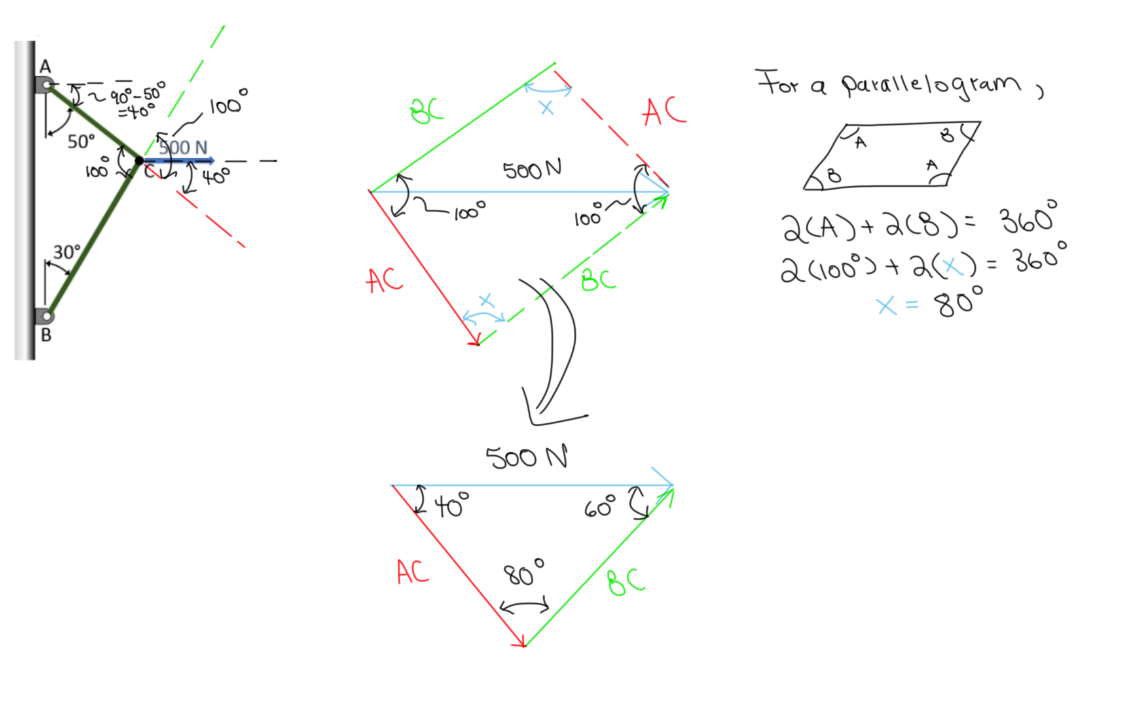

Image illustrating Examples: Scalars and Vectors (Sine and Cosine Laws)


By Sine law:


500sin⁡80=ACsin⁡60=BCsin⁡40\frac{500}{\sin80}=\frac{AC}{\sin60}=\frac{BC}{\sin40}


500sin⁡80=BCsin⁡40\frac{500}{\sin80}=\frac{BC}{\sin40}


BC = 326 NBC\ =\ 326\ N


500sin⁡80=ACsin⁡60\frac{500}{\sin80}=\frac{AC}{\sin60}


AC = 440 NAC\ =\ 440\ N


The screw eye illustrated is subjected to two cable forces, as indicated. Determine the equivalent force consisting of a single resultant force.

Illustration for practice question: Vectors (2D)
Your answers

Create a free account to get started

Unlock full course notes by signing up

  • Video lessons taught by top educators
  • Practice questions with guided solutions
  • Written review notes for reference
  • Expert answers anytime from course tutors

Practice Question

Determine the resultant force along lines AC and BC:


Illustration for practice question: Practice Question


Your answers

Create a free account to get started

Unlock full course notes by signing up

  • Video lessons taught by top educators
  • Practice questions with guided solutions
  • Written review notes for reference
  • Expert answers anytime from course tutors

Create a free account to get started

Unlock full course notes by signing up

  • Video lessons taught by top educators
  • Practice questions with guided solutions
  • Written review notes for reference
  • Expert answers anytime from course tutors

Rectangular Components of a Force.

- Can be represented in two ways: Scalar or Cartesian Vector notation.

- To find rectangular components we use the parallelogram law where we resolve the magnitude force into its respective x and y components.

Example (we will come back to this later!)

Resolve F2 and F3 into their respective x and y components.
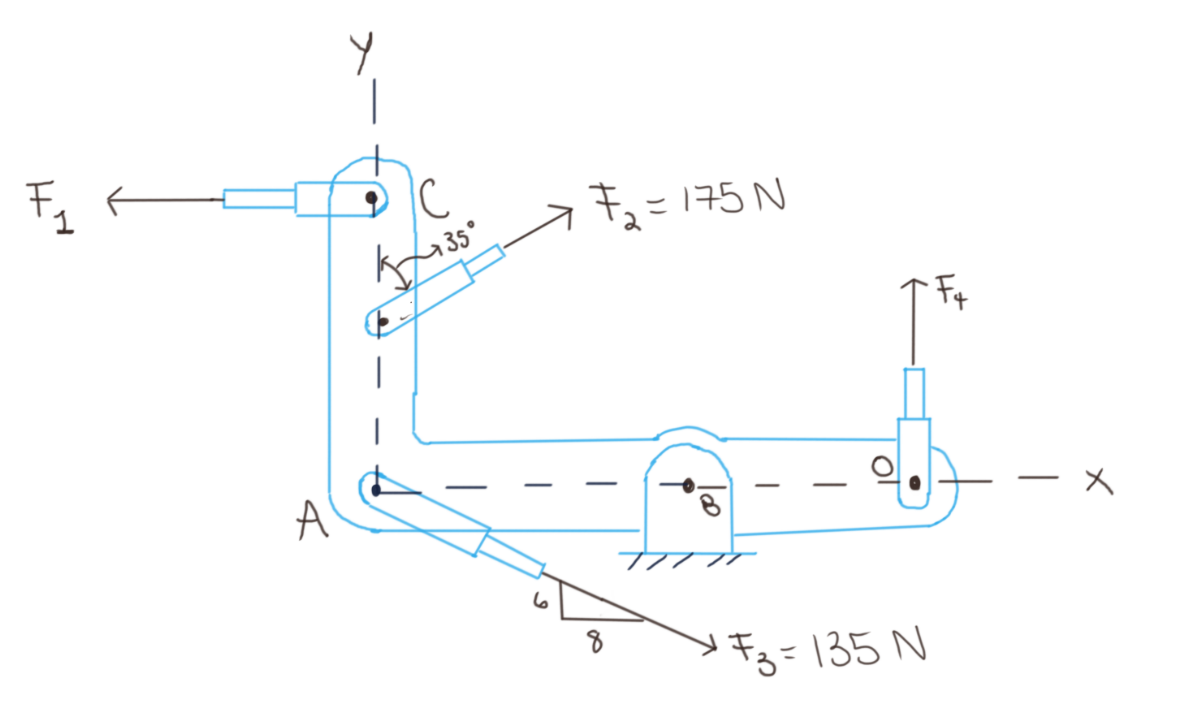

Image illustrating Example: Scalars and Vectors (Rectangular Components)


For force vector F2 = 175N,


Image illustrating Example: Scalars and Vectors (Rectangular Components)

Figure (a),


F2x = 175N sin⁡(35) = 100.38 NF_{2x}\ =\ 175N\ \sin\left(35\right)\ =\ 100.38\ N

F2y = 175N cos⁡(35) = 143.35 NF_{2y}\ =\ 175N\ \cos\left(35\right)\ =\ 143.35\ N


Figure (b),


F2x = 175N cos⁡(55) = 100.38 NF_{2x}\ =\ 175N\ \cos\left(55\right)\ =\ 100.38\ N

F2y = 175N sin⁡(55) = 143.35 NF_{2y}\ =\ 175N\ \sin\left(55\right)\ =\ 143.35\ N


Figure (c),


F2x = 175N sin⁡(35) = 100.38 NF_{2x}\ =\ 175N\ \sin\left(35\right)\ =\ 100.38\ N

F2y = 175N cos⁡(35) = 143.35 NF_{2y}\ =\ 175N\ \cos\left(35\right)\ =\ 143.35\ N


For force vector F3 = 135N,

We use similar triangles of the given slopes,
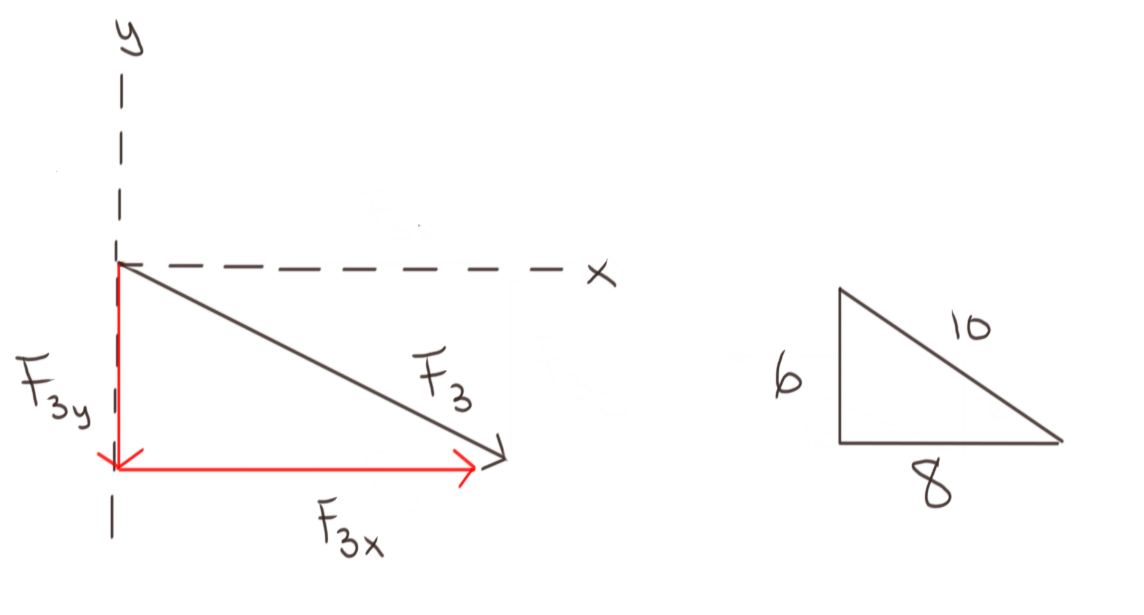

Image illustrating Example: Scalars and Vectors (Rectangular Components)


Given Similar Triangles (based on the figure above.)


F310=F3y6→135N10=F3y6\frac{F_3}{10}=\frac{F_{3y}}{6}\rightarrow\frac{135N}{10}=\frac{F_{3y}}{6}


Cross multiply and solve for F3y,


F3y=81.0 NF_{3y}=81.0\mathrm{\ N}


F310=F3x8→135N10=F3x8\frac{F_3}{10}=\frac{F_{3x}}{8}\rightarrow\frac{135N}{10}=\frac{F_{3x}}{8}


Cross multiply and solve for F3x,


F3x=108.0 NF_{3x}=108.0\ \mathrm{N}


Example

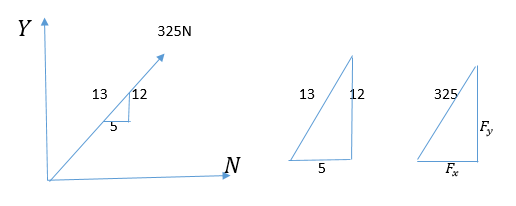
Represent the 325N force into its x and y components.


Image illustrating Example: Scalars and Vectors (Rectangular Components)


Image illustrating Example: Scalars and Vectors (Rectangular Components)


Fxy=32513 →  Fx=125N\frac{Fx}{y}=\frac{325}{13}\ \rightarrow\ \ Fx=125N


Fy12=32513  →   Fy=300N\frac{Fy}{12}=\frac{325}{13}\ \ \rightarrow\ \ \ Fy=300N


Practice Question

The following bracket illustrated is subjected to three cable forces. Resolve each force into its corresponding x and y components.


Illustration for practice question: Example: Vectors


Your answers

Create a free account to get started

Unlock full course notes by signing up

  • Video lessons taught by top educators
  • Practice questions with guided solutions
  • Written review notes for reference
  • Expert answers anytime from course tutors