Create a free account to get started

Unlock full course notes by signing up

  • Video lessons taught by top educators
  • Practice questions with guided solutions
  • Written review notes for reference
  • Expert answers anytime from course tutors

Conservation of Momentum


Conservation of momentum means that our change in momentum, or impulse, is zero. This is particularly useful when we talk about collisions.

Δp⃗ = 0     →     p⃗f = p⃗i\Delta\vec{p}\ =\ 0\ \ \ \ \ \rightarrow\ \ \ \ \ \vec{p}_f\ =\ \vec{p}_i


To understand the conditions of this conservation, we can use the second law of Newton to show that:


Fext=ΔPΔtF_{ext}=\frac{\Delta P}{\Delta t}


The above equation tells us that:


  • Note that sum of all internal forces between elements of a system should be zero because of third law of Newton!
  • In order to use the conservation of momentum you have to choose your system of particles carefully to make sure the net force acting on the system is zero!

Example:


Momentum is a Vector!


Create a free account to get started

Unlock full course notes by signing up

  • Video lessons taught by top educators
  • Practice questions with guided solutions
  • Written review notes for reference
  • Expert answers anytime from course tutors

Two carts on a friction less surface collide and stick to each other. What is the velocity of the two carts after collision?


A) 5.33 m/s to left B) 5.33 m/s to right

C) 2.67 m/s to right D) 2.67 m/s to left
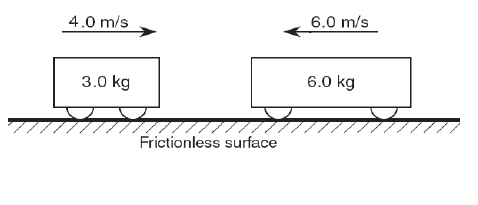


Image illustrating Example: Collision

Solution:


The conservation of momentum states that the total momentum of the two carts will be conserved during collision. Thus:


m1v1+m2v2=(m1+m2)v′m_1v_1+m_2v_2=(m_1+m_2)v'

Left hand side is the total momentum before collision and right-hand side is the total momentum after collision. Since the two carts stick together after collision, both travel with the same velocity after collision.


Thus:

(3)×(+4)+(6)×(−6)=(3+6)v′\left(3\right)\times\left(+4\right)+\left(6\right)\times\left(-6\right)=\left(3+6\right)v'


−24=(9)v′   ⇒  v′=−249=−2.67m / s-24=\left(9\right)v'\ \ \ \Rightarrow\ \ v'=\frac{-24}{9}=-2.67m\ /\ s

Negative sign indicates that the two carts move toward left after collision.


Mark Yourself Question

  1. Grab a piece of paper and try this problem yourself.
  2. When you're done, check the "I have answered this question" box below.
  3. View the solution and report whether you got it right or wrong.

An 80 kg man steps from one cart onto another at a velocity of 1.5 m/s relative to cart A. Each cart has a mass of 30 kg. Determine the final velocity of each cart.

Illustration for practice question: Conservation of Momentum Practice 1

Create a free account to get started

Unlock full course notes by signing up

  • Video lessons taught by top educators
  • Practice questions with guided solutions
  • Written review notes for reference
  • Expert answers anytime from course tutors

Practice: Conservation of Momentum with Spring

A 15.0-kg block is attached to a very light horizontal spring with spring constant 500 N/m and is resting on a friction-less horizontal table. It is struck by a 3.00-kg stone traveling horizontally at 8.00 m/s to the right. The stone rebounds at 2.00 m/s horizontally to the left. Find the maximum distance that the block will compress the spring after the collision. Enter the answer with 3 significant digits.


Illustration for practice question: Problems on Momentum Conservation and Collisions


Create a free account to get started

Unlock full course notes by signing up

  • Video lessons taught by top educators
  • Practice questions with guided solutions
  • Written review notes for reference
  • Expert answers anytime from course tutors

Two carts on a friction less surface collide and stick to each other. What is the velocity of the two carts after collision?


Illustration for practice question: Momentum: Collision


Choose an answer

Create a free account to get started

Unlock full course notes by signing up

  • Video lessons taught by top educators
  • Practice questions with guided solutions
  • Written review notes for reference
  • Expert answers anytime from course tutors

Extra Practice