Constructive and Destructive Interference
- For two waves propagating from similar sources but traveling different paths, the phase would be different
- The interference pattern between two waves depends on their phase differences
For two waves, generated by two similar in phase sources, the phase difference is equal to:
- is the wave number
- is the path difference travelled by two waves
Conditions over the phase difference in order to have constructive or destructive interference:
Constructive Interference:
Destructive Interference:
Conditions over the path difference in order to have constructive or destructive interference:
Case 1: In Phase Sources:
When the sources are in phase, the waves look the same when they are emitted, and we have:
Constructive Interference (in phase): , so we get:
The waves are in phase and their interference is fully constructive.

Destructive Interference (in phase): , so we get:
- Alternate formula: , from which we get
The waves are out phase and their interference is fully destructive.
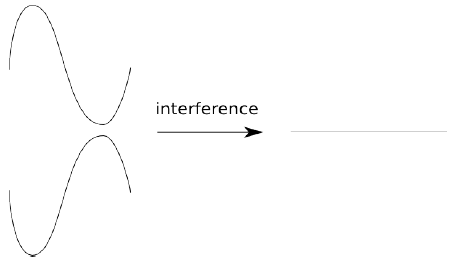
Case 2: Out of Phase sources:
When the sources are out of phase, the waves look the opposite when they are emitted, and we have:
Constructive Interference (out of phase):
Destructive Interference (in phase):
Interference Shortcuts
In Phase Sources () Out of Phase Sources ()
Constructive: Destructive:
Destructive: Constructive:
Sound Wave Interference
If two speakers with the same frequency are located a distance and from point , then the type of interference that occurs depends on the path difference between the two sound waves at that point.
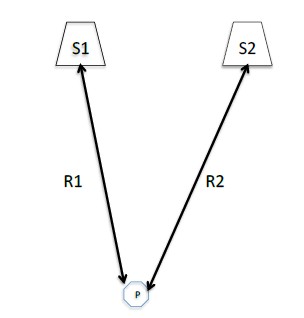
For sources that are in phase:
Constructive Interference: the path difference is an integer number of wavelengths:
Destructive Interference: the path difference is a half-integer number of wavelengths:
Example: Speakers Out of Phase
You are standing m from one of the two speakers as shown. The two speakers are out of phase. For which frequencies in the hearing range ( Hz to kHz) do you hear a minimum signal? (Speed of sound is m/s)
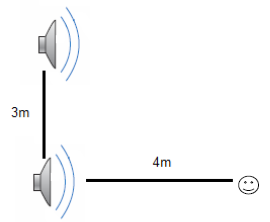
To find the path difference, we first need to find the path length from the top speaker to the observer:
Now we'll find the path difference:
We have destructive interference, and the sources are out of phase, so we have to use:
Let's substitute and convert from wavelength to frequency using :
since we'll need to find the possible values for the given range of frequencies.
For we have:
For we have:
Therefore we could have , but since can only be an integer we get:
Let's find the corresponding frequencies:
(Hz)
(Hz)
.
.
.
(Hz)