Linear Momentum and Impulse
Linear Momentum
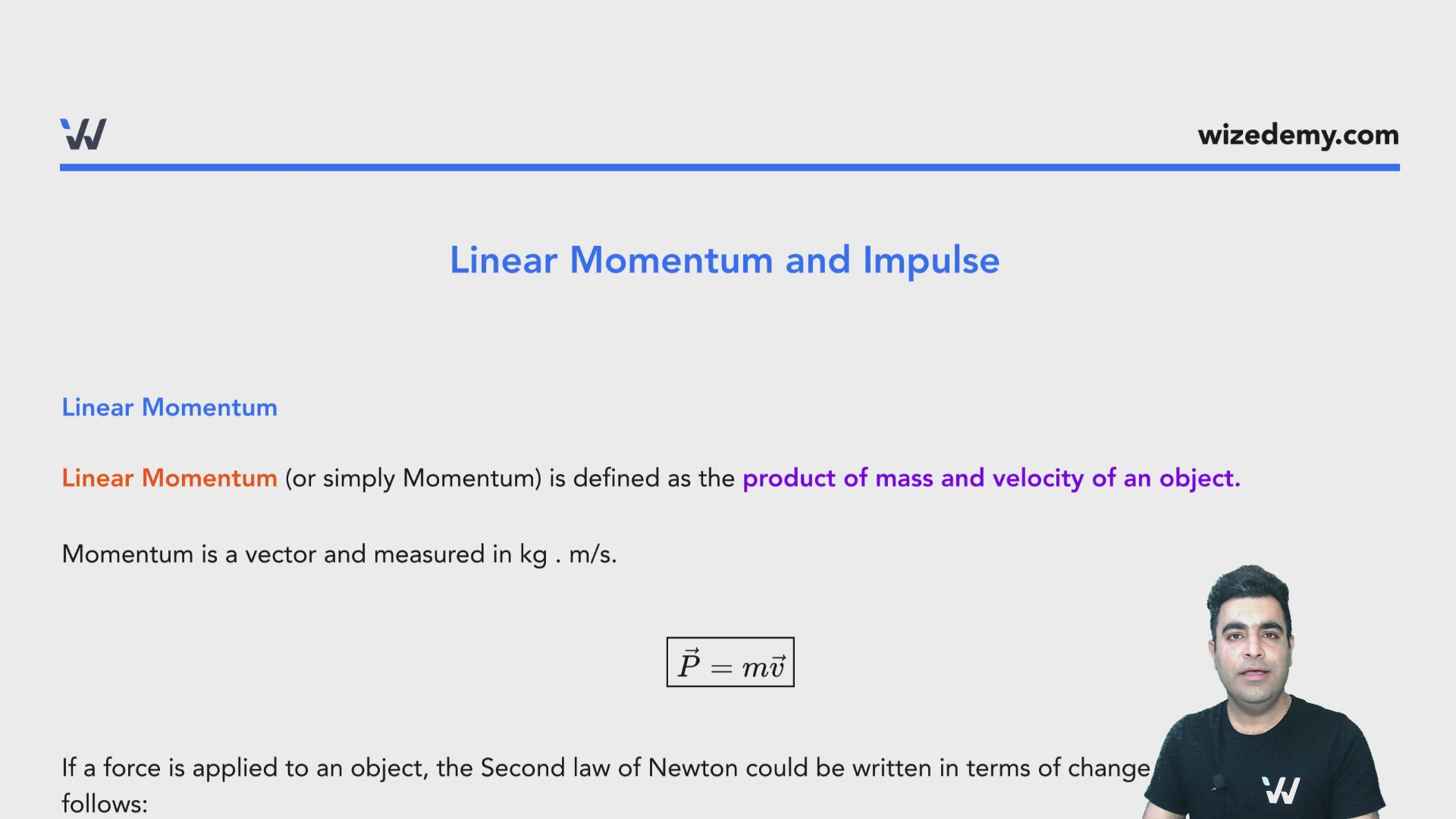
Linear Momentum (or simply Momentum) is defined as the product of mass and velocity of an object.
Momentum is a vector and measured in kg . m/s.
If a force is applied to an object, the Second law of Newton could be written in terms of change in momentum as follows:
Impulse
Impulse is defined as the change in the momentum of the object if a constant external force of F is applied to the object:
Linear Momentum and Impulse
Linear Momentum
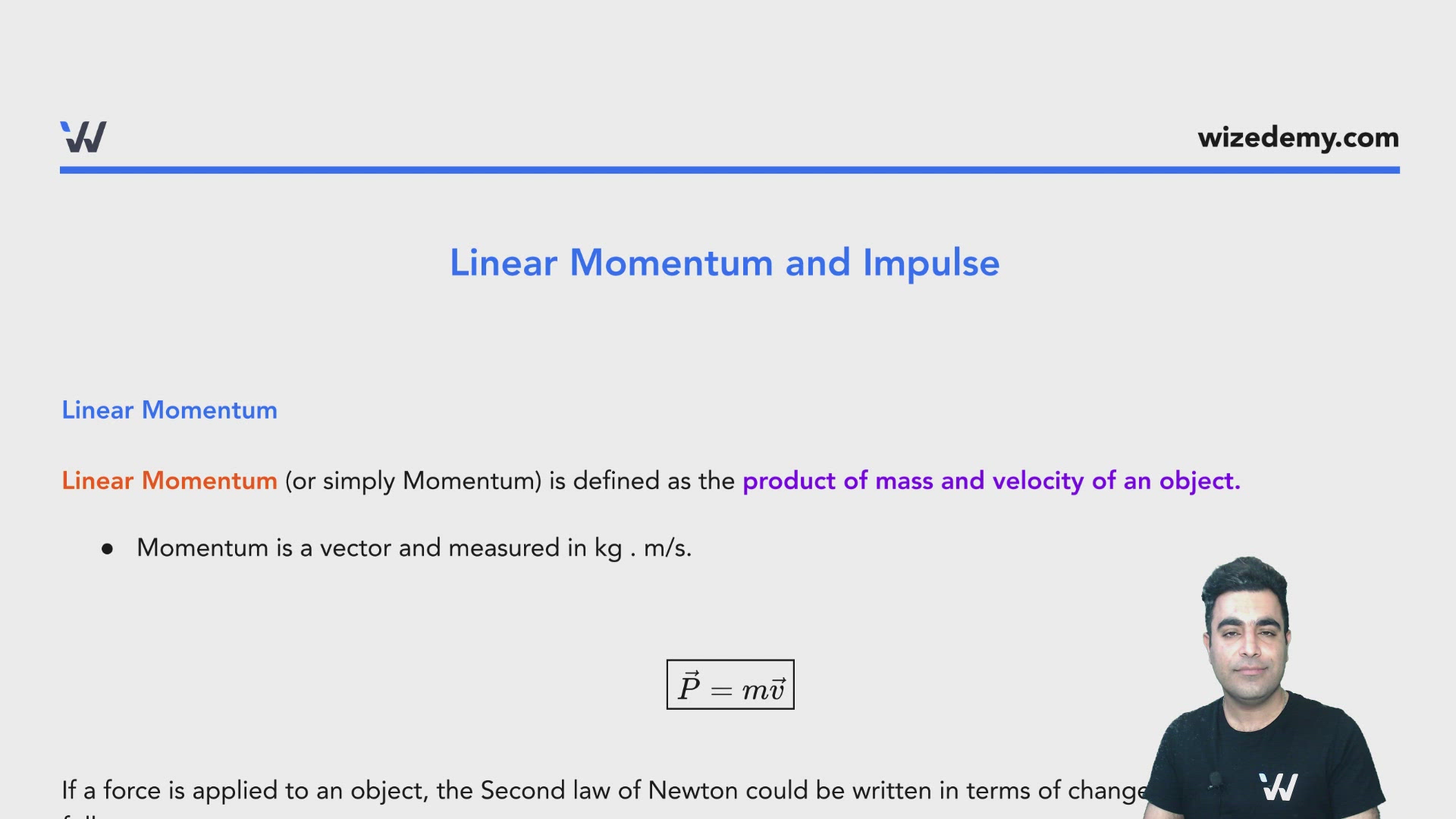
Linear Momentum (or simply Momentum) is defined as the product of mass and velocity of an object.
- Momentum is a vector and measured in kg . m/s.
If a force is applied to an object, the Second law of Newton could be written in terms of change in momentum as follows:
Impulse
Impulse is defined as the change in the momentum of the object if a constant external force of F is applied to the object:
For a net external force which is changing in time, impulse is defined as below:

Example: Impulse to a Soccer Ball
A soccer player applies an average force of 180 N during a kick. The kick accelerates a 0.45 kg soccer ball from rest to a speed of 18 m/s. What is the impulse imparted to the ball? What is collision time?
Solution:
We know that impulse is defined as:
Since the ball is at rest before the kick, its initial momentum is zero.
So, we can easily calculate impulse as:
Furthermore, we can find the time duration of the kick again by looking at the definition of impulse:
