
Kinematics Equations for Rotation
The parameters describing the translational motion have an analogue in rotational motion.
Angular velocity is the equivalent of linear velocity, angular acceleration is analogue to linear acceleration, and etc.

Kinematic equations for rotational motions are very similar to kinematic equations for linear motion. For a rotation with a constant angular acceleration:
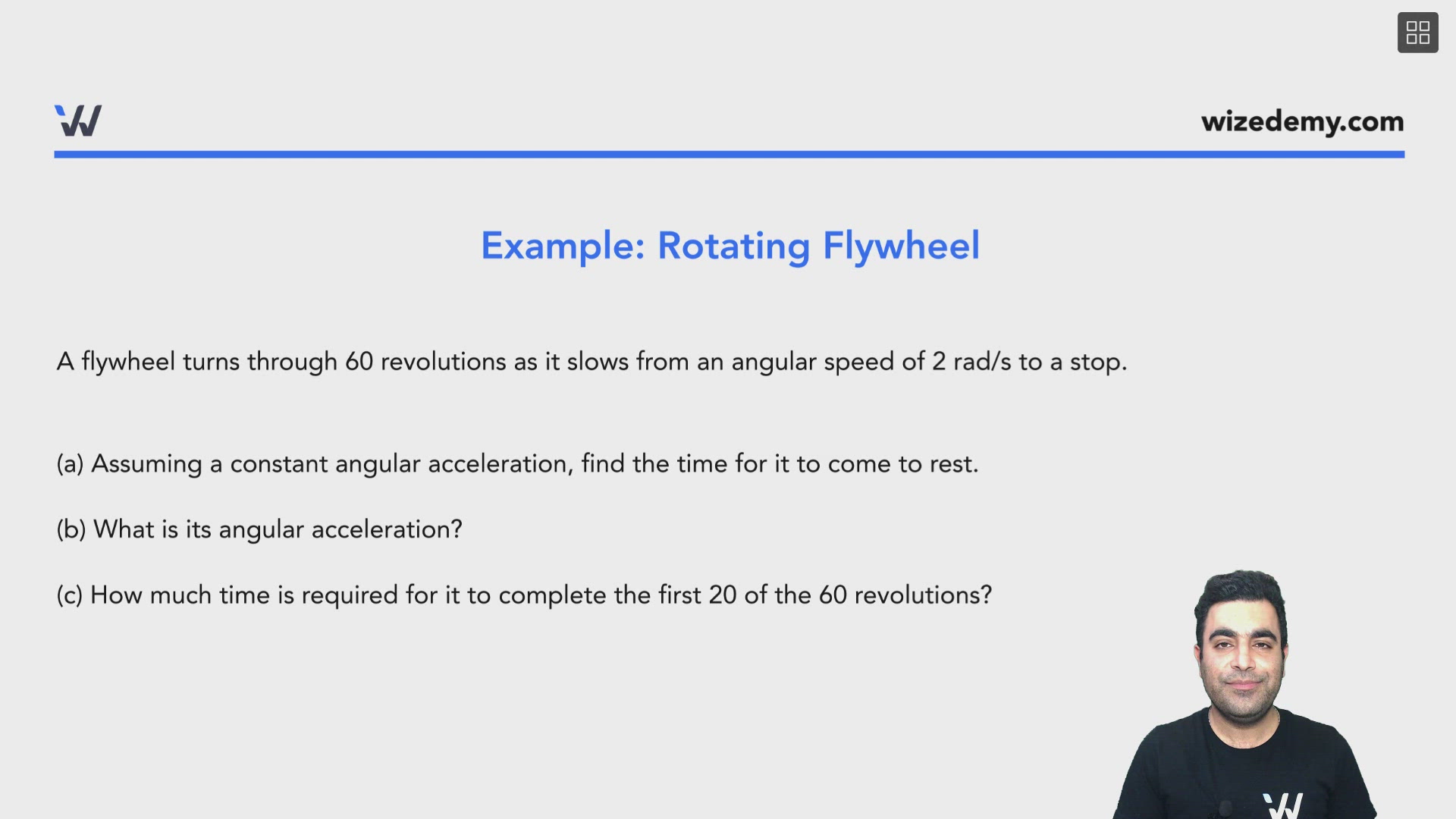
Example: Rotating Flywheel
A flywheel turns through 60 revolutions as it slows from an angular speed of 2 rad/s to a stop.
(a) Assuming a constant angular acceleration, find the time for it to come to rest.
(b) What is its angular acceleration?
(c) How much time is required for it to complete the first 20 of the 60 revolutions?
Solution:
Part a)
As angular acceleration is not given, we use the below formula to find the time for the flywheel to stop:
Note that here the flywheel turns through 60 revolutions before it stops, since each revolution covers . The net change in the angle for this rotation is . From the above equation:
Part b)
Now we can use another kinematic equation for rotation to solve for the angular acceleration:
Note that here the angular acceleration is negative which means that the angular speed is decreasing!
Part c)
We first need to find the angular speed when the flywheel makes 20 revs:
Now we use the formula below to find time: