Create a free account to get started

Unlock full course notes by signing up

  • Video lessons taught by top educators
  • Practice questions with guided solutions
  • Written review notes for reference
  • Expert answers anytime from course tutors

Parallel Axis Theorem


Remember that moments of inertia depends on the specific axis of rotation. If the object is rotating abut any other axis, we can use the Parallel Axis Theorem to calculate the moment of inertia about this new axis.


If we know the moment of inertia about an axis that extends through the body's center of mass (IcomI_{com}), the moment of inertia about an axis that is parallel to this axis is:


I=Icom+M⋅h2\boxed{I=I_{com}+M\cdot h^2}

where h is the distance between the axes, and M is the total mass of object.
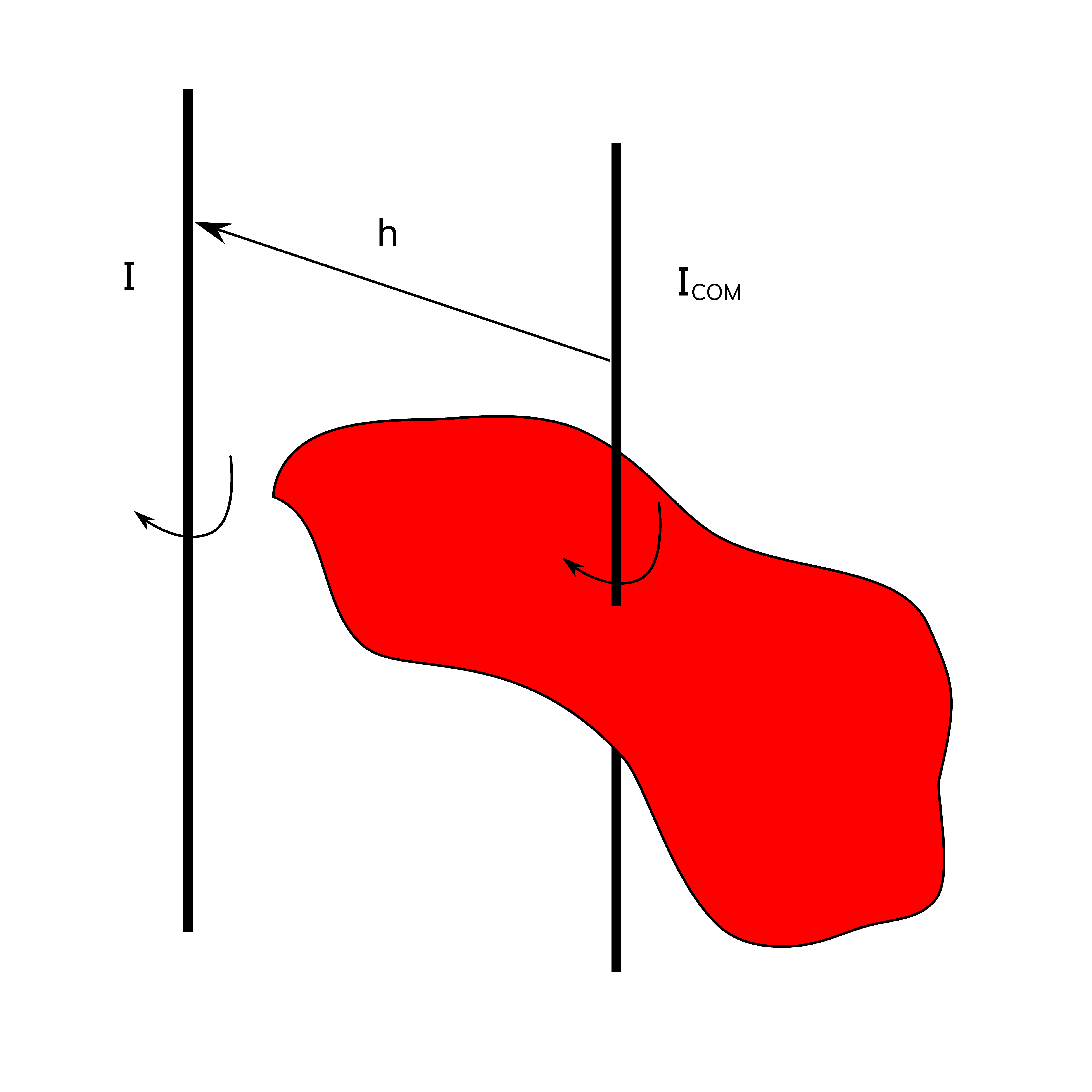
Image illustrating Parallel axis theorem


Moment of Inertia of Composite Shapes


Create a free account to get started

Unlock full course notes by signing up

  • Video lessons taught by top educators
  • Practice questions with guided solutions
  • Written review notes for reference
  • Expert answers anytime from course tutors

Example: Snowman Moment of Inertia


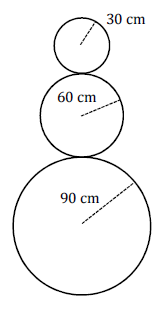
Tom and Jerry decide to build a snowmen at the edge of a cliff.  The snowman consists of three spheres with radii 90 cm, 60 cm and 30 cm, and the density of snow is 300kg/m3300kg/m^3.  They fight and Tom pushes the snowman over the cliff.  The snowman begins to rotate around its center of mass as it falls.  What is the moment of inertia of the snowman as it’s falling?


(For a solid sphere, Icm=25MR2 , and  V=43πR3I_{cm}=\frac{2}{5}MR^2\ ,\ and\ \ V=\frac{4}{3}\pi R^3, )

Image illustrating Example: Moment of Inertia


Solution:


Let's label spherical snowballs as 1, 2 and 3 as shown in the picture.
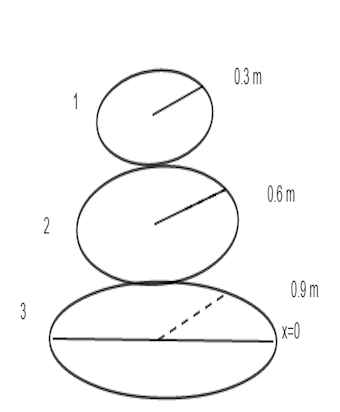
Image illustrating Example: Moment of Inertia


First we can find mass of each snowball using their radius and density of snow:


m1=ρV1=(300 kgm3)(43π)(0.3)3=10.8 π kgm_1=\rho V_1=\left(300\ \frac{kg}{m^3}\right)\left(\frac{4}{3}\pi\right)\left(0.3\right)^3=10.8\ \pi\ kg

m2=86.4π kg                 m3=291.6π kgm_2=86.4\pi\ kg\ \ \ \ \ \ \ \ \ \ \ \ \ \ \ \ \ m_3=291.6\pi\ kg


Now we need to find the center mass position. We can guess that due to symmetry it should be on the line passing through center of all snowballs. We can find its height respect to any arbitrary point. I chose the center of lowest snowball (the third one in the picture).


So, the position of the snowman center of mass respect to the center of the lowest snowball is:


Xcm=m1x1+m2x2+m3x3m1+m2+m3=(10.8)(2.4 m)+(86.4)(1.5)+(291.6)(0)(10.8+86.4+291.6)X_{cm}=\dfrac{m_1x_1+m_2x_2+m_3x_3}{m_1+m_2+m_3}=\dfrac{\left(10.8\right)\left(2.4\ m\right)+\left(86.4\right)\left(1.5\right)+\left(291.6\right)\left(0\right)}{\left(10.8+86.4+291.6\right)}

∴Xcm=0.4 m\therefore X_{cm}=0.4\ m

So, the snowman center of mass is 0.4m above the center of the lowest snowball or 1.3m above the ground.


Since the snowman is rotating about its center of mass, we need to find its moment of inertia respect to this point. We can use the formula given to us to find the moment of inertia of each snowball about its own center of mass and then use parallel axis theorem to calculate its moment of inertia about the snowman's center of mass.


Icm1=25m1r12=25(10.8π)(0.3)2=0.3888π kg.m2I_{cm1}=\frac{2}{5}m_1r_1^2=\frac{2}{5}\left(10.8\pi\right)\left(0.3\right)^2=0.3888\pi\ kg.m^2

Icm2=12.4416π kg.m2        Icm3=94.4784π  kg.m2                     I_{cm2}=12.4416\pi\ kg.m^2\ \ \ \ \ \ \ \ I_{cm3}=94.4784\pi\ \ kg.m^2\ \ \ \ \ \ \ \ \ \ \ \ \ \ \ \ \ \ \ \ \


We can use the radius of snowballs to find the distance between their center of mass and the snowman's center of mass (axis of rotation)


I1=Icm1+m1h12=0.3888π+(10.8π)(2.0)2=136.9 kg m2I_1=I_{cm1}+m_1 h_1^2=0.3888\pi+\left(10.8\pi\right)\left(2.0\right)^2=136.9\ kg\ m^2


I2=Icm2+m2h22=12.4416π+(86.4π)(1.1)2=367.5 kg . m2I_2=I_{cm2}+m_2 h_2^2=12.4416\pi+\left(86.4\pi\right)\left(1.1\right)^2=367.5\ kg\ .\ m^2


I3=Icm3+m3h32=94.4784π+(291.6π)(0.4)2=443.4 kg. m2I_3=I_{cm3}+m_3 h_3^2=94.4784\pi+\left(291.6\pi\right)\left(0.4\right)^2=443.4\ kg.\ m^2


Finally, we need to add above moments of inertia to find the snowman's moment of inertia

∴Itot=947.8 kg.m2\therefore I_{tot}=947.8\ kg.m^2


Two thin Hoops each of mass M and radius of R are joined together as shown in the figure. What is the moment of inertia for rotations in the plane of the page about pint O?

(The moment of inertia of a hoop with mass M and Radius R about an axis perpendicular to it and passing through its center is equal to MR2MR^2)


Illustration for practice question: Moment of Inertia of a Composite Shape


Choose an answer

Create a free account to get started

Unlock full course notes by signing up

  • Video lessons taught by top educators
  • Practice questions with guided solutions
  • Written review notes for reference
  • Expert answers anytime from course tutors