
Rotational Analog of Newton's Second Law
Torque is the rotational analog for force. When we apply a torque, we are changing the angular acceleration (making it spin faster or slower). This change is given by Newton's second law for rotations
where is the moment of inertia and is the angular acceleration.
Example: Rotating Rod
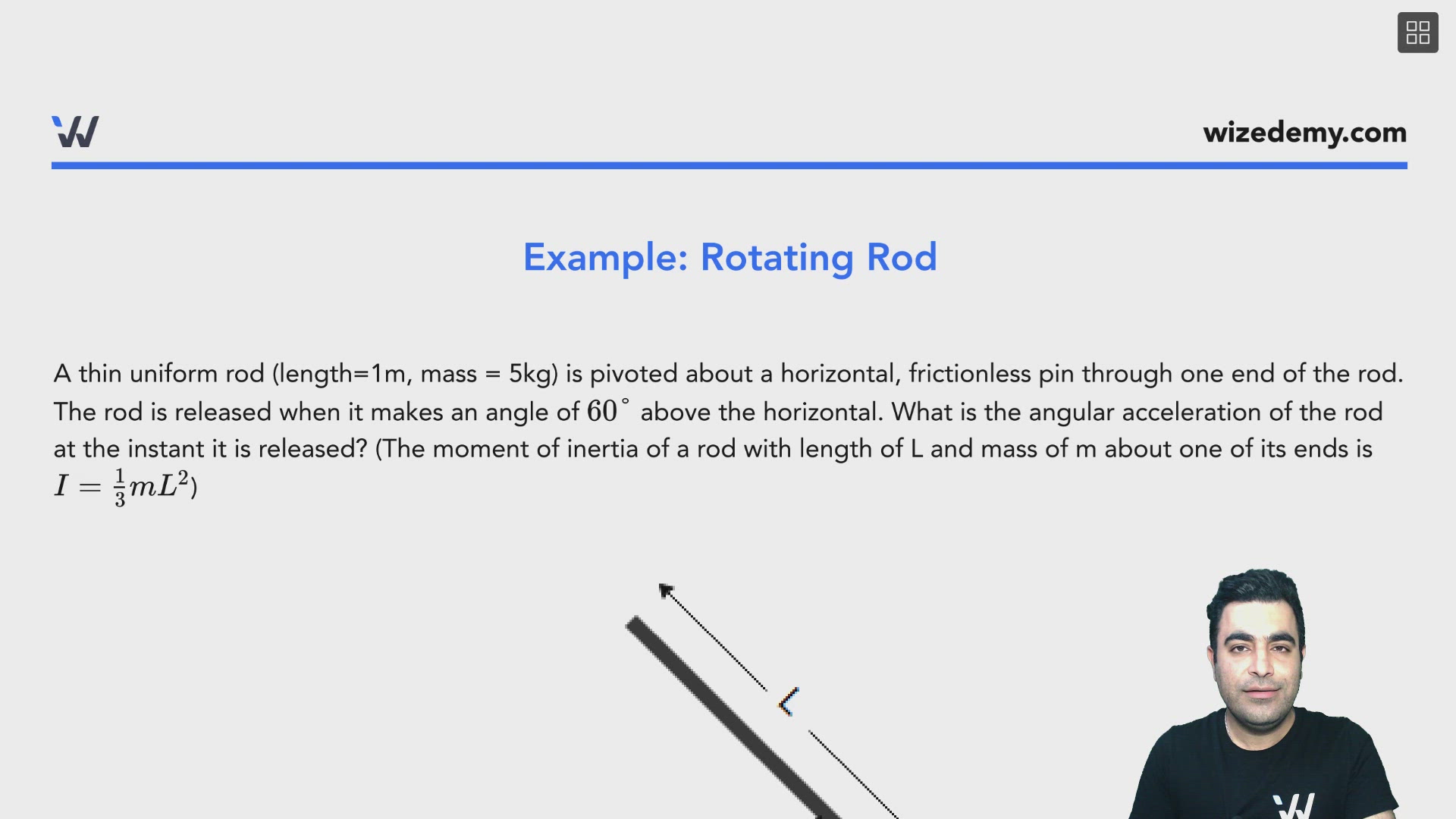
A thin uniform rod (length=1m, mass = 5kg) is pivoted about a horizontal, frictionless pin through one end of the rod. The rod is released when it makes an angle of above the horizontal. What is the angular acceleration of the rod at the instant it is released? (The moment of inertia of a rod with length of L and mass of m about one of its ends is )

Solution:
The only force acting on the rod is gravity, and so this produces a torque at the centre of mass. We write:
To find the torque caused by gravity, we need the distance from the pivot point to the center of mass which is half of the length of rod and also the angle gravity force makes with the position vector along the rod. This angle is
Solving for we get: