Create a free account to get started

Unlock full course notes by signing up

  • Video lessons taught by top educators
  • Practice questions with guided solutions
  • Written review notes for reference
  • Expert answers anytime from course tutors

Linear Combinations of Random Variables

For a random variable XX, let...

  • E(X)=E\left(X\right)= expected value or mean
  • Var(X)=Var\left(X\right)= variance
  • SD(X)=SD\left(X\right)= standard deviation


A new distribution could be formed by combining random variables Given the mean and standard deviation a given distribution, we can combine random variables to find the combined mean, combined variance, and combined standard deviation of the new distribution.

Linear Rescaling of RV

A linear rescaling is a transformation of the form Y=aX+bY=a\textcolor{orange}{X}+b


  • E(aX+b)=aE(X)+bE\left(a\textcolor{orange}{X}+b\right)=aE\left(\textcolor{orange}{X}\right)+b
  • Var(aX+b)=a2Var(X)Var\left(a\textcolor{orange}{X}+b\right)=a^2Var\left(\textcolor{orange}{X}\right)
  • SD(aX+b)=∣a∣Var(X)SD(a\textcolor{orange}{X}+b)=|a|\sqrt{Var(\textcolor{orange}{X})}


Combining RV for Weighted Averages


A linear combination of two random variables XX and YY is in the form aX+bYa\textcolor{orange}{X}+b\textcolor{green}{Y} where a weighted average is involved such that a+b=1a+b=1.

  • E(aX+bY)=aE(X)+bE(Y)E\left(a\textcolor{orange}{X}+b\textcolor{green}{Y}\right)=aE\left(\textcolor{orange}{X}\right)+bE\left(\textcolor{green}{Y}\right)
  • Var(aX+bY)=a2Var(X)+b2Var(Y)Var\left(a\textcolor{orange}{X}+b\textcolor{green}{Y}\right)=a^2Var\left(\textcolor{orange}{X}\right)+b^2Var\left(\textcolor{green}{Y}\right)
  • SD(aX+bY)=a2Var(X)+b2Var(Y)SD\left(a\textcolor{orange}{X}+b\textcolor{green}{Y}\right)=\sqrt{a^2Var\left(\textcolor{orange}{X}\right)+b^2Var\left(\textcolor{green}{Y}\right)}


  • E(aX−bY)=aE(X)−bE(Y)E\left(a\textcolor{orange}{X}-b\textcolor{green}{Y}\right)=aE\left(\textcolor{orange}{X}\right)-bE\left(\textcolor{green}{Y}\right)
  • Var(aX−bY)=a2Var(X)+b2Var(Y)Var\left(a\textcolor{orange}{X}-b\textcolor{green}{Y}\right)=a^2Var\left(\textcolor{orange}{X}\right)+b^2Var\left(\textcolor{green}{Y}\right)
  • SD(aX−bY)=a2Var(X)+b2Var(Y)SD\left(a\textcolor{orange}{X}-b\textcolor{green}{Y}\right)=\sqrt{a^2Var\left(\textcolor{orange}{X}\right)+b^2Var\left(\textcolor{green}{Y}\right)}


Create a free account to get started

Unlock full course notes by signing up

  • Video lessons taught by top educators
  • Practice questions with guided solutions
  • Written review notes for reference
  • Expert answers anytime from course tutors

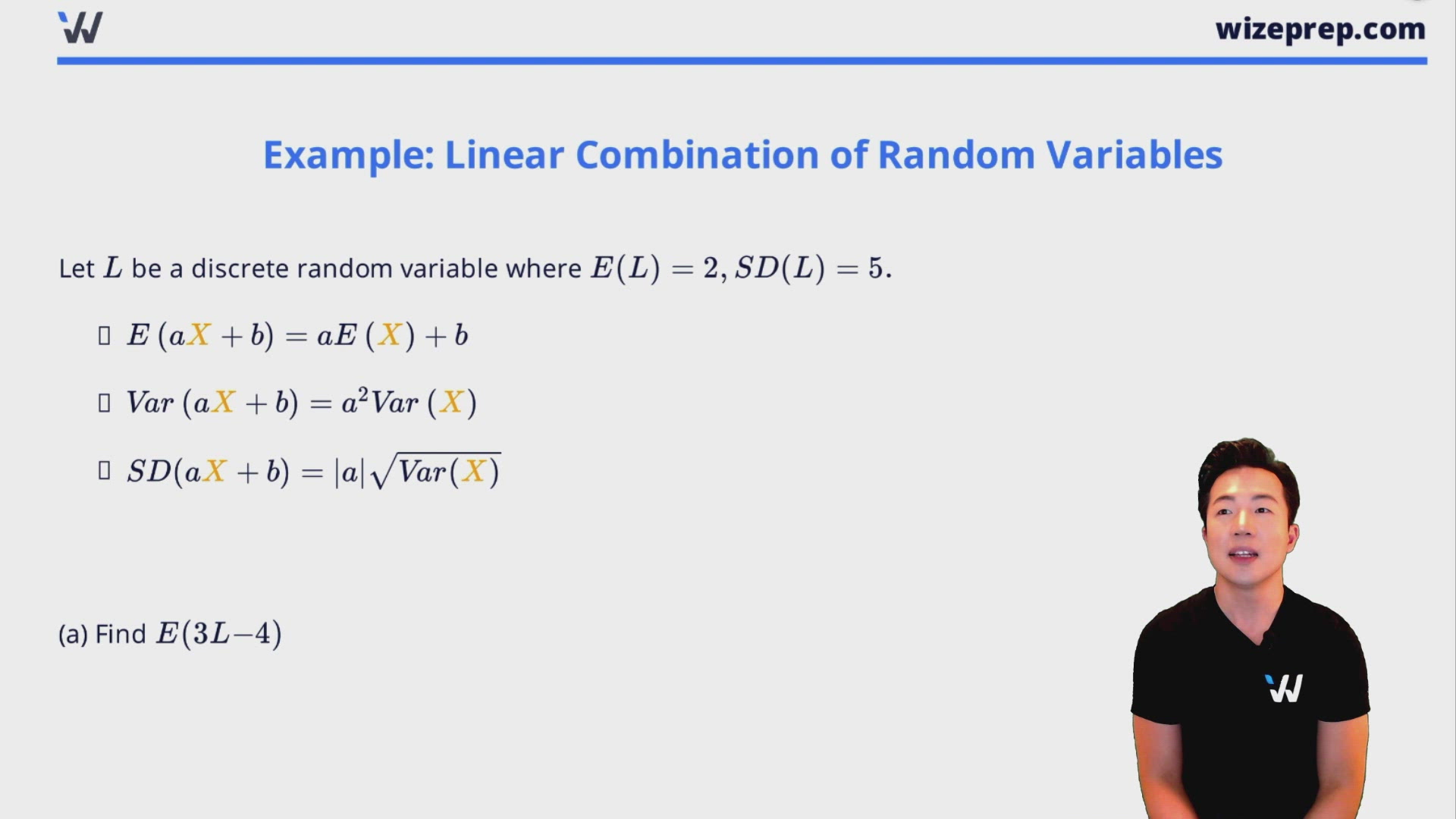
Example: Linear Combination of Random Variables


Let LL be a discrete random variable where 𝐸(𝐿)=2,SD(𝐿)=5.𝐸(𝐿)=2,SD(𝐿)=5.

  • E(aX+b)=aE(X)+bE\left(a\textcolor{orange}X+b\right)=aE\left(\textcolor{orange}X\right)+b
  • Var(aX+b)=a2Var(X)Var\left(a\textcolor{orange}{X}+b\right)=a^2Var\left(\textcolor{orange}{X}\right)
  • SD(aX+b)=∣a∣Var(X)SD(a\textcolor{orange}{X}+b)=|a|\sqrt{Var(\textcolor{orange}{X})}


(a) Find 𝐸(3𝐿−4)𝐸(3𝐿 − 4)


E(aX+b)=aE(X)+bE\left(a\textcolor{orange}X+b\right)=aE\left(\textcolor{orange}X\right)+b


𝐸(3𝐿−4)=3(2)−4=2𝐸(3𝐿 − 4) = 3(2) − 4 = 2


(b) Find SD(−𝐿+12)SD(−𝐿+12)


SD(aX+b)=∣a∣V(X)SD(a\textcolor{orange}{X}+b)=|a|\sqrt{V(\textcolor{orange}{X})}


Tip: Imagine an invisible 1 in front of the LL, so a=−1a=-1.


SD(−𝐿+12)=∣−1∣SD(𝐿)=(1)(5)=5SD(−𝐿+12)=|−1|SD(𝐿)=(1)(5)=5


I personally prefer to solve for the variance first, then find the square-root of the variance to solve for the standard deviation:


V(aX+b)=a2V(X)V\left(a\textcolor{orange}{X}+b\right)=a^2V\left(\textcolor{orange}{X}\right)


Var(−𝐿+12)=(−1)2(5)2=25Var(−𝐿+12)=\left(-1\right)^2\left(5\right)^2=25

SD=Var=25=5SD=\sqrt{Var}=\sqrt{25}=5


Let QQ be a discrete random variable where 𝐸(Q)=25,SD(Q)=6.𝐸(Q)=25,SD(Q)=6.


(a) Find 𝐸(Q2−1)𝐸\left(\frac{Q}{2}−1\right)


(b) Find SD(Q2−1)SD\left(\frac{Q}{2}−1\right)


Your answers

Create a free account to get started

Unlock full course notes by signing up

  • Video lessons taught by top educators
  • Practice questions with guided solutions
  • Written review notes for reference
  • Expert answers anytime from course tutors

Create a free account to get started

Unlock full course notes by signing up

  • Video lessons taught by top educators
  • Practice questions with guided solutions
  • Written review notes for reference
  • Expert answers anytime from course tutors

Example: Combining Random Variables with Weighted Averages


Conrad invests in two portfolios, 40% in the Aggressive Portfolio and 60% in the Slow-and-Steady Portfolio. His wealth manager determined that the average rate of return in the Aggressive Portfolio is 14.5% with a standard deviation of 20% – risky! The Slow-and-Steady Portfolio has an average rate of return of 3.3% with a standard deviation of 1%.


Determine the mean rate of return, variance, and standard deviation of his portfolios. (Assume the two portfolios are independent.)

  • E(aX+bY)=aE(X)+bE(Y)E\left(a\textcolor{orange}{X}+b\textcolor{green}{Y}\right)=aE\left(\textcolor{orange}{X}\right)+bE\left(\textcolor{green}{Y}\right)
  • Var(aX+bY)=a2Var(X)+b2Var(Y)Var\left(a\textcolor{orange}{X}+b\textcolor{green}{Y}\right)=a^2Var\left(\textcolor{orange}{X}\right)+b^2Var\left(\textcolor{green}{Y}\right)
  • SD(aX+bY)=a2Var(X)+b2Var(Y)SD\left(a\textcolor{orange}{X}+b\textcolor{green}{Y}\right)=\sqrt{a^2Var\left(\textcolor{orange}{X}\right)+b^2Var\left(\textcolor{green}{Y}\right)}

a=0.4 a=0.4\

b=0.6b=0.6


Let Portfolio P=0.4X+0.6YP=0.4X+0.6Y


Combined mean:


E(aX+bY)=aE(X)+bE(Y)E\left(a\textcolor{orange}{X}+b\textcolor{green}{Y}\right)=aE\left(\textcolor{orange}{X}\right)+bE\left(\textcolor{green}{Y}\right)


E(P)=0.4(14.5)+0.6(3.3)=7.78E\left(P\right)=0.4\left(14.5\right)+0.6\left(3.3\right)=7.78 (or 7.78%)


Combined variance:


Var(aX+bY)=a2Var(X)+b2Var(Y)Var\left(a\textcolor{orange}{X}+b\textcolor{green}{Y}\right)=a^2Var\left(\textcolor{orange}{X}\right)+b^2Var\left(\textcolor{green}{Y}\right)


Var(P)=(0.4)2(20)2+(0.6)2(1)2=64.36Var\left(P\right)=\left(0.4\right)^2\left(20\right)^2+\left(0.6\right)^2\left(1\right)^2=64.36 (or 64.36%)


Combined standard deviation:


SD(aX+bY)=a2Var(X)+b2Var(Y)SD\left(a\textcolor{orange}{X}+b\textcolor{green}{Y}\right)=\sqrt{a^2Var\left(\textcolor{orange}{X}\right)+b^2Var\left(\textcolor{green}{Y}\right)}


SD(P)=Var(P)=64.36=8.022SD\left(P\right)=\sqrt{Var\left(P\right)}=\sqrt{64.36}=8.022 (or 8.022%)


Alternative Method:


Combined mean:


E(aX+bY)=aE(X)+bE(Y)E\left(a\textcolor{orange}{X}+b\textcolor{green}{Y}\right)=aE\left(\textcolor{orange}{X}\right)+bE\left(\textcolor{green}{Y}\right)


E(P)=0.4(0.145)+0.6(0.033)=0.0778E\left(P\right)=0.4\left(0.145\right)+0.6\left(0.033\right)=0.0778 (or 7.78%)


Combined variance:


Var(aX+bY)=a2Var(X)+b2Var(Y)Var\left(a\textcolor{orange}{X}+b\textcolor{green}{Y}\right)=a^2Var\left(\textcolor{orange}{X}\right)+b^2Var\left(\textcolor{green}{Y}\right)


Var(P)=(0.4)2(0.2)2+(0.6)2(0.01)2=0.006436Var\left(P\right)=\left(0.4\right)^2\left(0.2\right)^2+\left(0.6\right)^2\left(0.01\right)^2=0.006436*


*Note: The variance’s usefulness is limited here because the units are squared and not the same as the original data.


Combined standard deviation:


SD(aX+bY)=a2Var(X)+b2Var(Y)SD\left(a\textcolor{orange}{X}+b\textcolor{green}{Y}\right)=\sqrt{a^2Var\left(\textcolor{orange}{X}\right)+b^2Var\left(\textcolor{green}{Y}\right)}


SD(P)=Var(P)=0.006436=0.08022SD\left(P\right)=\sqrt{Var\left(P\right)}=\sqrt{0.006436}=0.08022 (or 8.022%)


Practice: Combining Random Variables with Weighted Average

The midterm is worth 30% of your overall grade; the final exam is worth 70%.


The average grade on the midterm is 68% with a standard deviation of 12%.

The average grade on the final exam is 73% with a standard deviation of 16%

Your answers

Create a free account to get started

Unlock full course notes by signing up

  • Video lessons taught by top educators
  • Practice questions with guided solutions
  • Written review notes for reference
  • Expert answers anytime from course tutors

Create a free account to get started

Unlock full course notes by signing up

  • Video lessons taught by top educators
  • Practice questions with guided solutions
  • Written review notes for reference
  • Expert answers anytime from course tutors

Functions of Two Independent Random Variables X and Y

Two random variables XX and YY are independent if knowing the value of one of them does not affect the probabilities for the other one.

If X and Y are independent, we have these formulas:

  • E(XY)=E(X)×E(Y)E(\textcolor{orange}{X}\textcolor{blue}{Y})=\textcolor{orange}{E(X)}\times\textcolor{blue}{E(Y)}
  • E(X+Y)=E(X)+E(Y)E(\textcolor{orange}{X}\textcolor{blue}{+Y})=\textcolor{orange}{E(X)}+\textcolor{blue}{E(Y)}
  • E(X−Y)=E(X)−E(Y)E(\textcolor{orange}{X}\textcolor{blue}{-Y})=\textcolor{orange}{E(X)}-\textcolor{blue}{E(Y)}
  • Var(X+Y)=Var(X)+Var(Y)Var(\textcolor{orange}{X}+\textcolor{blue}{Y})=\textcolor{orange}{Var(X)}+\textcolor{blue}{Var(Y)}
  • Var(X−Y)=Var(X)+Var(Y)Var(\textcolor{orange}{X}-\textcolor{blue}{Y})=\textcolor{orange}{Var(X)}+\textcolor{blue}{Var(Y)}


The standard deviation is the square-root of the variance:

  • SD(X+Y)=Var(X)+Var(Y)SD(\textcolor{orange}{X}+\textcolor{blue}{Y})=\sqrt{\textcolor{orange}{Var(X)}+\textcolor{blue}{Var(Y)}}
  • SD(X−Y)=Var(X)+Var(Y)SD(\textcolor{orange}{X}-\textcolor{blue}{Y})=\sqrt{\textcolor{orange}{Var(X)}+\textcolor{blue}{Var(Y)}}


As you can see, there are a lot of formulas but they will all make sense after we do a bunch of examples.


Create a free account to get started

Unlock full course notes by signing up

  • Video lessons taught by top educators
  • Practice questions with guided solutions
  • Written review notes for reference
  • Expert answers anytime from course tutors

Example: Combining Independent Random Variables

Let 𝐴𝐴, 𝐵𝐵 be two discrete independent random variables with:


E(A)=10, SD(𝐴)=5E\left(A\right)=10,\ SD(𝐴)=5

E(B)=26, SD(𝐵)=12E\left(B\right)=26,\ SD(𝐵)=12


  • E(XY)=E(X)×E(Y)E(\textcolor{orange}X\textcolor{blue}Y)=\textcolor{orange}{E(X)}\times \textcolor{blue}{E(Y)}
  • E(X+Y)=E(X)+E(Y)E(\textcolor{orange}{X}\textcolor{blue}{+Y})=\textcolor{orange}{E(X)}+\textcolor{blue}{E(Y)}
  • E(X−Y)=E(X)−E(Y)E(\textcolor{orange}{X}\textcolor{blue}{-Y})=\textcolor{orange}{E(X)}-\textcolor{blue}{E(Y)}
  • Var(X+Y)=Var(X)+Var(Y)Var(\textcolor{orange}{X}+\textcolor{blue}{Y})=\textcolor{orange}{Var(X)}+\textcolor{blue}{Var(Y)}
  • Var(X−Y)=Var(X)+Var(Y)Var(\textcolor{orange}{X}-\textcolor{blue}{Y})=\textcolor{orange}{Var(X)}+\textcolor{blue}{Var(Y)}

The standard deviation is the square-root of the variance:

  • SD(X+Y)=SD(X−Y)=Var(X)+Var(Y)SD(\textcolor{orange}{X}+\textcolor{blue}{Y})=SD(\textcolor{orange}{X}-\textcolor{blue}{Y})=\sqrt{\textcolor{orange}{Var(X)}+\textcolor{blue}{Var(Y)}}


(a) Find E(A+B)E\left(A+B\right)

E(A+B)=E(A)+E(B)=10+26=36E(\textcolor{orange}{A}\textcolor{blue}{+B})=\textcolor{orange}{E(A)}+\textcolor{blue}{E(B)}=10+26=36

(b) Find SD(A+B)SD(A+B)

Do not add standard deviations! Add variances first, then find the square-root of the combined variances.


SD(A+B)SD(A+B)

=Var(A+B)=\sqrt{Var(A+B)}

=Var(A)+Var(B)=\sqrt{Var(A)+Var(B)}

=52+122=\sqrt{5^2+12^2}

=169=\sqrt{169}

=13=13


(c) Find SD(2𝐴−𝐵)SD(2𝐴−𝐵)


Do not subtract standard deviations! Add variances first, then find the square-root of the combined variances.


SD(2A−B)SD(2A-B)

=Var(2A−B)=\sqrt{Var(2A-B)}

=22Var(A)+(−1)2Var(B)=\sqrt{2^2Var(A)+(-1)^2Var(B)}

=4Var(A)+1Var(B)=\sqrt{4Var\left(A\right)+1Var\left(B\right)}

=4⋅52+122=\sqrt{4\cdot5^2+12^2}

=100+144=\sqrt{100+144}

=244=\sqrt{244}

Suppose that certain car parts are manufactured so that their heights are independent of each other, with a mean of μ=31.2\mu=31.2 cm and a standard deviation of σ=0.1\sigma=0.1 cm.


If 2 of these parts are stacked on top of each other to form a new part, what are the mean and standard deviation of this new part?

Choose an answer

Create a free account to get started

Unlock full course notes by signing up

  • Video lessons taught by top educators
  • Practice questions with guided solutions
  • Written review notes for reference
  • Expert answers anytime from course tutors

You have 50 job candidates to interview for a job at your firm. Each interview lasts an average of 12 minutes with a standard deviation of 3 minutes. What is the mean and standard deviation of the total time to interview all 50 candidates (not counting breaks in between)?

Your answers

Create a free account to get started

Unlock full course notes by signing up

  • Video lessons taught by top educators
  • Practice questions with guided solutions
  • Written review notes for reference
  • Expert answers anytime from course tutors