
Conservative vs Non-Conservative Forces - Part 1
There are two types of work coming from different forces: conservative and nonconservative (nc).
- Conservative forces perform work that do not depend on the path taken (gravity, spring force). The energy is converted into potential energy.
- Nonconservative forces perform work that depend on the path (friction). The energy is dissipated as heat or sound. Any non-zero nonconservative work will change the mechanical energy.
Conservative Forces and Potential Energy
Work done by any conservative force is proportional to the change in the potential energy associated with that force:
- Potential energy is a type of energy which is stored inside the object and can be converted into other energies such as kinetic energy.
- Potential energy is usually shown by , or
- Gravitational Potential Energy (Earth):
- Gravitational Potential Energy (Any Planet):
- Spring Potential Energy:
- A conservative force is always toward the points with lower potential energies.
- If work is done by only conservative forces, then the mechanical energy of the system is conserved.
- Potential energy can also be described as the negative integral of the dot product of conservative forces and distance as a mathematical expression:
- As a differential equation the above equation can be written as:
Conservative vs Non-Conservative Forces - Part 2
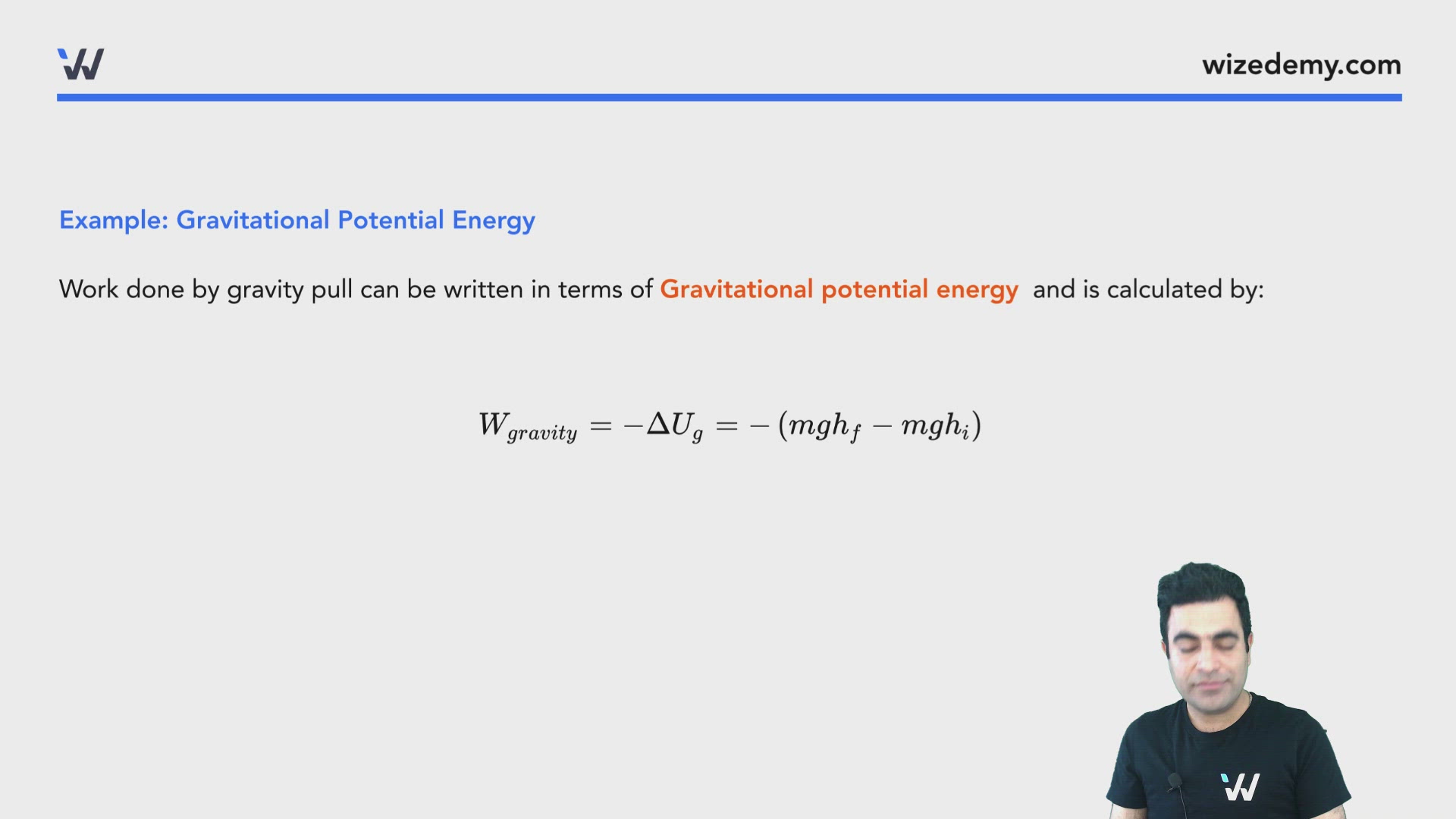
Example: Gravitational Potential Energy
Work done by gravity pull can be written in terms of Gravitational potential energy and is calculated by:
where h is the height and is measured relative to the reference potential energy.
- We can also express potential energy due to gravity on any planet by:
Example: Elastic Energy of Springs
Similarly, the restoring force of a spring is a conservative force and the potential energy stored inside a spring is given by:
Which of the following forces are non-conservative? (select all that apply)
a. Drag
b. Friction
c. Gravity
d, Electrostatic Force
e. Magnetic Force
f. Spring Force
a, b