AI Tutor
High School
SAT
SAT Elite 1500
SAT Tutoring
ACT
ACT Elite 33
ACT Tutoring
University
MCAT
MCAT Elite 515
Med-School Admissions
Med School Calculator
MCAT Score Percentiles
Pre-Med Tutoring
Pre-Med Plus
LSAT
LSAT Elite 170
LSAT Self-Paced
LSAT Tutoring
DAT
DAT Programs
DAT Elite
DAT Self-Paced
DAT Tutoring
Log in
Get Started for Free
Wize Exam Practice Questions: Which of the following enzymes catalyzes a revers…
Related Topics
Wize University Biology Textbook > Energy & Metabolism
Types of Energy [Potential, Kinetic, Free & Activation]
7 Activities
Wize University Biology Textbook > Energy & Metabolism
Enzyme Regulation
5 Activities
Wize University Biology Textbook > Energy & Metabolism
Coupled Reactions
4 Activities
Wize Exam Practice Questions:
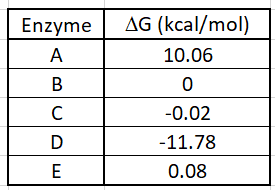
Which of the following enzymes catalyzes a reversible reaction?
Enzyme A
Enzyme B
Enzyme C
Enzyme D
Enzyme E
I don't know
Check Submission
More Types of Energy [Potential, Kinetic, Free & Activation] Questions:
C
6
H
12
O
6
+ 6O
2
--> 6CO
2
+6H
2
O is the balanced chemical equation for respiration. Is the process exergonic or endergonic?
Why is the gibbs free energy change for ATP +H
2
O -> ADP +P
i
a greater negative value than the gibbs free energy change for AMP +H
2
O -> Adenosine + P
i
?
Coupled Reactions
What is the gibbs free energy of reaction for a coupled reaction where one process has a standard free energy change of +43 kJ/mol and the other has a standard free energy change of -16kJ/mol?
Is this coupled reaction spontaneous or non-spontaneous?
High transfer potential: Similar to 2014 Question 8
Which of the following reactions has the most negative free energy change?
Free Energy
How can unfavourable reactions occur in a cell?
Which of the following have a negative ΔG?
Similar to 2018 exam Q4
Provide 2 examples of coupled reactions found in cellular respiration, then give a detailed explanation of each. Use free energy values were necessary (6pts)
Free Energy Diagram
Which letter represents the energy of activation of the reaction in the absence of enzyme? Which letter represents the free energy of the reaction?
If the entropy of a system is large, the enthalpy is negative and the temperature of the system is high, which of the following would be correct? All other conditions are constant and controlled. Select all that apply.
Gibbs Free Energy
Which of the following is true about an exergonically coupled reaction? Select all that apply.
The net
ΔG
is negative
There are more than 2 reactions happening at the same time
High transfer potential: Similar to 2014 Question 8
Which of the following reactions has the most negative free energy change?
Coupled Reactions
What is the gibbs free energy of reaction for a coupled reaction where one process has a standard free energy change of +43 kJ/mol and the other has a standard free energy change of -16kJ/mol?
Is this coupled reaction spontaneous or non-spontaneous?
Why is the gibbs free energy change for ATP +H
2
O -> ADP +P
i
a greater negative value than the gibbs free energy change for AMP +H
2
O -> Adenosine + P
i
?
What is the net free energy change of two reactions and indicate if it is favourable or unfavourabe. One with a free energy change of -26 kJ/mol and the other with +15 kJ/mol.
Practice: Enzyme Catalyzed Reactions
What is FALSE about this energy diagram of an uncatalyzed reaction?
Practice: Polymerization
Polymerization reactions are endergonic, why?
Free Energy
How can unfavourable reactions occur in a cell?
A bike at the top of a mountain represents what type of energy? [1 word]
Practice: What is Gibbs Free Energy?
What does Gibbs free energy determine?
Which of the following statements about protein folding is correct?
i. The native conformation of a protein is determined by the structure with the lowest free energy
ii. Denaturation of a protein results from high temperatures or exposure to chemicals like urea
Practice: Thermodynamics
Which enthalpic and entropic combinations will result in a spontaneous bilayer formation?
Which of the following would result in spontaneous membrane transport?
Using Gibb's Free Energy, an example
A biochemical pathway produces metabolite E. This pathway consists of A, B, C and D intermediates that require enzymes 1, 2, 3 and 4 to catalyze each step of the reaction.
a. Given the following information about each reaction, state which reactions are exergonic or endergonic. Where possible, state which reactions are exothermic or endothermic.
i. A
→
B, ΔG = +3
Given the Gibb's Free Energy of a reaction, predict if the reaction is spontaneous
Given the below steps to a biological reaction, what can you infer about each step? What can you predict about the reaction as a whole?
Using Gibb's Free Energy, an example
A biochemical pathway produces metabolite E. This pathway consists of A, B, C and D intermediates that require enzymes 1, 2, 3 and 4 to catalyze each step of the reaction.
a. Given the following information about each reaction, state which reactions are exergonic or endergonic. Where possible, state which reactions are exothermic or endothermic.
i. A
→
B, ΔG = +3
Given the below steps to a biological reaction, what can you infer about each step? What can you predict about the reaction as a whole?
(i.e. what is
Δ
G
T
o
t
a
l
\Delta G_{Total}
Δ
G
T
o
t
a
l
)
C
6
H
12
O
6
+ 6O
2
--> 6CO
2
+6H
2
O is the balanced chemical equation for respiration. Is the process exergonic or endergonic?
When a misfolded protein is being linearlized by the proteasome it requires ATP, why?
Given the figure, which of the following statements is correct?
Which of the following are accurate statements regarding membrane transport?
i. The entropy of the system decreases during active transport which is why it requires the use of ATP
ii. Passive diffusion functions because of an increase in entropy
Why are enzymes vital for life?
Given the following information, what is the value of the change in free energy?
T = 25oC
Entropy of the reactants = 3
Given the figure below, which of the following is true?
Which of the following statements best describes the enthalpy change of a reaction?
Which of the following enzymes catalyzes a reversible reaction?
A reaction with a positive ΔG is considered...
Which of the following have a negative ΔG?
Which of the following is true regarding non-spontaneous reactions?
Why are ADP + inorganic phosphate (Pi) more stable than ATP?
Fill in the blanks: Spontaneous reactions are _____________, and have a _____________ change in free energy.
How does energy coupling work?
Which of the following is true regarding non-spontaneous reactions?
Which of the following enzymes catalyzes an unfavorable reaction?
More Enzyme Regulation Questions:
Irreversible Inhibition
Which statement is FALSE about methods of irreversible inhibition.
Allosteric Enzymes
What statement is TRUE about allosteric enzymes?
Regulating enzymes
Which statement is TRUE about enzyme regulation?
Practice: Enzyme Catalyzed Reactions
What is FALSE about this energy diagram of an uncatalyzed reaction?
A molecule that binds at a site on the enzyme that is different than where the substrate binds and decreases the enzyme’s activity:
i. Is an allosteric inhibitor
ii. Positively regulates the enzyme’s activity
Allosteric Enzymes
What statement is TRUE about allosteric enzymes?
Regulating enzymes
Which statement is TRUE about enzyme regulation?
Irreversible Inhibition
Which statement is FALSE about methods of irreversible inhibition.
Which of the following can be concluded about an enzymes reaction rate? - Practice Question
Given the below figure showing the rate of reaction of an enzyme, which of the following can be concluded? (Select all that apply)
Which of the following are TRUE of allosteric inhibitors?
Anti-cancer antibodies are often used as a chemotherapeutic agent. They act by binding cell surface receptors, like Epidermal Growth Factor Receptor, whose aberrant activation leads to increase cellular proliferation. How are these antibodies affecting the protein interactions at the cell surface of these cancer cells?
Which of the following best describes the protein characterized by the following function?
Which of the following best describes the mechanism of action of an allosteric inhibitor?
Which of the following can be concluded about an enzymes reaction rate? - Practice Question
Given the below figure showing the rate of reaction of an enzyme, which of the following can be concluded?
Which of the following enzymes catalyzes a reversible reaction?
Practice: Metabolism Regulation
When AMP binds to glycogen phosphorylase it's enzymatic activity increases. This is an example of what kind of metabolic regulation?
Which of the following would positively affect an enzyme's activity?
Which of the following binds to the enzyme-substrate complex?
How does an uncompetitive inhibitor work?
Which of the following can bind distal to the active site of an enzyme?
Which of the following does not always enter an enzyme active site?
Protein 1 produces substrate A, and Protein 2 turns substrate A into substrate B. Substrate B binds to the enzyme-substrate complex of protein 1 and prevents production of substrate B. What is going on here?
Which of the following is true regarding enzyme inhibitors?
Practice: Enzyme Inhibitors
lnvirase and Nevirapine are both drugs used to treat HIV. Invirase is a competitive inhibitor of HIV protease and nevirapine is a non-competitive inhibitor of reverse transcriptase. If the blue line in the graph below represents uninhibited enzyme activity, which line represents Invirase activity (orange or green)?
More Coupled Reactions Questions:
C
6
H
12
O
6
+ 6O
2
--> 6CO
2
+6H
2
O is the balanced chemical equation for respiration. Is the process exergonic or endergonic?
Coupled Reactions
What is the gibbs free energy of reaction for a coupled reaction where one process has a standard free energy change of +43 kJ/mol and the other has a standard free energy change of -16kJ/mol?
Is this coupled reaction spontaneous or non-spontaneous?
Free Energy
How can unfavourable reactions occur in a cell?
Which of the following have a negative ΔG?
What are the 3 steps of glycolysis that have the largest exergonic reactions? What enzymes are they regulated by?
Similar to 2018 exam Q4
Provide 2 examples of coupled reactions found in cellular respiration, then give a detailed explanation of each. Use free energy values were necessary (6pts)
Give a real-life example of an ATP coupled reaction. Write out the equations.
If the entropy of a system is large, the enthalpy is negative and the temperature of the system is high, which of the following would be correct? All other conditions are constant and controlled. Select all that apply.
Gibbs Free Energy
Which of the following is true about an exergonically coupled reaction? Select all that apply.
The net
ΔG
is negative
There are more than 2 reactions happening at the same time
Coupled Reactions
What is the gibbs free energy of reaction for a coupled reaction where one process has a standard free energy change of +43 kJ/mol and the other has a standard free energy change of -16kJ/mol?
Is this coupled reaction spontaneous or non-spontaneous?
What is the net free energy change of two reactions and indicate if it is favourable or unfavourabe. One with a free energy change of -26 kJ/mol and the other with +15 kJ/mol.
Practice: Polymerization
Polymerization reactions are endergonic, why?
Free Energy
How can unfavourable reactions occur in a cell?
Practice: What is Gibbs Free Energy?
What does Gibbs free energy determine?
Using Gibb's Free Energy, an example
A biochemical pathway produces metabolite E. This pathway consists of A, B, C and D intermediates that require enzymes 1, 2, 3 and 4 to catalyze each step of the reaction.
a. Given the following information about each reaction, state which reactions are exergonic or endergonic. Where possible, state which reactions are exothermic or endothermic.
i. A
→
B, ΔG = +3
Given the below steps to a biological reaction, what can you infer about each step? What can you predict about the reaction as a whole?
(i.e. what is
Δ
G
T
o
t
a
l
\Delta G_{Total}
Δ
G
T
o
t
a
l
)
C
6
H
12
O
6
+ 6O
2
--> 6CO
2
+6H
2
O is the balanced chemical equation for respiration. Is the process exergonic or endergonic?
Given the figure, which of the following statements is correct?
Why are enzymes vital for life?
Given the following information, what is the value of the change in free energy?
T = 25oC
Entropy of the reactants = 3
Given the figure below, which of the following is true?
Which of the following statements best describes the enthalpy change of a reaction?
Which of the following enzymes catalyzes a reversible reaction?
A reaction where the products have less energy than the reactants is considered…
A reaction with a positive ΔG is considered...
Why is ATP hydrolysis exergonic?
How can energy coupling with ATP be described?
Which of the following is not a reason ATP hydrolysis is exergonic?
Which of the following describes a reaction that occurs on its own and releases energy?
Which of the following have a negative ΔG?
How does energy coupling work?