Ionic Bonding and Lattice Energy
Related Topics

Mark Yourself Question
- Grab a piece of paper and try this problem yourself.
- When you're done, check the "I have answered this question" box below.
- View the solution and report whether you got it right or wrong.
Ionic Bonding and Lattice Energy
Ionic Compounds
- Formed between oppositely charged species (cations and anions) and held together by electrostatic attraction
- Electrons are not shared
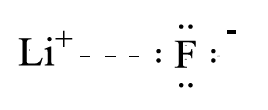
- An ionic bond is expected if the difference in electronegativity is greater than
Lattice Energy
- The energy required to separate one mole of an ionic substance into its constituent ions measured in kJ/mol.
- more lattice energy=stronger(stronger/weaker) ionic compound
- For a metal salt Mn+Xm- with interatomic distance M-X
Note that:
- As the magnitude of the charge increases the lattice energy increases.
LiF < MgF2 < MgO
- As the elements increase in size the lattice energy decreases.
LiF > NaF > KF > KCl > KBr
More Lattice Energy of Ionic Bonds Questions:
Intermolecular bonds: Highest Lattice Energy
Choose the option below with the highest lattice energy.