Wize University Chemistry Textbook > Chemical Bonding
Lattice Energy of Ionic Bonds
Popular Courses
MCAT
General Course
CHEM 1301A/B
Western University
General Chemistry
University Study Guides
AP Chemistry Exam Prep Course
AP Exam Prep
CHEM 101
University of Alberta
CHEM 121
University of British Columbia
DAT
General Course
Chemistry
General Course
CHEM 103
University of Alberta
General Chemistry
University Study Guides
CHEM 110
McGill University
CHEM 1E03
McMaster University
CHM135H1
University of Toronto
CHEM 120
University of Waterloo
CHEM*1050
University of Guelph
CHEM 205
Concordia University
CHEM 121
Simon Fraser University
SC/CHEM 1000 3.00
York University
CHEM 1100
University of Manitoba
CHEM 1481
Texas A & M University

0:00 / 0:00
Lattice Energy
Lattice energy: is the energy required to break ionic bonds into cation anion pairs, or the amount of energy released by forming the ionic compound from the constituent ions.
The lattice energy for an ionic compound depends on the strength of the electrostatic interactions between the cation and anion which can be calculated using the equation below.
Elattice is the lattice energy
k is a constant 8.99x10⁹J m/C2
Q1 is the charge of ion 1
Q2 is the charge of ion 2
d is the bond length
Wize Tip
On an exam, it is very unlikely that you would see a question that asks you to calculate the lattice energy.
A more typical exam question will ask you to compare the lattice energies between two different ionic compounds and determine which of the ionic compounds has the higher lattice energy.
If an ionic bond has a higher lattice energy, it means that ionic bond is (stronger/weaker)
stronger
According to the equation for lattice energy, answer the following questions.
- If the ions that are forming the ionic bond have greater charges, will the lattice energy be higher or lower?Higher
- If the atomic radii of the atoms forming the ionic bond is larger, the bond length will be larger and the lattice energy will be larger or smaller?Smaller
Wize Tip
Charge is more important than size when ranking compounds based on their lattice energy.

0:00 / 0:00
Example: Lattice Energy
Which of the following pairs of ionic compounds will have stronger ionic bonding (i.e. higher lattice energy)

a) LiF vs BeO
LiF is made up of Li+ and F-
BeO is made up of Be2+ and O2-.
Both ions in BeO have double the charge compared to LiF, and thus the ionic bond strength is roughly quadrupled for BeO vs LiF.
BeO has the higher lattice energy and is the stronger ionic bond!
b) LiF vs CsF
LiF is made up of Li+ and F-
CsF is made up of Cs+ and F-
Both compounds have ions with a +1 or -1 charge, so the charges are the same
However, the sizes of the ions are different.
Cs+ is much larger than Li+, and therefore, since Lattice Energy is inversely proportional to bond length, CsF will have a longer bond and smaller ionic bond energy.
Therefore, LiF has the higher lattice energy and is the stronger ionic bond!
c) LiF vs MgS
MgS is made up of Mg2+ and S2-
LiF is made up of Li+ and F-.
Since MgS is made up of ions with greater charges, it has the higher lattice energy and is the stronger bond!
Recall that ion charges are more important than bond length when it comes to lattice energy :)
0:00 / 0:00
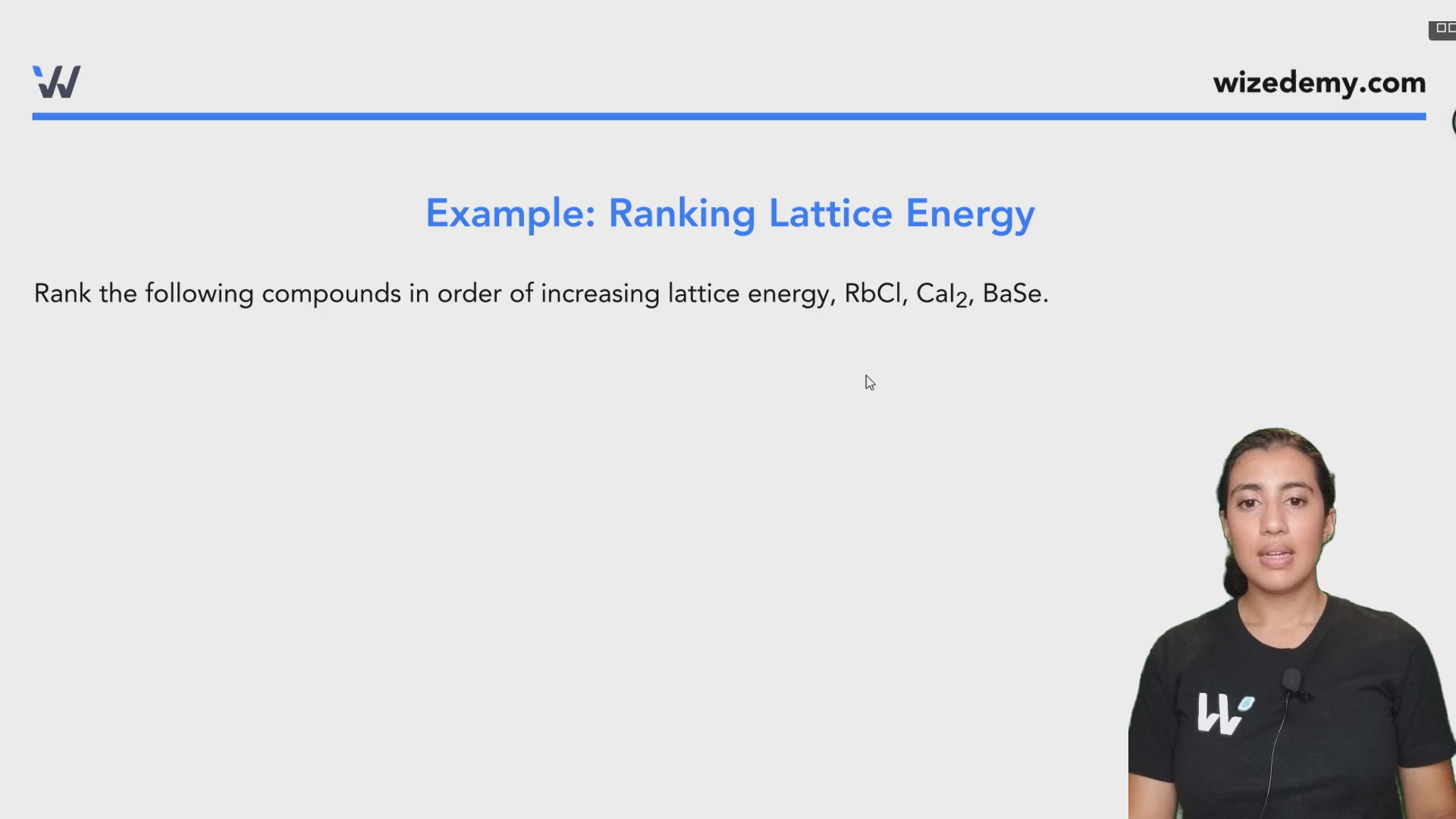
Example: Ranking Lattice Energy
Rank the following compounds in order of increasing lattice energy, RbCl, CaI2, BaSe.
RbCl → Rb+ + Cl-
(+1)(-1) = -1 smallest charges = smallest lattice energy
CaI2 → Ca2+ + 2I-
(+2)(-1) = -2
BaSe → Ba2+ + Se2-
(+2)(-2) = -4 largest charges = greatest lattice energy
RbCl < CaI2 < BaSe
Practice: Ionic Bond Strength
Consider two compounds: CaS and LiCl. Which ionic compound would have a larger Lattice Energy released upon forming their respective ionic compounds. Why?
Practice: Highest Lattice Energy
Choose the option below with the highest lattice energy.