AI Tutor
High School
SAT
SAT Elite 1500
SAT Tutoring
ACT
ACT Elite 33
ACT Tutoring
University
MCAT
MCAT Elite 515
Med-School Admissions
Med School Calculator
MCAT Score Percentiles
Pre-Med Tutoring
Pre-Med Plus
LSAT
LSAT Elite 170
LSAT Self-Paced
LSAT Tutoring
DAT
DAT Programs
DAT Elite
DAT Self-Paced
DAT Tutoring
Log in
Get Started for Free
Gases
Related Topics
Wize University Chemistry Textbook > Gases and their Properties
Gas Laws
4 Activities
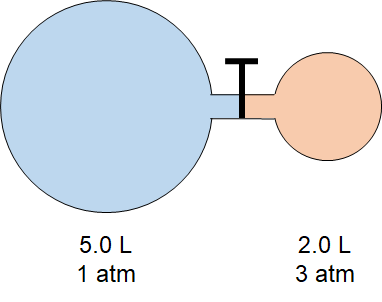
In the gas apparatus below, the pressure of the gas in the 5.0 L bulb is 1 atm and the pressure of the gas in the 2.0 L bulb is 3.0 atm. What is the pressure in the bulbs once the valve is opened, assuming the temperature is held constant.
1.65 atm
1.57 atm
2.23 atm
3.17 atm
5.00 atm
I don't know
Check Submission
More Gas Laws Questions:
Gases
In the gas apparatus below, the pressure of the gas in the 5.0 L bulb is 1 atm and the pressure of the gas in the 2.0 L bulb is 3.0 atm. What is the pressure in the bulbs once the valve is opened, assuming the temperature is held constant.
Gases
In the gas apparatus below, the pressure of the gas in the 5.0 L bulb is 1 atm and the pressure of the gas in the 2.0 L bulb is 3.0 atm. What is the pressure in the bulbs once the valve is opened, assuming the temperature is held constant.
Gas Laws: Kinetic energy
Which of the following relationships is/are CORRECT for gases?
Ideal Gas Laws: Molar volume
Answer the following two questions based on the Ideal Gas Law:
Ideal Gas Law
Which of the following changes will NOT affect the total pressure of gas in a container, assuming all other factors remain constant?
Gas Mixtures: Partial pressures
Consider the gas-phase reaction shown in this balanced chemical equation:
2
A
(
g
)
+
B
2
(
g
)
→
2
A
B
(
g
)
2A(g)+B_2(g)→2AB (g)
2
A
(
g
)
+
B
2
(
g
)
→
2
A
B
(
g
)
A rigid flask is filled with gases so that the initial partial pressure of A is 1.0 atm and the intial partial pressure of B is 0.50 atm. If the reaction goes to completion and the temperature stays constant, what is the final pressure in the flask?
Ideal Gas Laws
At very high pressures, gas properties deviate from those predicted by the ideal gas law. The actual volume of the gas will be…
Gas Laws
Suppose you have a sample of gas at a fixed temperature, and you increase the volume of the container. The pressure changes, since there are...
Gas Laws
Which of the following relationships is/are CORRECT for gases?
The amount of a gas (in moles) is inversely proportional to its volume (at constant temperature and pressure).
The volume of a gas is directly proportional to its temperature in kelvin (at constant pressure and moles).
2 moles of hydrogen gas are held in a sealed steel vessel so that the Volume is held constant. The temperature is doubled, what is the effect on the pressure?
What is the volume of 2.5 mols of Ne at 298 K and 1.0 atm? What is the new volume after 4.5 mols of Ne are added?
A sample of a gaseous compound is distributed into two vessels, A and B, of equal volume held at the same temperature and pressure. Vessel A is heated to twice its initial temperature in Kelvin, followed by compression to one quarter of its initial volume. Vessel B is cooled to half of its initial temperature in K, followed by expansion to twice it’s original volume. What is the ratio of the pressure in vessel A to the pressure in vessel B after these transformations?
A 15 L sample of N
2
gas held at 328 K is compressed such that the pressure rises from 1.0 atm to 7.8 atm. What is the final volume of the gas?
Whose law states that at constant temperature for a fixed amount of gas, the volume is inversely proportional to the pressure?
Who is the scientist who related the volume of gas to the number of particles contained in the gas, regardless of which gas it is?
Gas Law: Volume
If the pressure inside a container is kept constant and the container is heated, what would happen to the volume of the gas?
Gases (Ideal)
A tank of gas has a pressure of 10 atm at 25
o
C. At what temperature (in degrees Celcius) will it reach a pressure of 20 atm?
Gas Laws: Pressure as a function of temperature
An ideal gas is heated in a sealed container from 45 °C to 100 °C. If the original pressure in the vessel was 0.50 atm, what is the pressure after heating in kPa?
Gas Laws
A 15 L sample of N
2
gas held at 328 K is compressed such that the pressure rises from 1.0 atm to 7.8 atm. What is the final volume of the gas?
If there are 0.33 moles each of hydrogen (H
2
), argon (Ar), and methane (CH
4
) at the same temperature and pressure then which statement is CORRECT?
To increase the volume of a fixed amount of gas from 100 mL to 200 mL
A 15 L sample of N
2
gas held at 328 K is compressed such that the pressure rises from 1.0 atm to 7.8 atm. What is the final volume of the gas?
For an ideal gas which variables in the following pairs are not directly proportional to each other (if all other factors remain constant)?
Which of the following graphs is
NOT
consistent with the ideal gas law assuming that the other parameters are kept constant?
Ideal Gas Law: Practice
A small tank of compressed oxygen gas is left outside in the sun and its temperature increases.
Assume that the amount of gas and the volume of the tank do not change
.
Identify which of the four graphs below show how…
A. …the pressure (P) of the gas inside the tank changes as T increases.
Ideal Gas Law: Mixtures of Gases
You have a rigid container filled with a mixture of three gases: nitrogen, oxygen, and carbon dioxide. Your task is to compare two different methods to remove all of the carbon dioxide from the container.
Method
A:
Adding a solid material which
adsorbs
CO
2
gas – this means that CO
2
molecules stick to this material so that all of the CO
2
will be removed when the solid is removed.
Method
B:
Adding an excess of solid sodium peroxide (Na
2
O
2
) to convert all of the CO
2
gas to oxygen gas.
Gas laws
A 15 L sample of N
2
gas held at 328 K is compressed such that the pressure rises from 1.0 atm to 7.8 atm. What is the final volume of the gas?
Gas Laws: Pressure
4. A sample of a gaseous compound is distributed into two vessels, A and B, of equal volume held at the same temperature and pressure. Vessel A is heated to twice its initial temperature in Kelvin, followed by compression to one quarter of its initial volume. Vessel B is cooled to half of its initial temperature in K, followed by expansion to twice it’s original volume. What is the ratio of the pressure in vessel A to the pressure in vessel B after these transformations?
Ideal Gas Laws: Volume
6. What is the volume of 2.5 mols of Ne at 298 K and 1.0 atm? What is the new volume after 4.5 mols of Ne are added?
Gas Stoichiometry
A tank of gas has a pressure of 5 atm at 25
o
C. At what temperature (in degrees Celsius) will it reach a pressure of 8 atm?
Ideal Gas Law
12 moles of Xenon are held inside a 15L flask at room temperature.
The flask is then cooled to – 100
o
C.The flask is then allowed to expand into a 23L but we need to keep the pressure constant. What temperature is required to keep the pressure constant as the gas expands into the new volume.
Ideal Gas Law
12 moles of Xenon are held inside a 15L flask at room temperature.
The flask is then cooled to – 100
o
C what is the pressure inside the flask at -100
o
C?