Popular Courses
MCAT
General Course
CHEM 1302A/B
Western University
General Chemistry
University Study Guides
AP Chemistry Exam Prep Course
AP Exam Prep
CHEM 101
University of Alberta
CHEM 112
Queen's University
DAT
General Course
CHM 1311
University of Ottawa
Chemistry
General Course
CHEM 103
University of Alberta
General Chemistry
University Study Guides
CHM135H1
University of Toronto
CHEM 154
University of British Columbia
CHEM 120
University of Waterloo
CHEM 123
University of British Columbia
CHY 102
Toronto Metropolitan University
CHEM 205
Concordia University
CHEM 121
Simon Fraser University
CHEM 120
McGill University
SC/CHEM 1000 3.00
York University

0:00 / 0:00
Gas Laws
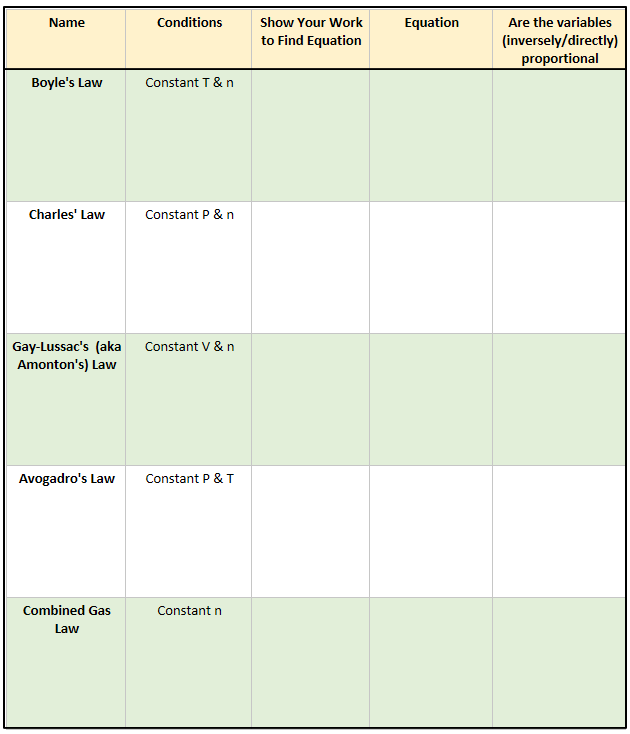
Contained within the ideal gas law are a series of simpler relationships describing how pairs of gas properties change when others are held constant. We will go through each equation and understand how to get each equation without having to memorize them! 🙌

Watch Out!
Remember that we must plug in a temperature value in K not °C!
T(K)=°C + 273
Wize Tip
You could see two types of gas law questions:
1) You're given 4/5 variables for the ideal gas law and asked to solve for the 5th (PV=nRT)
2) You're told about an initial scenario and a final scenario and asked to solve for a missing variable. For these types of problems you'll need to use one of the above gas laws depending on what is being kept constant.
Note: You do not have to memorize the names of the equations (ex. Charles' Law) but you should be able to know which equation to use when told certain variables are constant!
0:00 / 0:00
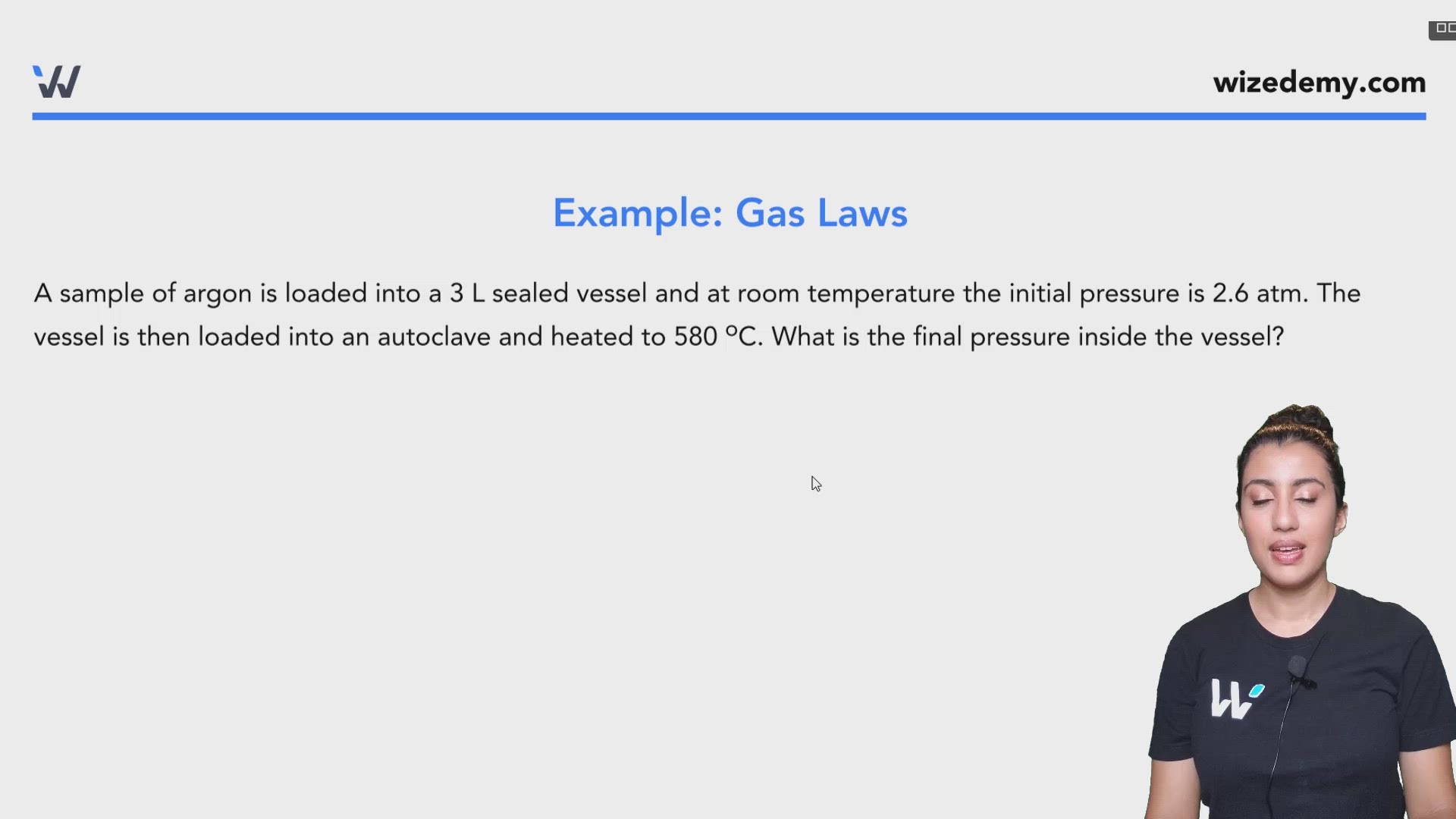
Example: Gas Laws
A sample of argon is loaded into a 3 L sealed vessel and at room temperature the initial pressure is 2.6 atm. The vessel is then loaded into an autoclave and heated to 580°C. What is the final pressure inside the vessel?
Extracting the information from the question yields:
ni = nf =
Ti = 298 K Tf = 853 K (used °C + 273 to solve for K)
Vi = 3 L Vf = 3 L
Pi =2.6 atm Pf = ?
V and n are constant here.
PV = nRT
P/T = constant
Practice: Gas Laws
If the pressure inside a container is kept constant and the container is heated, what would happen to the volume of the gas?
Practice: Gas Laws
A 15 L sample of N2 gas held at 328 K is compressed such that the pressure rises from 1.0 atm to 7.8 atm. What is the final volume of the gas?